
FLUX 3 Image Klein's 5.6B count leaves out its encoder
Testing Catalog relayed the FLUX 3 Image Klein launch line on Threads, and it says the model "runs on a single consumer GPU". Black Forest Labs' own lowest peak-memory figure for the model was measured on a B200, a datacenter card.
That figure comes from Black Forest Labs' model card on Hugging Face, which describes a 5.6B open-weight model that both generates and edits images. You give it a prompt and up to 10 reference images and get back one image. Text-to-image, single-reference edits and multi-reference compositions all go through the same checkpoint.
At a glance
- The 5.6B label covers only the image transformer. The Qwen3-VL-4B-Instruct text encoder is separate, and the optional prompt upsampler is an 18.8 GB download.
- There are two checkpoints: a distilled one that runs 16 steps with no guidance, and an undistilled Klein Base that runs 50 steps at guidance 3.5 and is meant for fine-tuning.
- The license allows non-commercial use, plus commercial output for Qualifying Users with less than US$5M in gross annualized revenue.
The 5.6B figure counts only the image transformer
According to the model card, the parameter count refers to the image transformer alone. Text goes through Qwen3-VL-4B-Instruct, which is released under Apache-2.0, and there is also an image autoencoder. All of these ship in the repository, but the headline number covers only one of them.
The reference CLI runs a prompt upsampler before every generation. It turns a short request into the full scene caption the model expects. The upsampler is an 18.8 GB download and adds about 28 GB of GPU memory on an 80 GB card. You can skip it with the --no-pup flag, but the card warns that short prompts give generic output, and that a one-line edit such as "make it blue" can reframe the whole shot.
The encoder comes from a different family than before. FLUX.2 paired a Mistral vision-language model with a rectified-flow transformer, and its 32B generation used a Mistral-3 24B VLM. According to ScriptByAI, the previous small line, FLUX.2 [klein], launched on January 15, 2026 in 4B and 9B sizes.
Quantization saves 6 GB at 1024x1024
All three memory figures on the card were measured under the same conditions: a B200, the reference code, 1024x1024 output and the upsampler off. Under those conditions, BF16 peaks at 31 GB, FP8 at 26 GB and NVFP4 at 25 GB. The most aggressive variant therefore uses 6 GB less than full precision. The card also notes that the file size of a quantized package is not a measure of total GPU memory use.
The two sources disagree on which variants exist. Testing Catalog's post lists FP8, NVFP4 and INT8. The repository describes FP8 and NVFP4 alongside the BF16 transformer, and its download instructions name only the variants/fp8r and variants/nvfp4 folders.
Two checkpoints: 50 steps with guidance, 16 without
This repository holds the distilled checkpoint. It runs in 16 sampling steps with no guidance and is built for generation, editing and self-hosting. BFL also serves it on its API as FLUX 3 Image Klein. The separate undistilled Klein Base runs 50 steps at guidance 3.5 and is the one for fine-tuning, LoRA training and research. That fits the Threads post's claims that developers can post-train the model and that there is a low-latency version for faster generation.
For layout, you write bounding boxes into the prompt as [top, left, bottom, right] on a 0 to 1000 grid. Each box is tagged to an element in the caption. In edits, an element can be moved or replaced, or removed by giving it a null target.
Boxes control placement and scale, but they don't act as a hard mask. An element can extend past its box, and small requested elements may not appear at all. ScriptByAI reports that FLUX 3 Image launched on October 1, 2026 through the BFL API with bounding-box control. On October 15 we also covered Krea 3, which edits images through drawn boxes too.
What the numbers do not show
The Threads post promises native 4K and says the distilled model with native 4K will come to BFL's APIs. Every memory figure on the card is for 1024x1024, and the card gives no 4K measurement. It also gives no latency figure and no benchmark scores. The launch quote's "pixel-perfect editing" sits awkwardly next to the card's own warning that edits can change content outside the requested region.
No measurement BFL has published supports the "single consumer GPU" claim either. The card's figures come from a B200, and it documents no run on a consumer card.
In our view, the license is a bigger change than the parameter count. ScriptByAI reports that the 4B FLUX.2 [klein] models shipped under Apache 2.0. Klein now uses the FLUX Kommunity License. It caps commercial output at US$5M in revenue, bars using outputs to improve competing image models, and says its commercial exception is not blanket permission for commercial fine-tuning or distribution. For a model sold as customizable, that looks like the tighter limit.
The figure to watch is peak memory at native 4K, or any measurement on a consumer card, whether BFL publishes it or someone running the weights does.
Up next
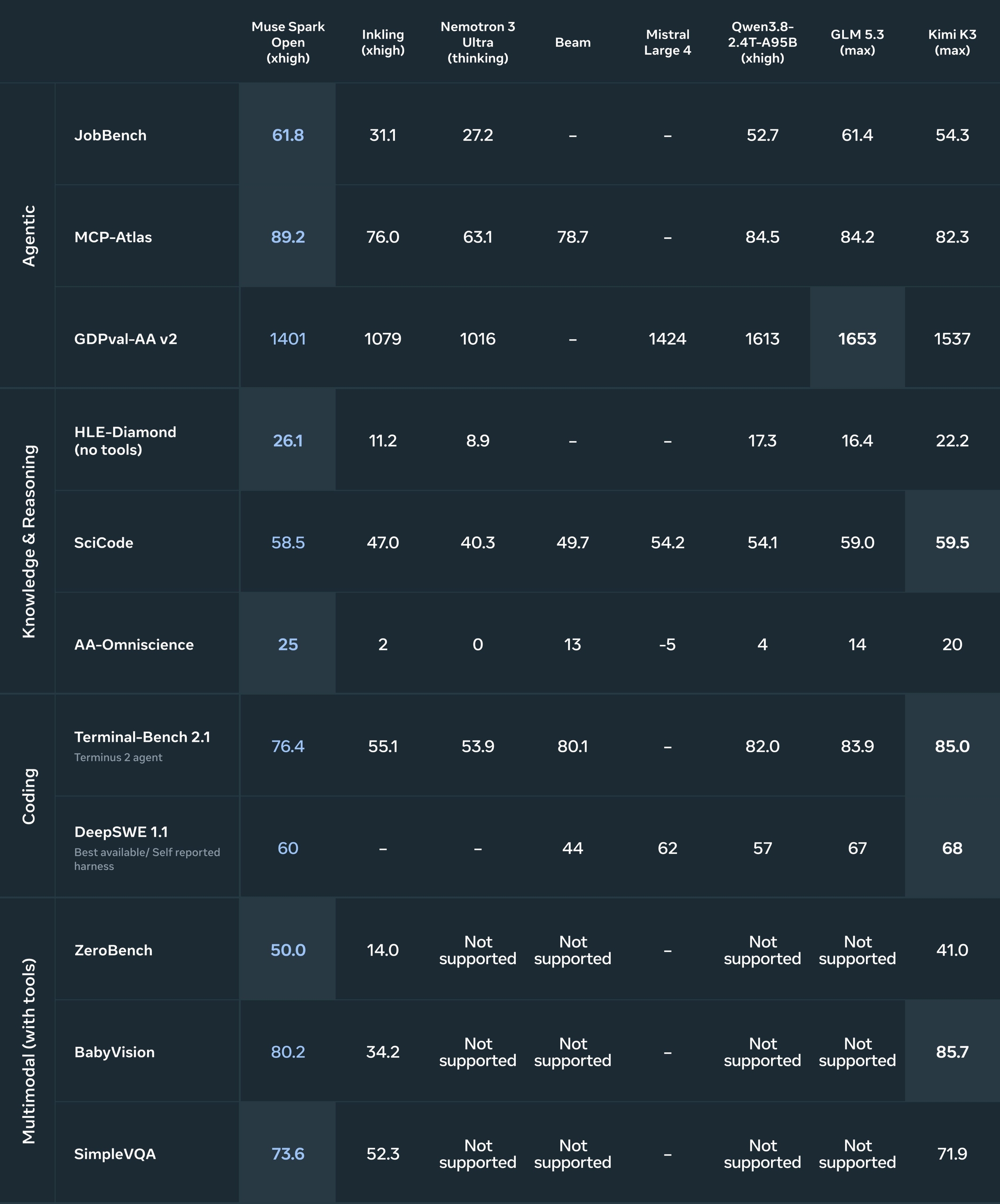
Meta's open-weight Muse Spark Open lags Kimi K3 at coding
Two linked M5 Ultra Mac Studios with 512 GB can run Meta's 816B Muse Spark Open locally, Meta says, but Apple doesn't sell that 512 GB Mac Studio to regular buyers yet. Would you run an 816B model on your own desk, or keep it in the cloud?
Related stories
- Ideogram 4.5 prices images from 0.8 to 22 cents at 2K
- Krea 3 edits a 2K image in under 8 seconds
- Nemotron 3.5 Super VL gives NVIDIA's 120B agent model eyes
- 552B MoE opens DeepSeek's new architecture family
- Stealth OpenRouter model Ox Alpha linked to GLM-5.3
- Vision-Exp brings image input to DeepSeek's API
Comments
No comments yet. Be the first.
Join the conversation
Sign in to leave a comment. It appears after moderation.