
Meta's open-weight Muse Spark Open lags Kimi K3 at coding
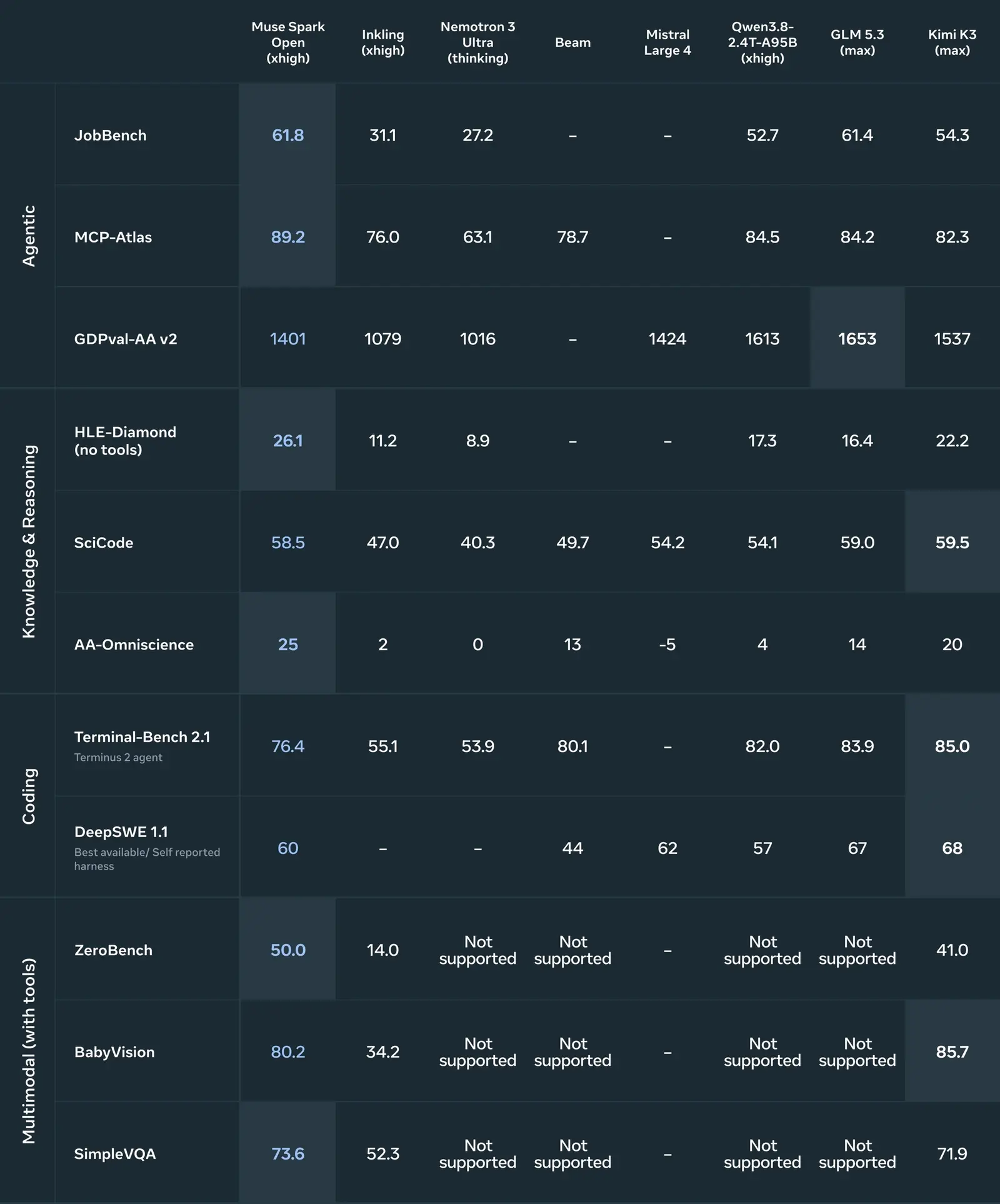
The weights for Muse Spark Open went up today in Meta's Hugging Face collection. The catch is in Meta's own benchmark chart: the model it pitches for coding loses the coding rows to Kimi K3 and GLM 5.3.
All the sources agree on what Muse Spark Open is, but Meta's claim that it is the "most capable US open-weight model to date" only holds up on the agentic benchmarks. On coding it falls short.
The sources agree on the specs: 816B parameters, 42B active, 1M tokens
Meta describes the model on Hugging Face in two sentences:
"Muse Spark Open is a mixture-of-experts model with 42B active parameters, 816B total parameters, and a 1M-token context window."
"It's built for agentic and coding workflows, from understanding large repositories to completing multi-step engineering tasks with tools."
In a mixture-of-experts model, a router sends each token to a small group of specialist sub-networks, so about 42B parameters do the work on any given token. All 816B still have to be held in memory, though, and that matters for the hardware section below.
Testing Catalog describes the release as an open-weight version of Muse Spark 1.2. According to Wikipedia, Muse Spark 1.2 launched on August 5, 2026, together with Muse Code, a terminal-based coding agent that can run several sub-agents at once. Until now 1.2 was only available through the Meta Model API and OpenRouter.
The News Stack lists where the open version is available. You can call it through the APIs of Baseten, Fireworks AI, Groq, Modal, Nebius, OpenRouter and Together AI. You can download the weights from Amazon SageMaker AI, Google Cloud Model Garden, Hugging Face and Microsoft's Foundry Model Catalog.
Meta's charts show a lead on agent tasks and a deficit on coding
Meta's pitch, as quoted by The News Stack, is a model for "coding and agentic work" that "excels at long-horizon tasks, complex software engineering, and multi-step reasoning." Testing Catalog says Meta is teasing it as the best open model from the US.
Against the other US open models, Thinking Machines' Inkling and Nvidia's Nemotron 3 Ultra, Meta's own benchmarks show Spark Open winning every comparison, often by 20 points or more, The News Stack reports. Against the Chinese models many developers already run, it leads Kimi K3, GLM 5.3 and Qwen3.8 on the agentic and tool-use benchmarks, including JobBench and MCP-Atlas. On SciCode it roughly ties them.
Coding is a different story. On Terminal-Bench 2.1, Kimi K3 scores 85.0 and GLM 5.3 scores 83.9, against 76.4 for Spark Open. On DeepSWE 1.1, The News Stack puts the spread at 68 to 60, with Spark Open on the low side.
This gap isn't new. The News Stack notes that Meta acknowledged the same gap when it launched the closed Muse Spark in April, and says there has been little visible progress since. That launch post on Meta's AI blog listed "current performance gaps" in "long-horizon agentic systems and coding workflows." According to the Meta AI Research blog, Muse Spark 1.1 had already been trained to work with different coding harnesses, with planning mode, sub-agent delegation and context compaction, which is exactly the kind of work Terminal-Bench measures.
Meta also isn't the only lab using this kind of superlative. On October 6 we reported that Mistral called Mistral Large 4 the best open-weights model from the US or Europe on aggregated benchmarks, with weights planned for the end of October.
The weights are free to download, but the license draws a line at $20 million in revenue
The model ships under the Muse Model License, which Meta describes as having "limited commercial terms, which allow many developers to use the model for free." According to The News Stack, a company with more than $20 million in gross revenue in any consecutive twelve-month period must "notify Meta and enter into a separate written agreement with Meta" before offering the model or a derivative as a model-as-a-service business.
Any product built on it, or on a derivative trained, fine-tuned or distilled from it, must "prominently display 'Built with Muse Spark Open'" in its interface. Internal use and building the model into your own product are free. The usage policy bars military and critical-infrastructure deployments. The News Stack links that clause to a carve-out Meta added for the US government with Llama in 2024. The outlet also notes that the policy is looser than Anthropic's new usage policy for Claude, and compares the license as a whole to the one Moonshot uses for Kimi K3.
Meta's earlier releases make a useful comparison. On August 10 we covered Muse Glimmer, a 30-billion-parameter Meta model released under Apache 2.0, which has no revenue threshold and no branding requirement. The original Muse Spark went the other way: AI Learning Guides describes it as API-only and closed-weight, the first Meta frontier model shipped that way after Llama 1 through Llama 4 all came with downloadable weights.
Running it locally takes two 512 GB Mac Studios that Apple doesn't sell yet
Testing Catalog wrote that users would be able to run the model locally on new Mac Studio devices. Mark Zuckerberg posted that it "runs great on new Mac Studios thanks to work with @johnternus and Apple."
The News Stack spells out what that means. You need two Mac Studios with M5 Ultra chips and 512 GB each, linked together and running the model through MLX. Meta says it used that setup to run Muse Code on Muse Spark and ship updates to the Ice Cubes Mastodon client. Apple doesn't currently sell the 512 GB configuration to the general public. The News Stack expects that to change in a few weeks, at which point a pair will cost about as much as a compact car.
Glimmer is the option that fits on a desk. According to Wikipedia, it runs offline on a 24 GB consumer GPU.
What we don't know
- How the model performs under independent testing. Every benchmark figure above comes from Meta.
- Which model scores 68 on DeepSWE 1.1. The News Stack gives the spread but not the name.
- Memory footprint, quantized builds and decode speed on the dual-Mac setup. The sources give the hardware but no throughput figures.
- What the separate agreement for companies above $20 million actually costs or requires.
- How it compares with Mistral Large 4 once those weights are out.
The parts that are well documented are the specs, the list of distribution partners and the license terms. "Most capable" is the weak claim. It rests on Meta's own chart, and even that chart supports it only for agent and tool-use work. Muse Spark Open is a coding model whose model card leads with repositories and engineering tasks, and it sits 8.6 points behind Kimi K3 on Terminal-Bench 2.1. We think that gap stops the superlative from covering the very job Meta built the model for.
Up next
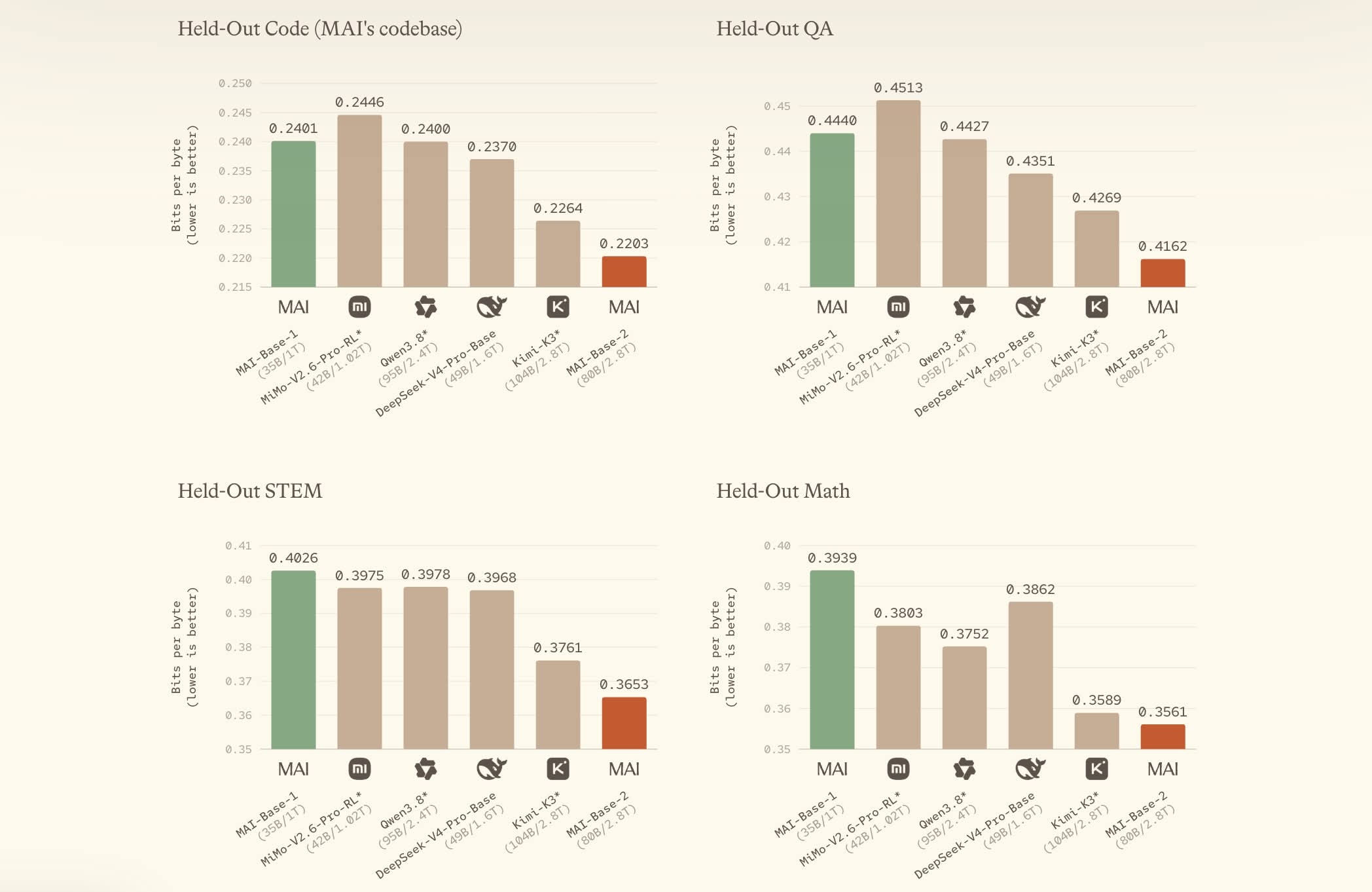
Microsoft AI's MAI-Base-2 trained on 16K GPUs with Muon
4–12x: that's how much more pre-training FLOPs-efficient Microsoft AI says MAI-Base-2 is than DeepSeek-V4-Pro-Base, and the saving went into a larger model. Do you trust a lab's self-reported wins over rivals, or wait for outside tests?
Related stories
- Meta's Muse Wonder Full reportedly stays off the API
- Muse logs point to an OpenAI model behind one session
- Meta releases Muse Glimmer weights for local agents
- Nemotron 3.5 Super VL gives NVIDIA's 120B agent model eyes
- Liquid AI's 2B-active model beats Qwen on LiveClaw
- Mistral's 1T-parameter Le Chonk keeps only 49B active
Comments
No comments yet. Be the first.
Join the conversation
Sign in to leave a comment. It appears after moderation.