
Nemotron 3.5 Super VL gives NVIDIA's 120B agent model eyes
"Comparable with NVIDIA's largest reasoning model at roughly one-fifth the parameter count." That is how Kari Briski, NVIDIA's VP for open models and software, describes Nemotron 3.5 Super VL, according to The News Stack. She says the claim covers multimodal agentic work: instruction following, tool use, multistep business workflows and visual understanding.
The biggest change is in what the model accepts as input. Super VL keeps the main specs of Nemotron 3 Super: 120B total parameters, 12B active and up to 1M tokens of context. It adds image and video input to a model that previously read only text. Output is still text only. The base checkpoint is on Hugging Face with NVIDIA's model card, alongside a post-trained BF16 release for customization and an NVFP4 release for optimized deployment.
Before → after
- Input: text only in Nemotron 3 Super, released March 11, 2026 at GTC → text, RGB images (jpeg, png), document pages and mp4 video up to two minutes long. Visual input passes through a C-RADIO vision encoder and a vision-language connector.
- Licence: NVIDIA Nemotron Open Model License → OpenMDW License Agreement 1.1, which The News Stack says permits commercial use and modification.
- Data window: a June 2025 pre-training cutoff for the earlier model, per its Hugging Face card → foundation data collected from 2013 to December 2025.
- Backbone: Nemotron 3 Super Base as shipped → the same base after 1T tokens of distillation from Nemotron 3 Ultra Base. That comes after a 100B-token stage in which a shared MTP head is trained while the backbone stays frozen.
After distillation, the card lists four more training stages: 100B tokens of continued pre-training on Indic languages, a 35B-token extension to 1M context, 67B tokens of software-engineering mid-training at 256K context, and a 9B-token long-context recovery stage. The software data includes repositories, issue and pull-request pairs, commit diffs, build and CI logs, and agent trajectories.
According to The News Stack, NVIDIA kept the hybrid architecture and added a vision encoder. The model still interleaves Mamba-2, mixture-of-experts and attention layers, with 512 routed experts per MoE layer. The prompt, images, conversation history, tool results and the response all share the 1M-token window. NVIDIA notes that individual deployment recipes may use a smaller window to fit GPU memory and concurrency.
LLM Stats explains how the design worked in Nemotron 3 Super. LatentMoE compresses each token from 4096 to 1024 dimensions before routing, and 22 experts are active per token. Mamba-2 layers process sequences in linear time, which is what makes 1M tokens of context practical.
The two sources describe the decoding speed-up differently. The card says a shared Multi-Token Prediction head predicts future tokens recursively, which gives native speculative decoding. The News Stack names the technique LiLiCorr and describes a smaller helper model that drafts several tokens for Super VL to check in one pass. NVIDIA says this speeds up generation on DGX Spark by up to 2.3 times compared with decoding without speculation. For the earlier model, LLM Stats reported an average of 3.45 accepted tokens per verification step on SPEED-Bench, against 2.70 for DeepSeek-R1.
Super VL beats Qwen3.5-122B-A10B on Terminal-Bench 2.1 and trails it on SWE-bench Verified
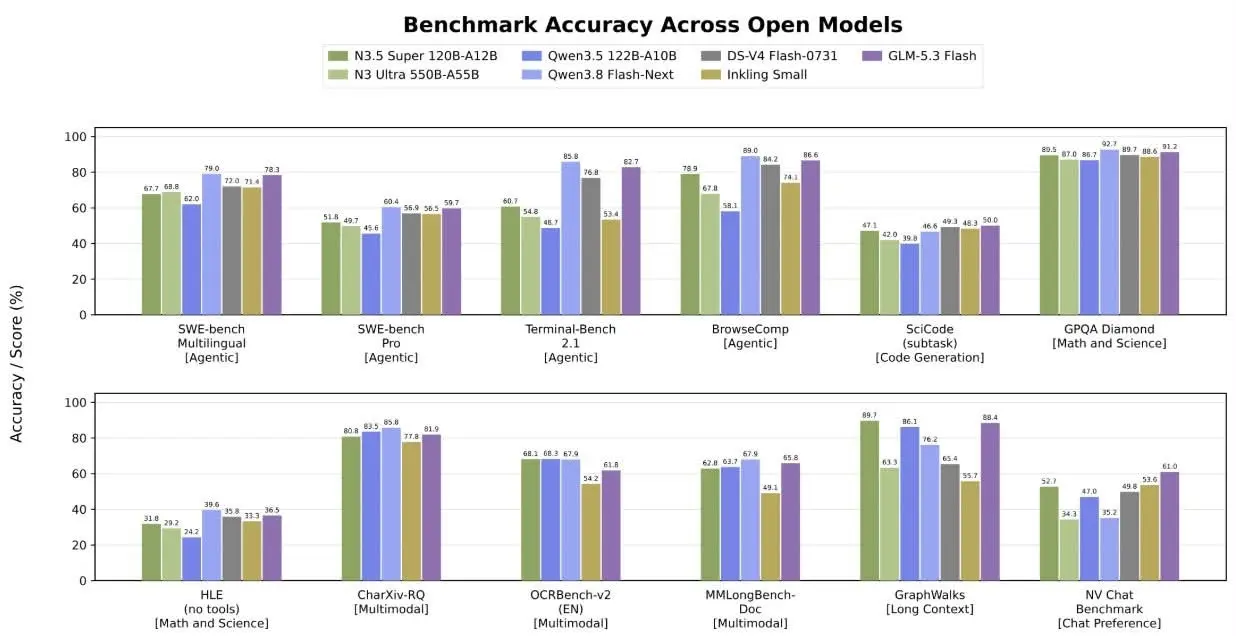
According to The News Stack, NVIDIA compared Super VL with Alibaba's Qwen3.5-122B-A10B on five tests: GPQA-Diamond, Terminal-Bench 2.1, SWE-bench Verified, IFBench and MMLongBench-Doc. Super VL scores 66.7 on Terminal-Bench 2.1 to Qwen's 48.7 and also leads on scientific reasoning. It trails on SWE-bench Verified, 71.1 to 71.9, and on document understanding. Qwen3.8-Flash-Next scores higher on all five tests, though its embedding and prediction components bring it to about 180B total parameters. Thinking Machines' Inkling-Small, with 276B total and 12B active, scores below Super VL on terminal tasks and above it on instruction following.
Against NVIDIA's own Ultra, Super VL leads on Hermes Bench, 63.44% to 56.33%, and on LangChain behavioral evaluations, 87.05% to 84.3%. For documents, NVIDIA highlights OCR, tables, charts and structured information. On the CharXiv chart-reasoning benchmark it reports 80.8% for Super VL against 63% for Nano Omni, and 84% when Super VL can interpret Python code.
The speed claim rests on 10,000 SWE-bench Pro tasks on four B200 GPUs, which Super VL completed four times faster. NVIDIA's own chart places its accuracy on that run below Qwen3.8-Flash-Next and DeepSeek V4 Flash.
The Hugging Face card publishes only text scores for the base backbone, measured before vision-language training. They include MMLU at 84.14, MMLU-Pro at 76.25, 5-shot CoT GPQA Diamond at 66.16 and LiveCodeBench CodeGen pass@1 at 47.61. Multilingual scores are 86.56 on Global MMLU across 8 languages and 87.53 on MGSM across 6.
Bolt fits a 74B model into 24GB
NVIDIA released two smaller Bolt models with Super VL. Nemotron 3.5 Bolt 74B-A9B 24GB is derived from Super VL and activates 9B of its 74B parameters. It gets down to 24GB with mixed precision that includes two-bit experts. In NVIDIA's tests it scores 51.0 on Terminal-Bench 2.1, against 44.4 for Qwen3.6-35B-A3B and 37.2 for Gemma4 26B-A4B, both run in BF16. NVIDIA is optimizing it for RTX Spark and DGX Spark, with support for llama.cpp, Ollama, LM Studio and vLLM.
Super VL and Bolt 74B are available now. Bolt E4B 4GB is scheduled for later this month. It targets conversational and physical agents on GeForce RTX, Jetson and Spark hardware, such as device assistants and interactive characters.
What we don't know
The comparisons with Qwen, Inkling-Small, Ultra and Nano Omni come from NVIDIA's own evaluations, as reported by The News Stack, and the only scores on the card are text-only base results. The earlier model's card reported 25.78 on the hard subset of Terminal Bench. That is a different benchmark from Terminal-Bench 2.1, so the gap to 66.7 is not a measure of the improvement. The Nemotron 3 Super card set a minimum of two H100-80GB GPUs. The new card lists Blackwell and Hopper on Linux, with PyTorch, Megatron-LM and NeMo, but gives no minimum configuration.
Our view: for teams doing their own training, the base checkpoint is the most useful part of this release. The card gives the token budget for each language-backbone stage, from the 100B-token MTP stage to the 9B-token recovery run.
If you run Nemotron 3 Super in production, check two things before switching: what OpenMDW 1.1 permits for your use, and how much of the 1M context your deployment recipe actually allocates.
Up next
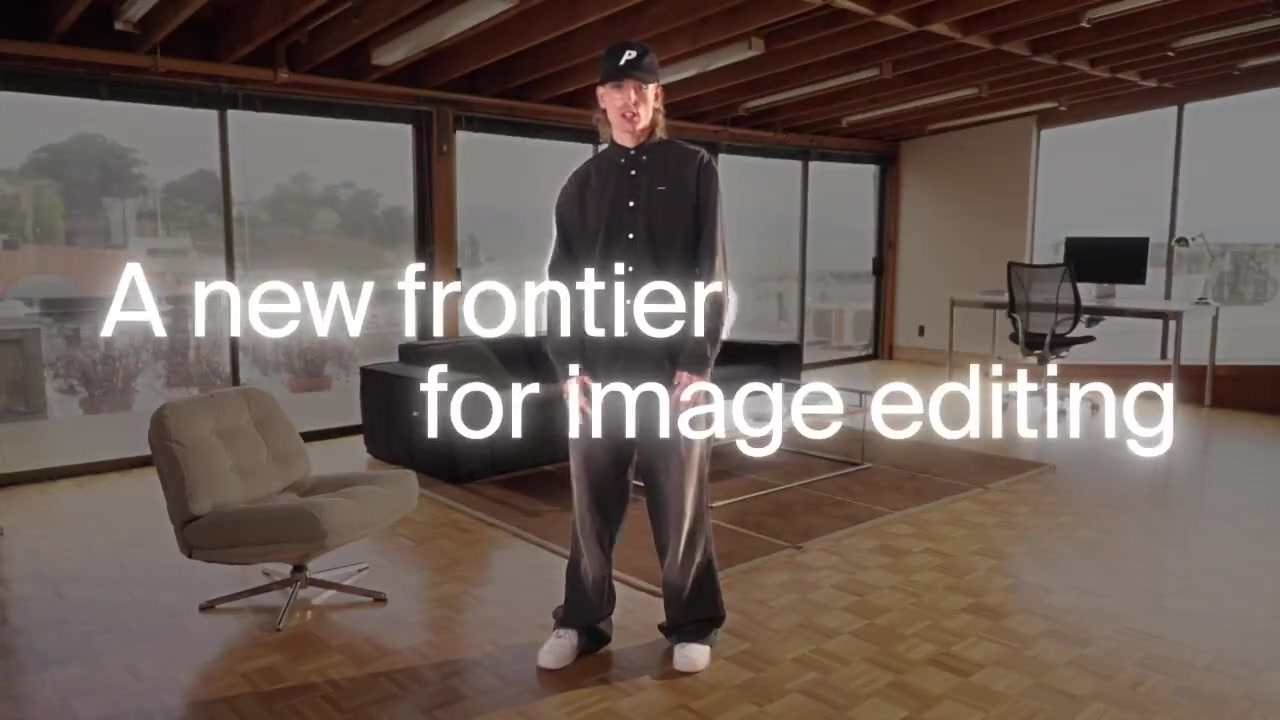
Krea 3 edits a 2K image in under 8 seconds, Video
Krea 3 finishes a 2K image edit in under 8 seconds for about $0.06, while Nano Banana Pro took about 26.8 seconds and $0.135 in Krea's own comparison. With AI image edits, is it one careful prompt or a string of quick retries for you?
Related stories
- Liquid AI's 2B-active model beats Qwen on LiveClaw
- Aleph Alpha puts a 1M-context model on your own servers
- Ideogram 4.5 prices images from 0.8 to 22 cents at 2K
- 552B MoE opens DeepSeek's new architecture family
- Stealth OpenRouter model Ox Alpha linked to GLM-5.3
- Vision-Exp brings image input to DeepSeek's API
Comments
No comments yet. Be the first.
Join the conversation
Sign in to leave a comment. It appears after moderation.