
Gemini Decisions API scores 1,000 questions in one call
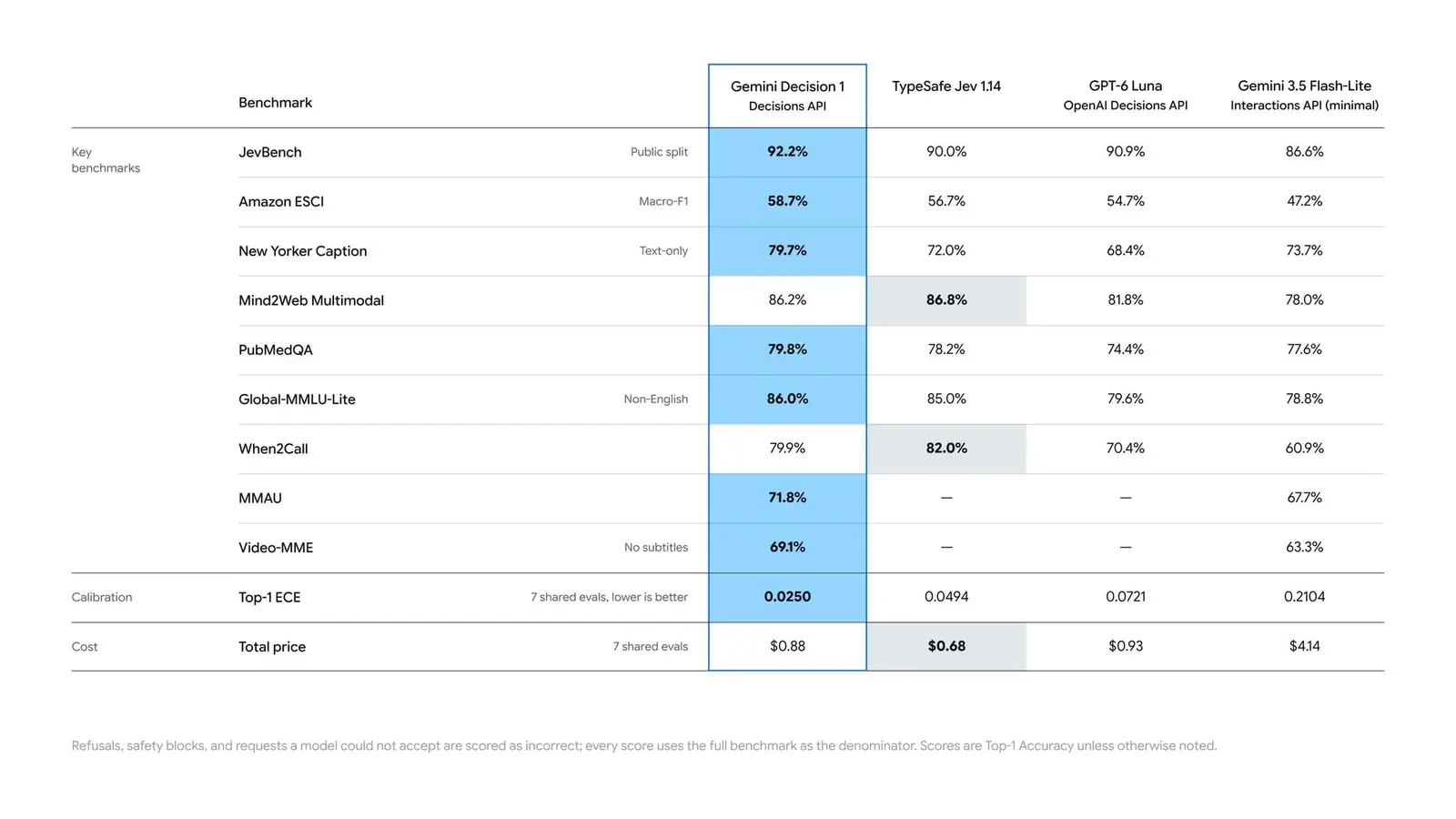
Google DeepMind on November 11 opened the Gemini Decisions API. It runs the new gemini-decision-1 model over one input of text, images, audio, video or PDFs and answers up to 1,000 yes/no, multiple-choice or rubric questions about it in a single request. If your team routes requests, picks tools or grades content with full generative calls, the case for switching is the bill: $0.10 per 1M input tokens, nothing for output, and the shared input charged once however many questions you ask. Google says that makes it nearly 5x cheaper than Gemini 3.5 Flash-Lite, a figure from Google’s own benchmark suite.
The model never writes an answer. According to Google’s announcement, it scores the candidate options in a single forward pass and returns probabilities plus a confidence score from 0 to 1 for every answer, so your code can send ambiguous cases to a fallback or a human reviewer. The target is a familiar chore in agent systems, where a yes/no decision usually costs a full generative call whose text then has to be parsed back into a structured value.
What a request costs
Each question adds only its own instruction and criteria tokens on top of the shared input. There are no output-token charges, no variable thinking-token bills and no separate fees for audio transcription or OCR. On image and video inputs you can set the resolution, trading visual detail against token cost. Google AI Studio has a no-cost tier of the API for prototyping.
The “nearly 5x” compares Gemini Decision 1 through the Decisions API with Gemini 3.5 Flash-Lite through the Interactions API, across the shared benchmark suite Google used. On the same suite, which covers agent routing, reasoning, ranking and multimodal understanding, Google says its model leads and has the lowest calibration error, meaning its stated probabilities track most closely how often the answers turn out right. Both claims are Google’s own measurements.
Three question types in one call
A request can mix three kinds of question against the same input:
noul(yes/no): the probability that a condition holds, with optional descriptions of what counts as true and false. The model docs put that probability between 0.01 and 0.99.choice: picks from 2 to 255 options and returns the winner plus normalized probabilities for every candidate.score: grades the input on an ordered rubric starting at 0, returning a continuous weighted score and the probability of each level.
The shared input can hold up to 256K tokens (262,144 in the docs) and can combine modalities, such as a call recording paired with account metadata or a scanned PDF claim with damage photos. The input field uses the same Content block format as the Interactions API, and in the Python SDK the call is client.decisions.create on the v1beta API version. On question count, Google’s 1,000 is above the limit of OpenAI’s Decisions API, which left beta in October capped at 400 questions a call.
How fast, and on what inputs?
Google puts median latency at 50-100 ms of model compute, or 150-250 ms end-to-end, for multimodal inputs and contexts up to 16K tokens, and says it stays nearly flat from 1 to 100 questions per request. Those conditions stop well short of the 256K-token input and the 1,000 questions the API accepts, so the published latency doesn’t cover a request near either limit.
Google says its own teams already run the API in production. Gemini Notebook uses it to send each incoming query to a model tier and thinking level, which Google says serves everyday queries with up to 40% lower latency. Google Search uses it as a safety layer for MCP tools, checking for adversarial behaviour and content. A rapid canvas experiment in Stitch builds playable wireframes from it. And CC from Google Labs picks an emoji reaction from a palette of more than 200, not far below the 255-option limit of a single choice question.
The API is live in the Gemini API through Google AI Studio, with Python, JavaScript and REST guides. Integrations for OpenRouter, LangChain, Vercel, LiteLLM, Pydantic AI, Pipecat, LiveKit and OpenCode are rolling out alongside the google-genai SDKs, and support in Gemini in Google Cloud is listed as coming soon.
Up next

OpenAIanalysis
Prompt injection reached the official Codex npm pipeline
A prompt injection in a GitHub issue let Depi reach the pipeline that publishes OpenAI’s official Codex npm package, the one auto-update pulls with no diff to review. For your coding tools, is auto-update on or do you pin versions and update by hand?
Related stories
- Perplexity puts its 4B decision model on the Mac
- OpenAI’s Decisions API exits beta at 400 questions a call
- Jev answers in 195 ms, OpenAI Decisions in 208 ms
- SubQ Snap reads 384K tokens before each agent decision
- OpenAI’s Decisions API beats its own engine by up to 10x
- Agent Studio on GCP lists Gemini 3.8 Flash
Comments
No comments yet. Be the first.
Join the conversation
Sign in to leave a comment. It appears after moderation.