
Gemini Notebook reports generate slides on demand
Promtime
 google
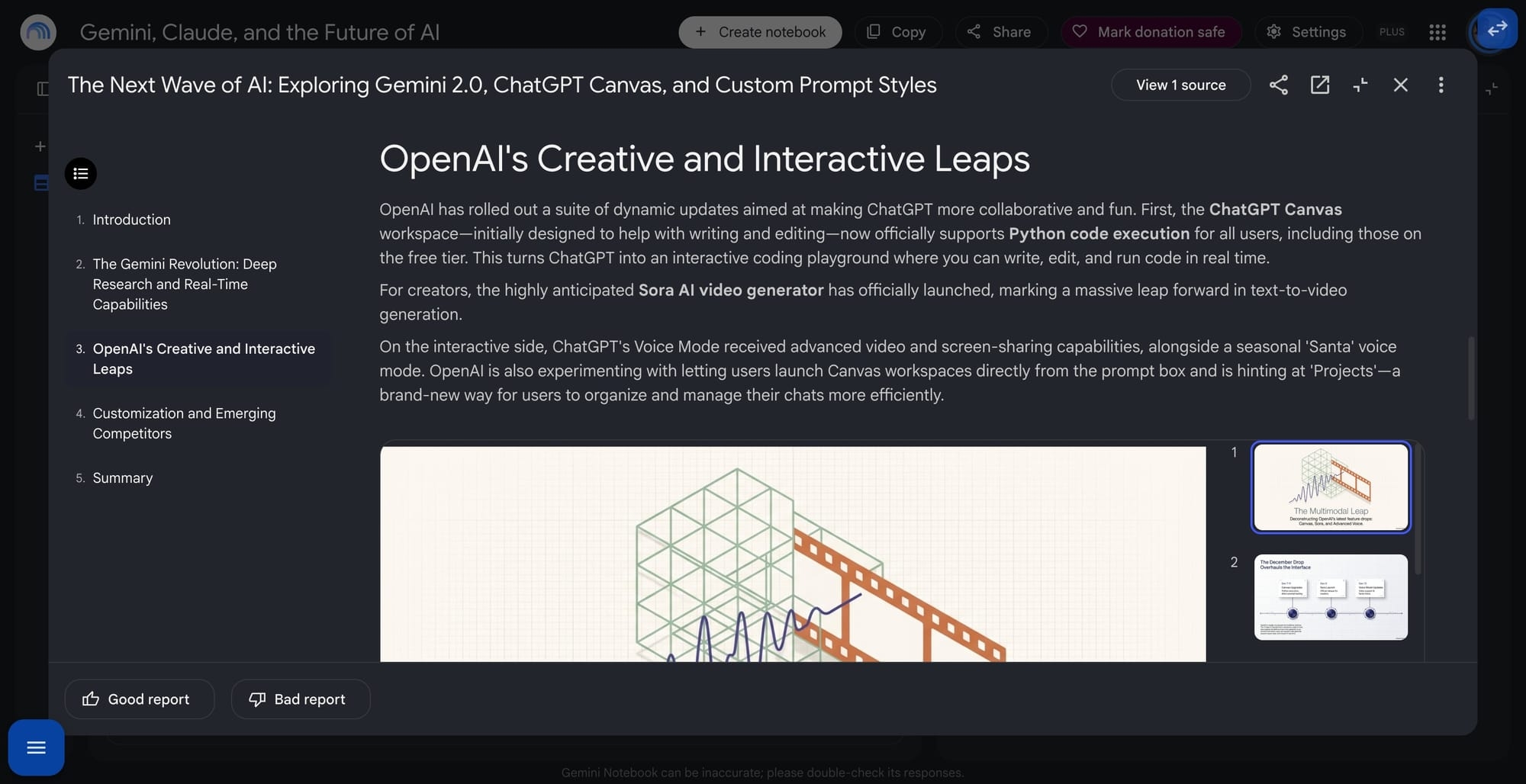
An interactive report in Gemini Notebook can open with an empty frame where a slide deck belongs, and the slides appear only after a reader presses Add. Testingcatalog, which generated and tested the format, describes it not as a new artifact type but as a longer report that carries other Gemini Notebook artifacts inside it.
At a glance
- Interactive Reports has surfaced in Gemini Notebook with new-feature labelling and now works well enough to generate content, though Google has not announced the format publicly and no rollout date is known.
- A report holds placeholders for a mind map, slide deck, quiz or flashcards, and each slot stays empty until a reader picks Add, which triggers generation of that one artifact on the spot.
- Once built, the artifact is saved into the notebook and stays embedded in the report at the same time, but whether other Studio outputs fit the same placeholders is still unclear.
If you have not been following the product: it began in May 2023 as Project Tailwind, according to Wikipedia's account, was rebranded NotebookLM in 2024 and lost its experimental status that October. Google renamed it Gemini Notebook on 16 July 2026. The pitch has stayed the same throughout: a notebook that only knows what you upload into it.
Interactive reports hold mind maps, slide decks, quizzes and flashcards
The report itself is ordinary long-form text. What is new is that placeholders can sit inside it where a mind map, slide deck, quiz or flashcards would go, and none of them is generated in advance. The reader sees an Add option, and the artifact is built when someone selects it.
Testingcatalog tested those four types in place and could not establish whether other Studio outputs fit the same slots. The same outlet flagged the feature on 30 August, when it showed up only as a new-feature notice in the Studio panel rather than something you could run. The format, Testingcatalog writes, suits students, educators, researchers and people publishing notebooks as explainers, since one document can combine written context with several source-grounded formats.
Pressing Add writes the artifact into two places at once
The order is what makes the design interesting. A report opens with empty frames, the reader presses Add on one, Gemini Notebook generates that artifact from the notebook's sources, and the finished item is filed into the notebook while also staying embedded in the report. Slides can be flipped through and a mind map navigated on the page, without leaving the report. Think of a menu rather than a buffet: the dish is listed, and it gets cooked when someone orders it.
Speed is part of the picture. By the NotebookLM Guide site's numbers, a mind map typically takes about 30 seconds and a quiz 30 to 60 seconds, both on the free tier. Everything the notebook produces is grounded in the uploaded documents, and per Codecademy's explainer each answer carries inline citation numbers pointing back to the passage it came from, so an embedded quiz asks about the readings rather than the topic in general.
Google renamed NotebookLM to Gemini Notebook on 16 July 2026
That rename came with a secure cloud computer for each notebook, running code for data analysis so the assistant can produce charts and spreadsheets, and with tighter ties to the rest of the Gemini ecosystem and to Google Search. As NotebookLM Tools put it, the rename followed the Bard-to-Gemini pattern from February 2024: the label changes, the product keeps running in place.
Notebooks were already in the Gemini app before then. According to NotebookLM Tools, they landed there in April 2026, with cross-app syncing between the app and the standalone experience live ahead of the rename. The Studio outputs — quiz, flashcards, mind map, data table, guide and report — have existed as separate artifacts for a while, per the NotebookLM Guide site, and Google has widened notebook sharing across its Gemini products. Interactive reports gather those pieces into a single presentation layer.
Two gaps are worth naming. The tested set stops at four artifacts, and it remains unclear whether a data table, or the Apps artifact that Testingcatalog described on 29 July, will ever get a placeholder of its own. In our view, making generation opt-in is the right call for a document that could otherwise trigger four builds the moment it opens, given that a mind map alone runs about 30 seconds.
When the Add button goes live Google has not announced Interactive Reports, and no rollout date is currently known. The feature is functional and carries new-feature labelling, which points to a release being close rather than distant, but nothing is dated. The question worth watching for anyone who publishes notebooks as explainers is which of the remaining Studio outputs, if any, get placeholders once the format ships beyond testing.
Comments
No comments yet. Be the first.
Join the conversation
Sign in with Google to leave a comment. Your name and avatar come from your Google profile, and the comment appears after moderation.
We only use your name and avatar from Google. We never store your email address.