
GPT-Live-1.1 makes ChatGPT Voice say "checking..." less
If you have ever talked to Codex out loud while it works through a repo, you know one word too well: "Checking..", which keeps coming back as the assistant goes off to do something and leaves you waiting. Testing Catalog, which flagged the update, says the constant version of it should now be gone, and adds that "It has been quite annoying during vibe coding sessions."
The change comes with GPT-Live-1.1, a new version of the model behind Voice in ChatGPT, Codex and dots. According to OpenAI's announcement on X, it is rolling out today to all users. It also brings better accents and new voices in French, German, Hindi, Mexican Spanish, Korean and Japanese. API access is "coming soon".
Voice in ChatGPT, Codex and dots gets new voices in six languages
For most people the change will show up without any action on their part. Open Voice in any of the three products and the model underneath should be GPT-Live-1.1 once the rollout reaches your account. The announcement doesn't say whether the new voices replace the old ones in those languages or sit alongside them.
Accents have a backstory. According to TechCrunch, the live translation demo at the original GPT-Live launch produced Hindi with a heavy American accent that sounded unnatural. Hindi is now on the list of languages with new voices. OpenAI doesn't say whether that demo prompted the work, and it gives no examples or metrics for how much the accents improved.
The Codex part matters more than it might look. TechCrunch reported that more than 150 million people talk to ChatGPT through features like Voice and Dictation, and that voice product lead Atty Eleti described voice as a primary interface for long-running agentic work, with Codex as his example. Long agent runs are exactly where a repeated waiting message gets on your nerves.
GPT-Live listens and speaks at the same time
GPT-Live is a full-duplex voice model family: it can listen while it talks, which earlier turn-based voice systems could not. TechCrunch describes the voice model it replaced as three models chained together. One transcribed your speech, a language model wrote the reply, and a text-to-speech model read it out. As The AI Navigator Hub tells it, Advanced Voice Mode later ran audio through a single model but still waited for silence, so a pause or background noise could be read as you having finished.
GPT-Live also keeps the fast conversational layer apart from deeper search and reasoning. At launch it passed hard tasks to GPT-5.5 in the background and kept talking in the meantime. According to Seedaudio, OpenAI describes Instant, Medium and High reasoning paths for GPT-Live-1, and the higher ones use GPT-5.5 Thinking behind the scenes. Seedaudio sums up the loop like this: listen continuously, decide in real time whether to speak, pause, interrupt or call a tool or model, hand deeper work off, then return the answer as speech and streamed text.
That handoff is most likely where "checking.." comes from: the voice layer fills the gap while a heavier model or tool does the work. The announcement doesn't say what 1.1 changed to make those gaps shorter or less frequent, whether that's faster delegation, fewer handoffs or simply less narration.
The API is still "coming soon"
Developers are where we would temper expectations. GPT-Live-1 and GPT-Live-1 mini launched in July 2026; TechCrunch dates it July 8 and says they replaced Advanced Voice Mode in ChatGPT. Per Seedaudio, the API was not generally available at that launch, and OpenAI offered a notification form instead. Seedaudio also listed video, screen sharing, connected apps, custom GPTs and desktop support as gaps at the time.
Developer documentation summarized by Gptlives describes two delegation modes for the GPT-Live API. One hands work to a supported Responses model. In the other, client delegation, your application runs its own model, agent harness or service. Transcription is handled by a separate gpt-live-transcribe model, according to the same source.
Our view: "less checking" is a soft promise, and "coming soon" is a soft date. OpenAI gives no figure for how much shorter the pauses got and no date for the API, and three months after the first GPT-Live release developers are still waiting for general access.
Q&A
Do I need to switch anything on?
The announcement doesn't mention a setting. It says GPT-Live-1.1 is rolling out today to all users of Voice in ChatGPT, Codex and dots. It doesn't say whether Free users get the full model or a mini variant; at the July launch, mini was the Free default, and according to The AI Navigator Hub, GPT-Live-1 became the default for Go, Plus and Pro.
Can I build on GPT-Live-1.1 today?
No. API access is listed as "coming soon", with no date, no pricing and no word on whether 1.1 arrives in the API as the first version or replaces something already in limited access.
Which model does the heavy thinking behind 1.1?
The announcement doesn't say. At launch, GPT-Live delegated to GPT-5.5. On September 23 we reported, citing The Verge, that GPT-6 Astra, Sol and Luna power the voice mode, and that Voice can use plugins for email, calendar and Slack. How those pieces fit with GPT-Live-1.1, and whether delegation works the same way, is not explained in today's post.
Up next
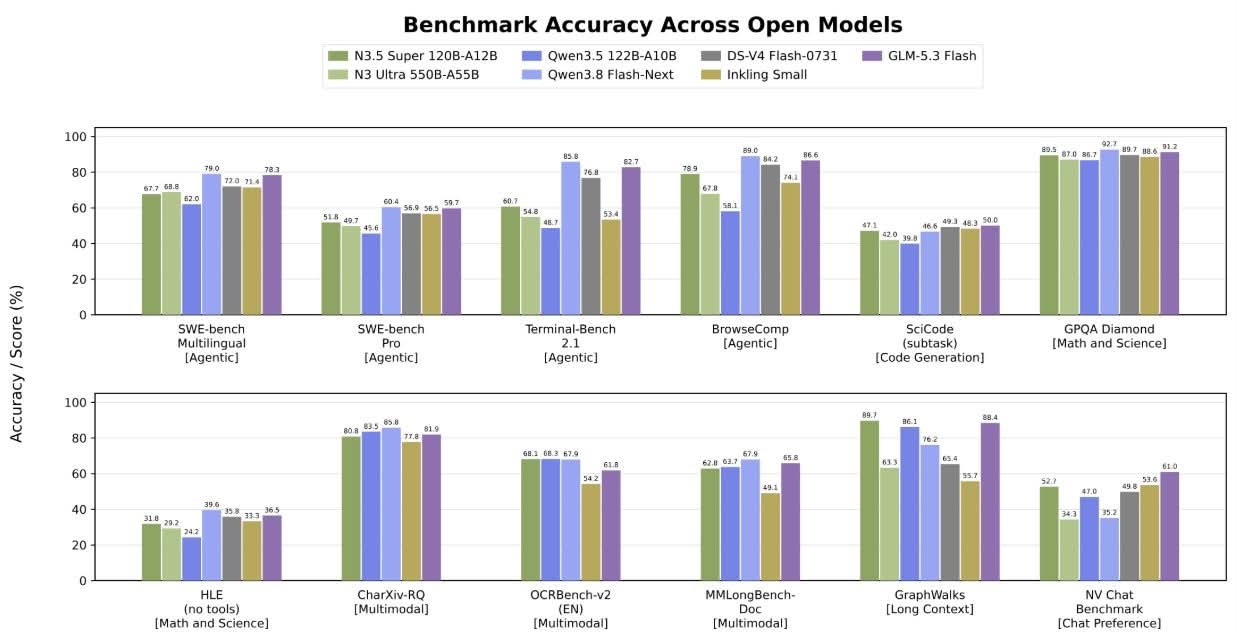
Nemotron 3.5 Super VL gives NVIDIA's 120B agent model eyes
"Roughly one-fifth the parameter count" is NVIDIA's pitch for Nemotron 3.5 Super VL, a 120B model with 12B active. Yet it trails Qwen3.5 on SWE-bench Verified, 71.1 to 71.9. Have you ever run an open model with 12B active parameters in your own agents?
Related stories
- ChatGPT Voice can now reach your email, calendar and Slack
- OpenAI says its Codex app should eat 60% less disk space
- OpenAI sends GPT-4o users to Luna ahead of 2027 retirement
- Codex and ChatGPT Work give GPT-6.1 Sol 500k context
- ChatGPT answers can now be a game or a budget calculator
- OpenAI's Decisions API beats its own engine by up to 10x
Comments
No comments yet. Be the first.
Join the conversation
Sign in to leave a comment. It appears after moderation.