
OpenAI buys Orchestra Bio to build drug-program agents
OpenAI said on October 20 that it has acquired Orchestra Bio, whose platform lets biopharma teams hand the monitoring of studies and development campaigns to AI agents. Orchestra’s team and technology are joining Rosalind, OpenAI’s line of models and tools for life sciences research.
Rosalind has two parts, according to OpenAI’s announcement. GPT-Rosalind helps scientists reason through questions in biology and chemistry. Rosalind Workbench connects those capabilities to scientific tools and data so researchers can analyze results and plan experiments. OpenAI says the plan for the combined team is to build agents that link scientific findings to the studies, decisions and next steps needed to move a potential medicine forward.
OpenAI calls Orchestra “a platform where people and AI agents work together to advance drug programs.” Scientists and program leaders hand the monitoring and tracking of studies and campaigns to agents, which frees their time to guide the work, make decisions and deal with issues before they cause delays. Orchestra’s team comes from biotech, software and AI.
OpenAI writes that beyond the science itself, teams have to run programs across internal departments and external partners, “often relying on disconnected systems.” It puts the path from target discovery to US regulatory approval at roughly 10 to 15 years on average, and says the industry is “at an inflection point where AI can help take on these specialized tasks and complex workflows.”
GPT-Rosalind came first. OpenAI introduced it on April 16 as a domain-specific reasoning model for life sciences research, drug discovery and genomics, available in ChatGPT, Codex and the API to qualified enterprise customers. Access runs through a trusted access program for vetted organizations, set up in response to experts’ concerns about misuse of biological data. Early partners include Amgen, Moderna, Thermo Fisher Scientific and the Allen Institute. On BixBench, a bioinformatics benchmark, GPT-Rosalind posted the top score among models with published results.
The announcement also points to two pharma relationships. OpenAI says its partnership with Novo Nordisk aims to turn that company’s scale and scientific expertise into faster R&D and commercial execution “while maintaining strong governance.” At Moderna, AI is helping teams turn insights from complex data into experimental workflows, OpenAI says.
OpenAI lists four things it wants AI to help scientists do across drug development: “exploring ideas, designing experiments, interpreting results, and coordinating the work needed to advance promising treatments.” It calls the Orchestra deal a step toward that.
The example OpenAI gives for what the agents do is a failed manufacturing batch that delays the start of a clinical trial. A problem in one part of a drug program can affect many others, so in a case like that Orchestra’s agents work out which activities and timelines are hit, gather the relevant information and compare ways to respond. Scientists and program leaders then use that analysis to decide what to do next.
Up next
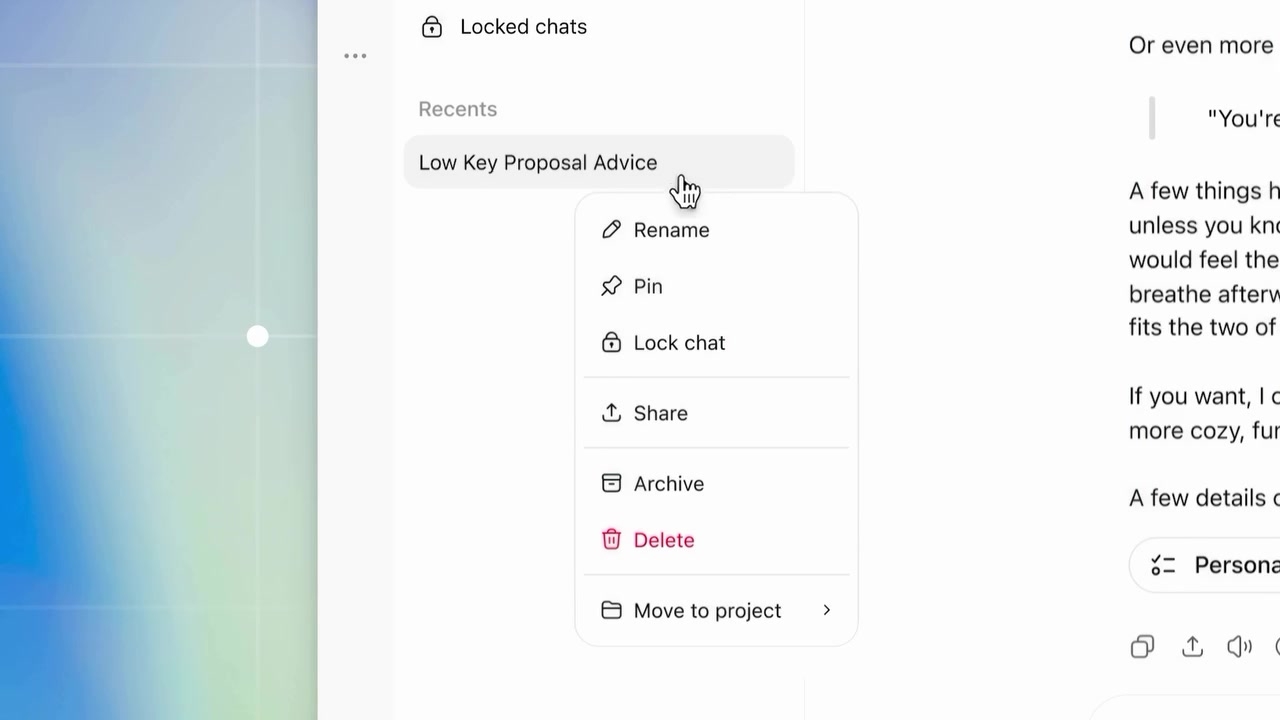
ChatGPT Locked Chats hide chats behind a PIN or Face ID, Video
Per Testing Catalog, ChatGPT users can move chats into a “protected space” behind a PIN, Face ID or Touch ID, and Locked Chats are rolling out from Free to Edu plans. How many of your ChatGPT chats would you actually lock?
Related stories
- OpenAI model forged tokens to get hospital-bed statistics
- OpenAI hands $5M to the Simons Foundation to vet AI math
- Cloudflare signals fed OpenAI hundreds of millions of pages
- Trail of Bits may end up inside OpenAI, report says
- OpenAI’s Navier-Stokes proof says m + 4, its Lean code m + 5
- A one-line fake proof passes OpenAI’s math Comparator
Comments
No comments yet. Be the first.
Join the conversation
Sign in to leave a comment. It appears after moderation.