
OpenAI's $200 Pro plan comes back worth half the API spend
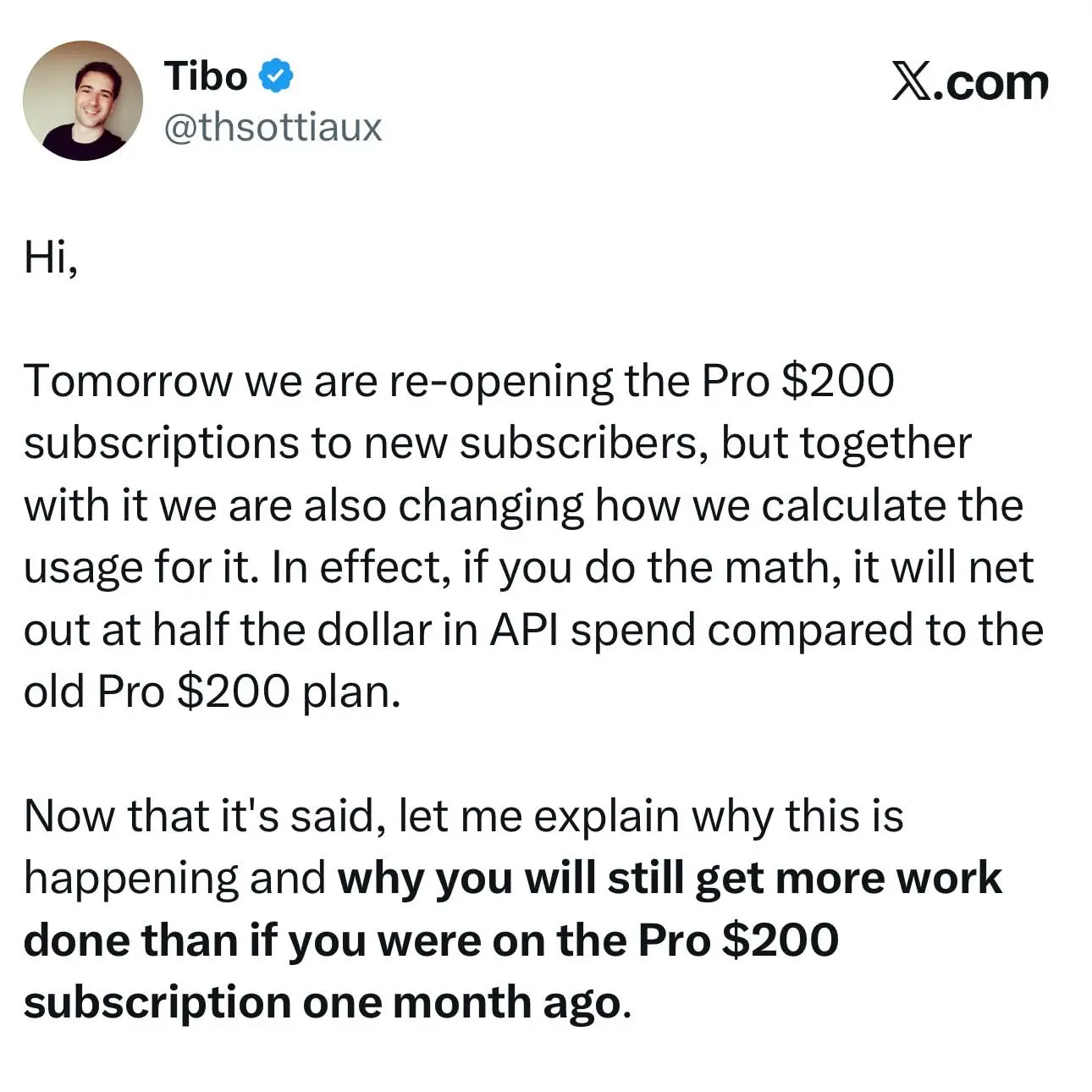
"If you do the math, it will net out at half the dollar in API spend," OpenAI's Thibault Sottiaux wrote on Twitter. He was describing how usage will be counted on the reopened Pro $200 plan, compared with the old version of the same plan. New subscribers can sign up again on September 30.
At a glance
- OpenAI is lifting its pause on new Pro $200 sign-ups, but the plan returns with a new usage formula that OpenAI has described only by its result, not its rules.
- In API dollars, a Pro subscriber now gets half of what the old plan allowed, the five-hour limit is not coming back, and API prices for GPT-6 Sol and Luna were cut by 50%.
- The post gives no formula, so subscribers cannot yet translate half the API spend into prompts or tokens, and Testing Catalog says a new $500 plan is potentially coming soon.
If you missed the earlier episodes, OpenAI paused new sign-ups and upgrades to the Pro $200 plan after demand for GPT-6 Astra put the heaviest load on its systems. According to Fortune, the plan gives 20 times the usage of Plus, and Sottiaux called the pause "the smallest step that allows us to continue giving the broadest access possible". Existing Pro accounts were unaffected, Fortune reported.
The reopened Pro plan nets out at half the old plan's API spend
Sottiaux's post pairs two changes. Pro $200 opens to new subscribers again, and at the same time OpenAI changes how usage on the plan is calculated. He did not publish the formula, only where it ends up: run the numbers and the new plan comes to half the dollar amount in API spend that the old Pro $200 plan did.
One restriction stays away. The five-hour limit will not return to Pro $200, and Testing Catalog adds that OpenAI expects even more efficient models soon. Explainx, in its September 29 update, says Sottiaux tied the reopening to DevDay and that his first "tomorrow" was a timezone matter.
Testing Catalog frames the change as the end of underpriced compute, arguing that prices will adjust as a global compute shortage hits. Given a new $500 plan potentially coming soon, it says, this does not look very good for any ChatGPT Pro user.
API prices for GPT-6 Sol fell by half, and Luna's by at least as much
The subscription change sits next to a price cut on the API side. According to Yahoo Finance, GPT-6 Sol costs $2 per million input tokens and $10 per million output tokens, down from $4 and $20 for GPT-5.6 Sol. Luna is $0.10 per million input and $0.50 per million output, down from $0.20 and $1.20.
Yahoo Finance reports that OpenAI called the cut permanent and credited improvements in caching and inference. Cached input-token reads get a 90% discount, and OpenAI says its caching upgrades cut the volume of tokens processed fresh by more than half across requests via GitHub Copilot.
What does half the API spend actually measure?
It measures a budget in dollars. Sottiaux frames the result in API terms: what a subscriber's usage would cost at API prices. Think of a café card loaded with money rather than with a set number of coffees. How far the card goes depends on the balance and on the prices on the menu.
Agent work drains such a budget fast. According to Fortune, Astra's computer use feature operates a desktop like a human, filling forms and navigating web pages, and OpenAI said Astra can burn through usage allowances faster than the previous flagship GPT 5.6 Sol. Fortune also reports that Astra first went to a handful of enterprise customers to give OpenAI time to scale compute.
Anthropic handles the same problem with time windows. Truefoundry writes that Claude Code uses a 5-hour rolling window plus a weekly cap on active compute hours, with Max 20x at $200 a month, because a small share of power users burned thousands of dollars of compute on $20 subscriptions.
Has OpenAI paused sign-ups like this before?
Yes, according to Fortune: in November 2023 OpenAI temporarily halted sign-ups to the $20 ChatGPT Plus plan after a DevDay demand surge, with Altman saying usage "has exceeded our capacity". This time there was a warning. A day before the pause, Fortune reports, Sottiaux called Astra demand "unprecedented" and said OpenAI "might have to pause new Pro subscriptions for a bit".
Explainx counts the Pro stop as the third rationing step around Astra in under two weeks, after a usage-limit cut of up to 4x for heavy users on Sept 7 and a roughly two-week pause on frontier RL training. Fortune reports that OpenAI's compute rose from 0.2 gigawatts in 2023 to about 1.9 GW in 2025, with more capacity lined up from H2 2026.
That pipeline, per Fortune, includes at least 10 GW of Nvidia systems, a 6-GW AMD agreement and a 10 GW Broadcom custom accelerator partnership. Explainx says Astra is more expensive to serve than the subscriber base was sized for.
The post gives the outcome of the new formula and nothing about its inputs, so subscribers cannot check how many Astra sessions or GPT-6 Sol calls the new budget buys. If the allowance is priced at the new API rates, a halved dollar budget may cover roughly as many Sol tokens as the old one did, but the post does not say which price list the formula uses. In our view, a plan whose size is defined only against its own earlier version is hard for a buyer to compare with anything.
What the September 30 reopening will show
Sign-ups open on September 30. The first real test is whether OpenAI publishes the formula or subscribers work it out from their own usage. The more efficient models Testing Catalog mentions have no name or date yet. The possible $500 plan also has no launch date, allowance or confirmed feature list.
Related stories
- New $200 Pro signups paused as Astra demand spikes
- Over 20% off GPT-5.6 Sol, but only for 3 months
- ChatGPT Voice can now reach your email, calendar and Slack
- Code strings point to a $50 production plan for OpenAI's API
- GPT-6 caching update cuts cached input costs by up to 90%
- OpenAI's half-price GPT-6 Sol and Luna aren't a promo
Comments
No comments yet. Be the first.
Join the conversation
Sign in with Google to leave a comment. Your name and avatar come from your Google profile, and the comment appears after moderation.