
OpenAI says its Codex app should eat 60% less disk space
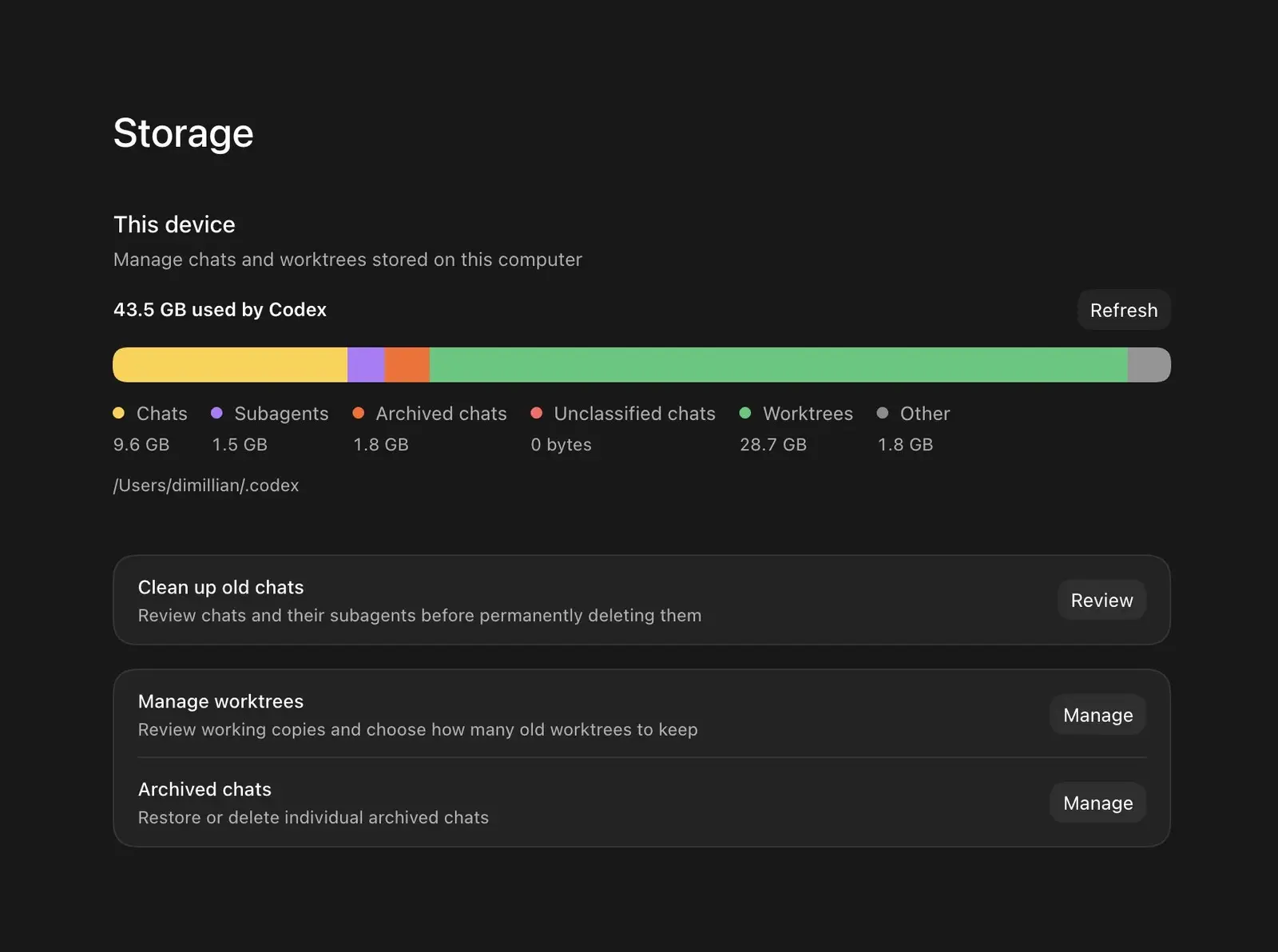
Power users of OpenAI's desktop apps had a problem that no model upgrade could fix: their drives were filling up. Tibo Sottiaux wrote on Twitter that the ChatGPT and Codex desktop apps should now store 60% less on disk, calling it a "small ship" and counting it as Day 9 of OpenAI's 28-day Codex sprint.
At a glance
- OpenAI changed how the ChatGPT and Codex desktop apps write their working state to disk, after hearing enough complaints from power users whose machines were running out of free space.
- The change counts as Day 9 of a 28-day sprint in which OpenAI promised, for each day, either one clear Codex improvement for most users or a full usage reset.
- OpenAI did not say how much space the apps used before the change, so the 60% reduction is an expected figure with no baseline to measure it against.
If you have not been following Codex, the sprint came after a rough few weeks. A Codex and Work outage on Sept 25-26 ended in a limits reset, a GPT-6 Astra quality postmortem brought another, and a GPT-6.1 Sol load spike on Oct 1-3 led to a global reset for paid ChatGPT accounts. Complaints about quota cuts and competition from Claude Opus 5.5 added to the pressure.
Day 9 shrinks what the ChatGPT and Codex desktop apps keep on disk by 60%
Unlike a speed boost or a limits reset, the Day 9 change touches files on your own computer. OpenAI rolled out optimizations to how the ChatGPT and Codex desktop apps store state on disk, and the amount stored there should fall by 60%. The stated reason is feedback from power users who kept running out of space.
State is the working data an app keeps on your machine between sessions, so it can pick up where you left off. In an app that stays open all day, that store grows with use, and the heaviest users are the ones who run into the limits of their drive.
Think of a desk drawer where every note gets filed and none gets thrown out: it works fine until the day it will not close. OpenAI's fix changes how that drawer is packed, and the post expects it to hold 60% less.
Sottiaux promised one improvement or one full reset on each of 28 days
Tibo Sottiaux, who runs Codex and ChatGPT work at OpenAI, made the pledge that turned this month into a countdown:
each day we'll either ship one thing that is a clear improvement and relevant for most codex/work users or ship a full reset.
The deal is either/or, so the month does not add up to 28 resets. The window reportedly runs from October 5 to November 1, 2026, although SmartScope notes that the exact dates are not confirmed in official documentation.
In an earlier post, according to Explainx, Sottiaux said the team was working only on simplifications, more efficiency for more usage, groundbreaking features or new models, and that feedback showed users want things to get simpler.
SmartScope describes what a reset does. It restores both the 5-hour and the weekly Codex limits and shifts the regular weekly reset date, so a Tuesday reset moves the next regular one to about the following Tuesday. Per SmartScope, resets come as banked entitlements or as global resets applied en masse.
Day 1 lifted GPT-6 Astra and GPT-6.1 Sol from about 30 to roughly 50 tokens per second
The sprint opened with speed rather than storage. GPT-6 Astra and GPT-6.1 Sol reportedly rose from about 30 to roughly 50 tokens per second, a gain attributed to backend optimizations rather than a model swap, and it reached Sign in with ChatGPT partners OpenCode, Pi, Amp and Devin within hours. One source cautions that these figures are rough estimates, not benchmarks.
After that, the record gets patchy. Observers have logged the days after Day 1 inconsistently: some days carried several small improvements, and on others a reset went out because the improvements fell short. Public trackers have appeared to keep score, including a GitHub scoreboard and an account that posts a daily status.
From Oct 30 the $200 Pro plan falls from 20× to 10× the Plus allowance
The sprint runs alongside a pricing change. From Oct 30, the $200 Pro plan's allowance falls from 20× to 10× the Plus allowance, offset by a one-time grant of 62,500 usage credits, worth about $2,500, that expires on Dec 31, 2026. A $500 plan offers 25× Plus.
According to Explainx, that $500 tier shipped at DevDay on Sept 29, together with the Dots agent and Ultrafast, while Pro 200 reopened with a smaller formula. Critics see the sprint as partly damage control around these changes. On the competitive side, byteiota reports that Claude Opus 5.5 scores 66.4% on Terminal-Bench 4.0, against 57.9% for GPT-6 Astra.
The weak spot of Day 9 is the missing baseline. OpenAI did not say how much space the apps used before, and the post says only that the change should cut storage by 60%, so the figure is an expectation with nothing to measure it against. In our view, a fix for full disks will matter more to people who live in these apps all day than a flashier feature would.
What Days 10 to 28 owe users
Each remaining day of the sprint owes Codex users either an improvement relevant to most of them or a full reset, and the GitHub scoreboard and the daily-status account will show which one arrived. OpenAI has not named what is planned for the days ahead, or whether more desktop app fixes are among them. A before-and-after storage figure from OpenAI would give users something to check the 60% against.
Up next

Lawsuit wants OpenAI to pay kids per token of their data
Equity or cash "in proportion to the number of tokens each child contributed" is the payout a Hawaii parent's lawsuit demands from OpenAI over children's ChatGPT data. Do your kids use ChatGPT on their own account, or only through yours?
Related stories
- Codex keeps coding in the cloud after your laptop closes
- Codex and ChatGPT Work give GPT-6.1 Sol 500k context
- OpenAI pulls GPT-5.5 from Codex on October 14, API spared
- Astra lands on Pro and Business before Plus
- Codex and ChatGPT Work now share the same projects and chats
- OpenAI sends GPT-4o users to Luna ahead of 2027 retirement
Comments
No comments yet. Be the first.
Join the conversation
Sign in to leave a comment. It appears after moderation.