
Claude now picks its own agent team in Managed Agents
If you run Claude Managed Agents with a coordinator and a roster of subagents you configured by hand, dynamic workflows give that design job to Claude. The lead agent decides how to split the work, which agents to start and what each one is passed. What stays with you is the budget, the defaults and reading the graph afterwards.
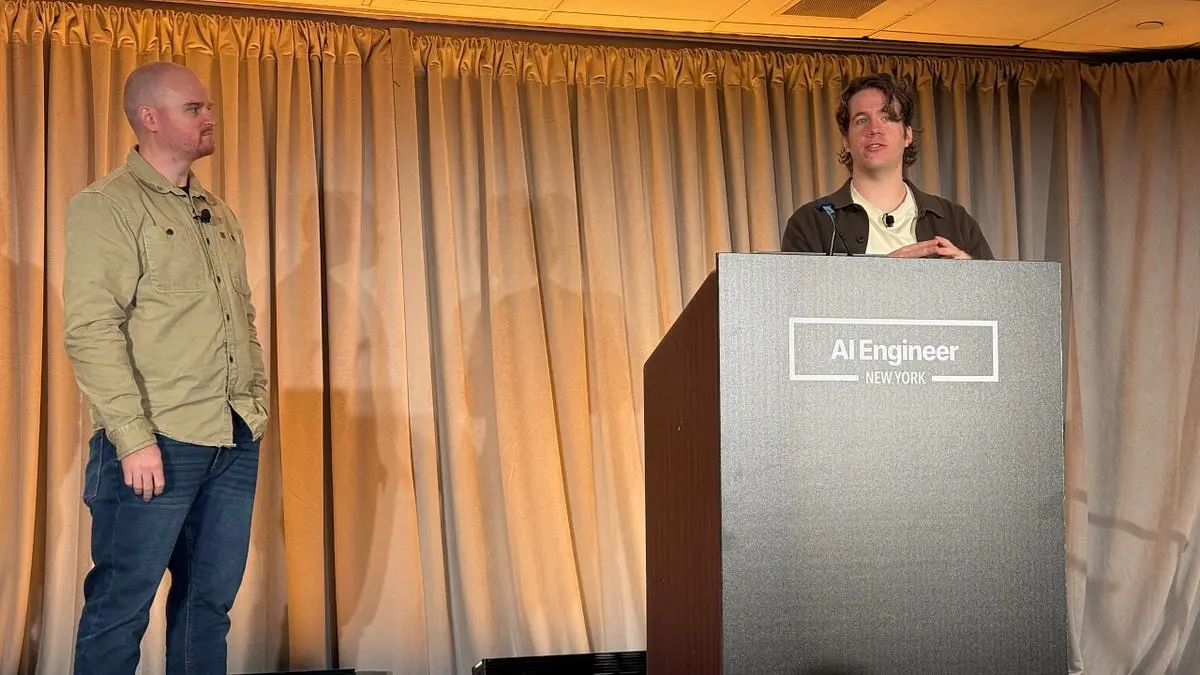
CJ Avilla and Harrison Stall, Members of Technical Staff at Anthropic, walked through the feature at a workshop at AI Engineer New York 2026, Latent reports. Anthropic announced it on Friday. The presenters mostly called it "flows" and described it as "a new type of multiagent orchestration, built for your most ambitious workloads."
Claude plans the work, then writes the program that runs it
The lead agent first drafts a plan. Claude then writes an orchestration program that launches agents, collects their results and routes information between them. Stall described it as letting Claude "fully orchestrate the entirety of its own multi-agent topology." The idea started in Claude Code as "a harness for every task". When we covered it on August 10, Claude Code's dynamic workflows had been in research preview since late May 2026, with Claude writing a JavaScript script that the runtime executed in the background.
Until now, a Managed Agents session could pass work to other agents only through subagents. The lead delegates each task itself, reads each report, and can send follow-up messages because a subagent's thread stays open until it is archived. The Claude Platform Docs describe how a workflow run differs. The program runs many agents in phases in the background, and context and results move between them in code without Claude's direct involvement, which leaves the main thread free to talk to the user and check progress. In return, the agent can't send follow-ups to a run's threads, and the server archives each of them by the end of the run.
You can still bring your own specialists. Avilla said pre-configured subagents can be passed in the agent config. Progressive Robot says there are two kinds of agents. Predefined agents have their own model, system prompt, tools and skills. Inline agents are defined on the fly and inherit the lead's model and tools. So if an expensive model leads the run, by default every worker runs on that model too. Cheaper workers have to be predefined and listed in <code>workflows.predefined_agents</code>, which takes up to 20 entries, according to the same outlet.
Agents can't message each other directly. Stall said they share a filesystem and can swap information through it, but the API gives you no way to tell one workflow subagent to message another. Progressive Robot adds that all agents in a session share the same sandbox, filesystem and vault credentials, that each one keeps its own thread and conversation history, and that delegation goes only one level deep.
Turning it on takes one config value
Set the agent type to <code>multiagent_20261001</code>. With that value, subagents and workflows are both on by default, and the advisor is off. Our October 9 item also mentioned a starting point in Claude Code, <code>/claude-api managed-agents-onboard bug-hunter</code>, and templates. Everything sits in Claude Console, the interface for developers who use Claude through the API. According to Claude Lab, Managed Agents itself entered public beta on April 8, 2026.
For debugging, Avilla pointed to the graph view in the Console: for each transition you can see the payload the lead agent passed to a subagent. On October 14 we reported that Managed Agents can also export OpenTelemetry traces covering every turn, model call and tool use.
The agent can't see the budget, so you have to set it
Stall said the model doesn't know its budget while it runs. Developers set a session budget instead. He added that telling models about their budget could make them "a little bit anxious." The docs say the same thing more dryly: every agent in a run consumes tokens, so set a session budget that caps the whole session's spend, runs included, and use the system prompt to tell the agent when a run is worth starting. The Decoder writes that Anthropic recommends starting small, because workflows can go through "a lot of tokens".
The demo was modest. A stock watchlist scanner gave each ticker to an agent with an isolated context, and a later review phase checked the findings and wrote a report. Compared with a single agent, Avilla said the flow cost "much more" but was "much more effective at finding all of the details." The Decoder cites a larger internal test: 70 bugs hidden in a 116,000-line codebase. A single agent found between 14 and 27 per run, and the dynamic workflow consistently found 66. The outlet cautions that it is not yet clear whether this holds for other kinds of tasks, and it notes that a senior OpenAI engineer recently called agent swarms a massive waste of tokens.
Progressive Robot puts numbers on the hosted ceilings. The "up to 1,000 agents" figure is a lifetime cap on agents started during a run, not on parallelism. Up to 64 agents can work at once, though that isn't guaranteed. A run lasts 24 hours by default, and a session can have 10 runs open at once by default.
Since Anthropic's own presenter says flows cost much more than a single agent, we find it odd that the lead agent can't see what it is spending. Today the session budget is a hard stop, and nothing on the planning side reacts to it.
Q&A
Could a simple scan start hundreds of agents? Stall's answer was "evals and lower defaults". He said ambitious tasks usually need explicit encouragement to parallelize more, so the default leans small.
Do repeated flows get cheaper or better over time? Not on their own. Apart from asking Claude to review the costs, Avilla suggested dreaming, a research-preview feature that reads a memory store alongside past session transcripts and writes a reorganized one, merging duplicates and replacing stale or contradicted entries. Asked whether the watchlist flow could notice that its scanning model was inadequate and change the next scheduled run, Stall said that isn't built in, and both presenters suggested hill-climbing and dreaming as ways to improve the loop.
Can flows handle large research problems? When an audience member brought up OpenAI's recently announced Navier–Stokes proof, Stall declined to say how Anthropic runs large scientific workloads. He described flows as "a way to throw test-time compute at hard problems and get more capability faster out of the models," and said the goal is to put that kind of work within reach of general API users.
Up next

FLUX 3 Image Klein's 5.6B count leaves out its encoder, Video
31 GB of peak GPU memory at 1024x1024 in BF16, says Black Forest Labs' own card for the 5.6B FLUX 3 Image Klein, and its prompt upsampler adds about 28 GB. Has an open model's real GPU memory use ever caught you off guard?
Related stories
- Claude agents get an OpenTelemetry trail for every step
- Claude Code threads collide as ordinary merge conflicts
- Claude Directory opens a submission flow for plugins
- Four Opus 5.5 API changes make Opus 5 requests fail
- Commerce agent blueprint ships with every write staged
- Editing chat history now breaks Claude's thinking blocks
Comments
No comments yet. Be the first.
Join the conversation
Sign in to leave a comment. It appears after moderation.