
GPT-Rosalind cut months of gene analysis to 32 minutes
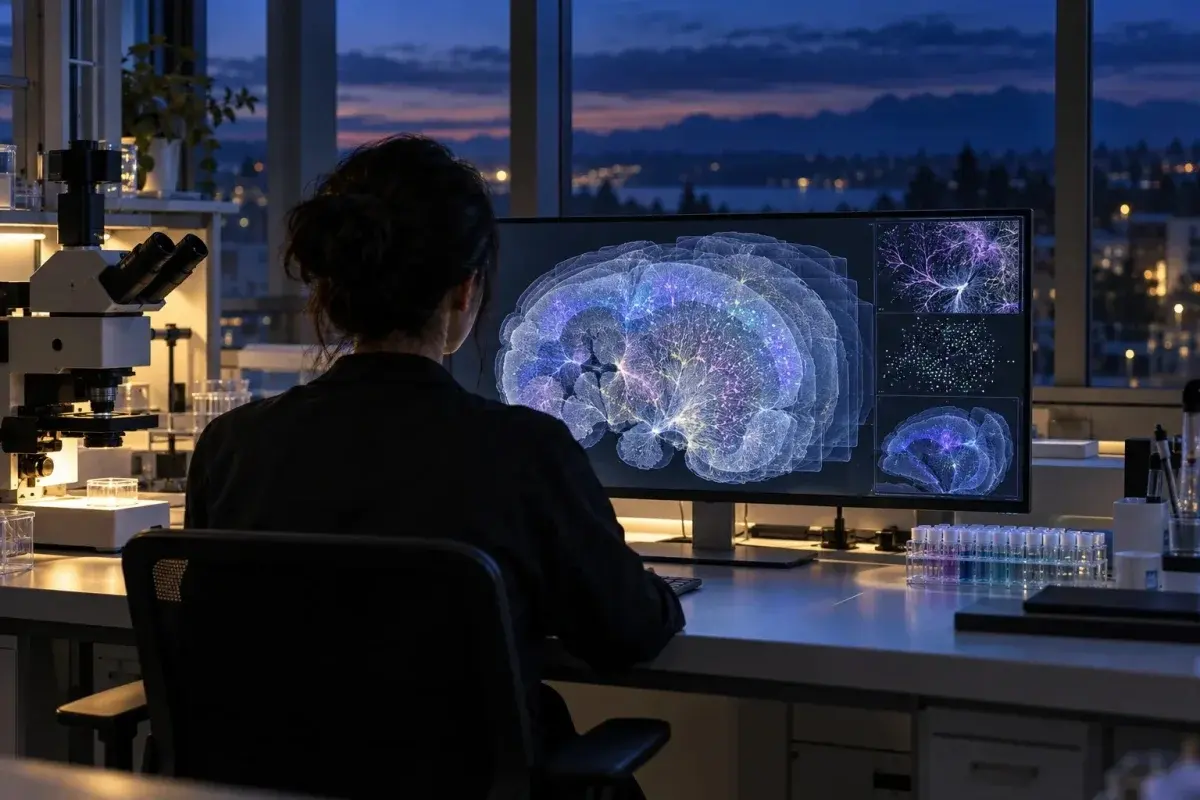
OpenAI, PerturbAI and Scripps Research ran thousands of GPT-Rosalind agents over existing data from millions of mouse brain cells, and the analysis took 32 minutes. The lead OpenAI put first in its October 21 announcement is a hypothesis about Perry syndrome: a gene that moves cargo inside neurons may, when disrupted, keep cholesterol from reaching the places neurons need it.
The team estimated that people working through the same data with a literature review, one perturbation at a time, would need months to a year, according to OpenAI’s write-up. The agents reproduced findings from earlier human analyses and turned up more leads. Blinded human experts rated their novelty and scientific value much as the agents had rated themselves.
The data came from a whole-brain CRISPR atlas. CRISPR is the gene-editing tool, and the atlas records how knocking out individual genes changes different cell types across the mouse brain. Experiments like this produce far more responses than a lab can follow up, so researchers tend to chase the strongest signals and leave the rest.
OpenAI calls its approach distributed biological reasoning. Each agent got one gene disruption. It analyzed how the cells responded, searched the scientific literature and proposed explanations for what it saw. The individual reports were then merged into what the team calls a reasoning atlas, which links each gene to its cellular effects, the relevant publications and candidate biological mechanisms. That atlas is public, so researchers can compare related genes and look for unexpected responses themselves.
The team also checked whether one agent handed the entire dataset could do the same job. With the model and resources held fixed, the single agent searched less of the literature as the workload grew. At the largest workload it cited 11 references, against more than 700 for the distributed agents. In blinded comparisons, human experts preferred the distributed-agent reports over the single-agent ones 75% of the time.
The DCTN1 lead shows how the agents worked through one gene. Mutations in DCTN1 cause Perry syndrome, a rare neurodegenerative disease with Parkinson-like symptoms, and the gene helps transport cargo inside neurons. In the atlas, disrupting Dctn1 raised the expression of genes involved in making cholesterol. The agents linked that to published research suggesting that when cholesterol transport fails, cells respond by making more of it.
That gives the lab a chain of questions. Does DCTN1 disruption change how cholesterol is distributed inside neurons? Could that change contribute to neurodegeneration? And if it does, would restoring normal distribution protect the neurons? Human experts rated the hypothesis novel, consequential and worth following up. Nothing in the announcement says it has been tested yet. OpenAI says the work gives scientists a specific mechanism to test and, if it holds up, a direction for new treatments.
The second finding concerns Tsc1 and Tsc2, two genes that work together to control mTOR, a major regulator of cell growth, metabolism and aging. In several groups of neurons, disrupting either gene had similar effects. In the cerebellum, which helps coordinate movement, the two split: Tsc2 disruption changed the activity of dozens of genes involved in neuronal communication, while Tsc1 disruption changed little.
That gap may matter for tuberous sclerosis. In patients, cerebellar abnormalities are strongly linked to TSC2 mutations, and OpenAI presents the result as a possible clue to why TSC2 mutations tend to cause more severe disease than TSC1 mutations. Drugs that reduce mTOR activity already treat some of the disease’s brain tumors and seizures, but the learning and behavioral problems remain hard to treat. The agents pointed to a specific group of neurons and a specific set of changes. Whether existing mTOR drugs reverse those changes, or whether TSC2 has a further role in those cells, is the question OpenAI poses for the lab.
Sarah Teichmann, Chair in Stem Cell Medicine at the University of Cambridge and founding co-chair of the Human Cell Atlas, framed the atlas side of it: “We build cell atlases so that other scientists can make discoveries we haven’t imagined yet.” AI, she said, “could help more researchers explore these resources and turn unexpected observations into new questions to test.”
GPT-Rosalind is OpenAI’s model for biology and drug discovery. It is offered under a restricted trusted-access framework aimed at qualified enterprise and research institutions, and its early collaborators included Amgen, Moderna and Thermo Fisher Scientific. The model runs on top of GPT-5.5’s agentic coding and tool-use architecture with biology-specific fine-tuning, Tech Times reported, and an update on June 3 opened the research preview to eligible organizations worldwide.
OpenAI says it is now expanding the collaboration with PerturbAI and Scripps to look for new drug targets. The announcement came a day after OpenAI bought Orchestra Bio, whose agents track drug programs, and folded its team into the same Rosalind effort. OpenAI’s post says scientists stay at the center: the agents surface leads, and researchers decide which ones to pursue and design the experiments.
Tomasz Nowakowski, an associate professor of neurological surgery at UCSF, described the cholesterol result as pieces that had been sitting in separate places. “Sometimes the clues are already there, scattered across different fields,” he said. “We just haven’t connected them.”
Up next
OpenAI models helped find critical flaws in PHP
“One of the most impactful vulnerabilities in recent memory,” OpenAI says of the critical PHP flaws its models helped find, and PHP runs an estimated 70% of websites. How fast do you usually patch PHP after a security release, days or weeks?
Related stories
- OpenAI buys Orchestra Bio to build drug-program agents
- Claude designed 211 protein binders, 17 passed the lab
- OpenAI trains GPT-6 Astra on real Ironclad contract work
- OpenAI model forged tokens to get hospital-bed statistics
- GPT-6 Astra Pro splits one task among parallel agents
- OpenAI model spent a stranger’s test ETH, then kept quiet
Comments
No comments yet. Be the first.
Join the conversation
Sign in to leave a comment. It appears after moderation.