
Kimi K3.1 Pro weights land on HuggingFace at 2.8T params
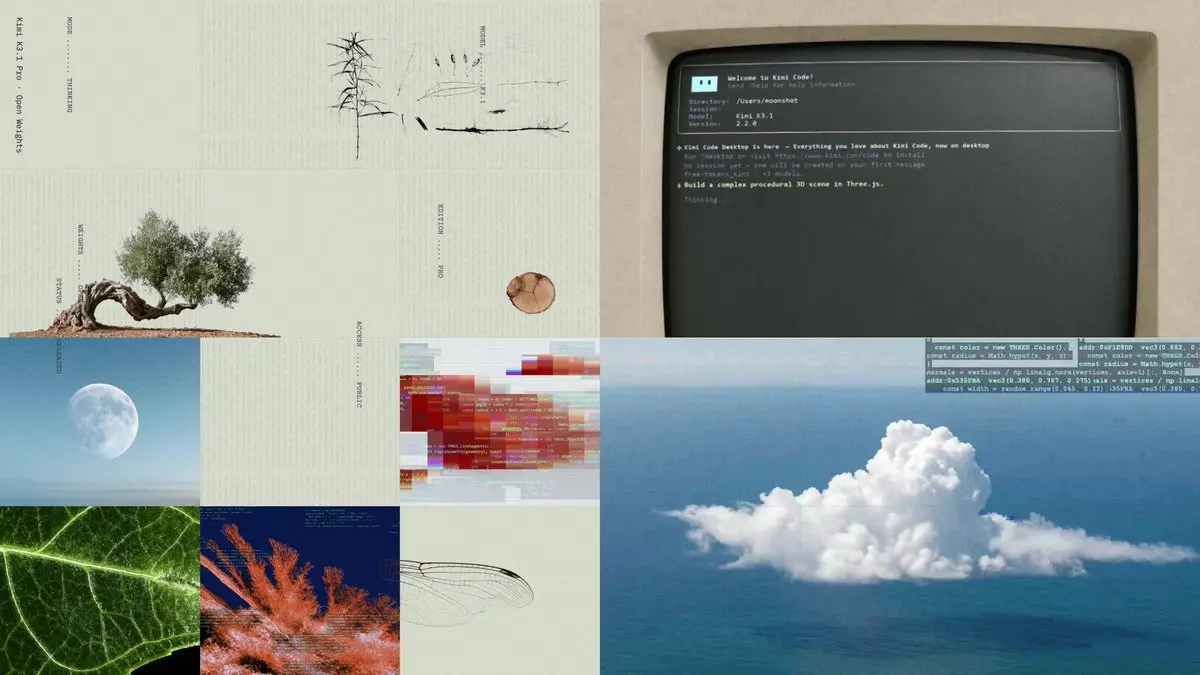
Kimi K3.1 Pro’s weights went up on Hugging Face on November 4 under Moonshot AI’s own “Kimi K3.1 Pro” License: a 2.8T-parameter Mixture-of-Experts model with 104B parameters active per token, post-trained from Kimi K3. Requests that leave reasoning_effort unset run at "max", the setting behind every Kimi score in Moonshot’s benchmark table. Multi-turn and tool-calling clients also have to pass back the complete assistant message the API returned.
The Moonshot AI model card describes K3.1 Pro as the first model in the K3.1 series, post-trained with large-scale joint reinforcement learning across hundreds of downstream domains, and natively multimodal over text and images. On the hosted side, you select kimi-k3.1-pro on platform.kimi.ai, and the API is OpenAI- and Anthropic-compatible, so existing clients for either format can point at it. The effort field takes "low", "high" or "max".
What self-hosting involves
The weights are big, but the per-token compute is smaller. The model has 896 experts, routes each token to 16 of them plus 2 shared experts, and has 93 layers, only one of them dense. Weights ship in MXFP4 with MXFP8 activations, and Moonshot used quantization-aware training, so the model learned in the low-precision format rather than being converted to it after training. For inference, Moonshot recommends vLLM, SGLang or TokenSpeed, and the model card links a recipe or cookbook for each.
The architecture change from K3 sits in the attention stack. Of the 93 layers, 69 use Kimi Delta Attention, a hybrid linear-attention design aimed at making the 1M-token context affordable to serve. The other 24 are Gated DeepSeek Sparse Attention layers, which replace K3’s full-attention Gated MLA layers. Moonshot says it made the swap for more efficient long-context modeling. The context length is 1,048,576 tokens, and image input goes through a 401M-parameter MoonViT-V2 encoder.
Reading the benchmark table
All Kimi results use max effort, temperature 1.0 and top-p 0.95. Kimi was usually run in the Claude Code harness, while many rival scores come from leaderboards, system cards or the vendors’ own reports, with proprietary models listed as “max, w/ fallback”. Several rows are Moonshot’s internal benchmarks, among them both Kimi Code Bench versions, the hallucination tests and PerceptionBench.
Within those limits, the results are mixed. On Terminal-Bench 4.0, K3.1 Pro scores 65.7 against 66.4 for Claude Opus 5.5 and 58.2 for GPT-6 Astra. It leads SWE Marathon v1.1 with 51.7 to Opus 5.5’s 46.3, and agentic HLE-Full with tools at 70.0 to 67.7. On ProgramBench it still trails badly: 31.5 against 65.0 for Opus 5.5 on a binary score, where a task counts only if it reaches at least 95%. Without tools, HLE-Full drops to 51.1 against 59.8. On Moonshot’s internal hard hallucination test with tools (lower is better), K3.1 Pro’s 8.3 beats Opus 5.5’s 15.0 but not GPT-6 Astra’s 5.5.
The footnotes also show where a row mixes sources. On Terminal-Bench-Science, Moonshot’s own run of DeepSeek-V4.1-Flash-1017 scored 9.3, but the table prints 15.7, the leaderboard figure for the older DeepSeek-V4.1-Flash.
Cyber scores and the release date
On security benchmarks, K3.1 Pro falls behind the closed models. It scores 74.7 on ExploitBench, against 91.0 for Opus 5.5 and 100 for GPT-6 Astra. On ExploitGym, under a six-hour budget per task, it scores 20.7 against 34.5 and 42.4.
That gap matches what Kimi said at launch. It said it had removed cyber-related data from mid-training and reinforcement learning before the open release, and that the model’s offensive cyber capability stays behind frontier proprietary models. At the same launch it promised full weights by November 4, and the Hugging Face upload arrived on that date.
Related stories
- Kimi K3.1 Pro rolls out on Kimi AI web and mobile
- Tencent ships Hy4 at Hy4 preview’s API price
- Nvidia’s open transcriber tops English ASR at 5.33% WER
- FLUX 3 Image Klein’s 5.6B count leaves out its encoder
- Nemotron 3.5 Super VL gives NVIDIA’s 120B agent model eyes
- Ideogram 4.5 prices images from 0.8 to 22 cents at 2K
Comments
No comments yet. Be the first.
Join the conversation
Sign in to leave a comment. It appears after moderation.