
Tencent ships Hy4 at Hy4 preview’s API price
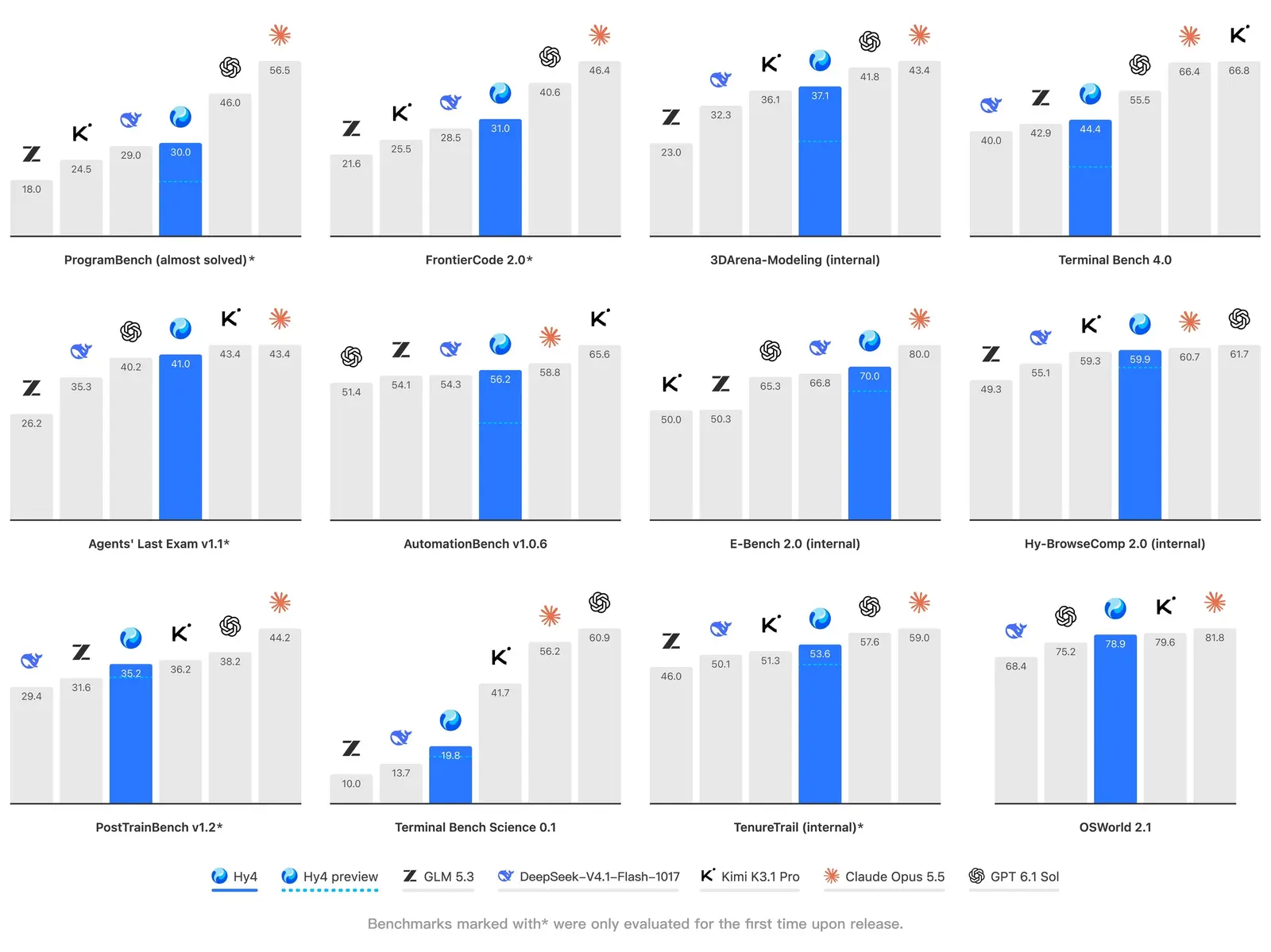
Tencent on November 4 put Hy4, the full successor to Hy4 preview, on Tencent Cloud and OpenRouter at the preview’s API price, and it adds image input and computer use. If you already call the preview through an API, you can switch without paying more per token. If you run the model on your own hardware, you are still limited to the preview: Tencent’s announcement says it plans to open Hy4’s weights but has not released them yet.
Same price, more to it
Per million tokens, Hy4 costs $0.834 for input, $2.501 for output and $0.042 for cached input. Cached input costs about a twentieth of the regular input rate, so agent loops that resend the same long prefix pay much less for that part. Besides the two API routes, Hy4 runs inside Tencent’s CodeBuddy, WorkBuddy, Yuanbao and ima. A Testing Catalog post on Threads also lists Hy AI Studio.
For the first time, the Hy line can read images. It can also operate a computer through both command-line and graphical interfaces, and Tencent trained it on specialised software such as Blender and CAD. For frontend and game work, Tencent adapted it to Unreal Engine, Unity and Godot. Against the preview, it reports gains of 19.1% on GameDev and 9.8% on GameLogic.
Self-hosting is still the preview
Tencent says it has lined up support from the vLLM (Inferact Inc.) and SGLang communities and will publish a full system card when it releases the weights. It has not given a release date. Until then, the only Hy4-family checkpoint you can download is the preview, which a Threads post said went up on Hugging Face under Apache 2.0.
The preview’s model card describes a Mixture-of-Experts model, where each token goes through only a few specialist sub-networks. It has 770B parameters in total and 49B active per token. Each token goes to the top 8 of 256 routed experts plus one shared expert, the context window is 1M tokens, and a built-in multi-token prediction layer supports speculative decoding. Tencent also plans a Hy4 flash “in the near future” and says it will be cheaper to run and faster at inference.
What the benchmark claims rest on
Tencent puts its own limit next to the launch claims. It says that “a notable gap remains between it and top proprietary models, particularly on challenging internal benchmarks for research-level mathematics, long-horizon coding, model self-improvement, and advanced visual question answering.”
The headline open-weight comparison comes from a finance evaluation Tencent ran with its fintech unit FiT. 213 finance professionals, 153 of them from leading financial institutions, graded 579 real-world tasks. Hy4 scored 3.04, DeepSeek-V4.1-Flash-1017 2.97, and Kimi K3.1 Pro and GLM-5.3 2.68 each. So the “first among open-weight models” claim rests on a lead of only 0.07 over DeepSeek, on a panel run by Tencent.
Search was reworked for time-sensitive retrieval and for checking facts across sources. In Tencent’s internal evaluations, the hallucination rate fell from 15.76% on the preview to 5.45%, and speculative errors fell from 23.1% to 5.6%.
Partners contributed figures too. RabyteTech, a company that builds AI agents for investment research, scored Hy4 at 61.63 on 101 tasks from its IRAB benchmark, 12.03 points above the preview. Two of the partner evaluations come from Tencent’s own products. In WorkBuddy’s evaluation of web, visual-creation and 3D tasks, Hy4 averaged 83.18 with a 96.15% pass rate and ranked first among Chinese models in 9 of 12 scenarios. Yuanbao’s internal set scored it 72.53, up from 65.25 for the preview.
Cyber and bio checks
Tencent says it limited Hy4’s cybersecurity training data to defensive material: proof-of-concept generation and vulnerability patching. It filtered out exploit development, reverse engineering and penetration testing. Red-team audits by Tencent Xuanwu Lab and Tencent Keen Security Lab found no elevated risk in tasks such as reversing cryptographic algorithms, defeating binary obfuscation or exploiting vulnerabilities. On Tencent’s Hy-BioExperimentBench, Hy4 scored 30.4 out of 100, which the company says is well below its high-risk threshold.
Up next
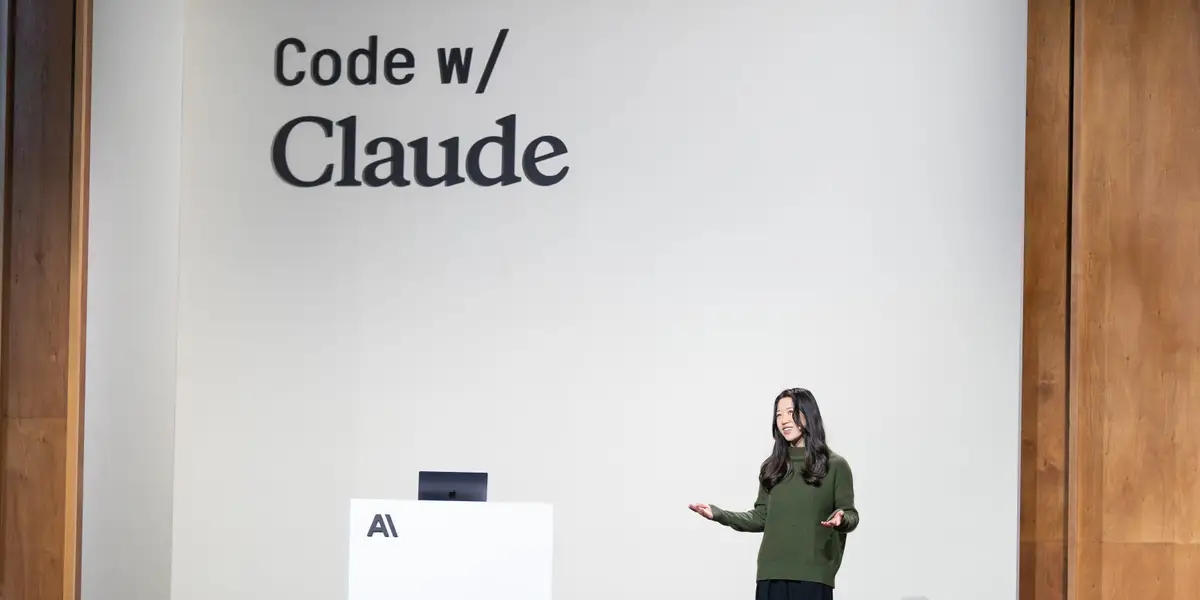
Cat Wu, Claude Code’s head of product, leaves Anthropic
Claude Code lost its head of product on Friday when Cat Wu left Anthropic, which confirmed the exit as it heads toward an IPO planned for later this month.
Related stories
- Hy4 Preview appears on Hugging Face under Apache 2.0
- Nvidia’s open transcriber tops English ASR at 5.33% WER
- FLUX 3 Image Klein’s 5.6B count leaves out its encoder
- Nemotron 3.5 Super VL gives NVIDIA’s 120B agent model eyes
- Ideogram 4.5 prices images from 0.8 to 22 cents at 2K
- 552B MoE opens DeepSeek’s new architecture family
Comments
No comments yet. Be the first.
Join the conversation
Sign in to leave a comment. It appears after moderation.