
Repos become persistent context in Claude's team projects
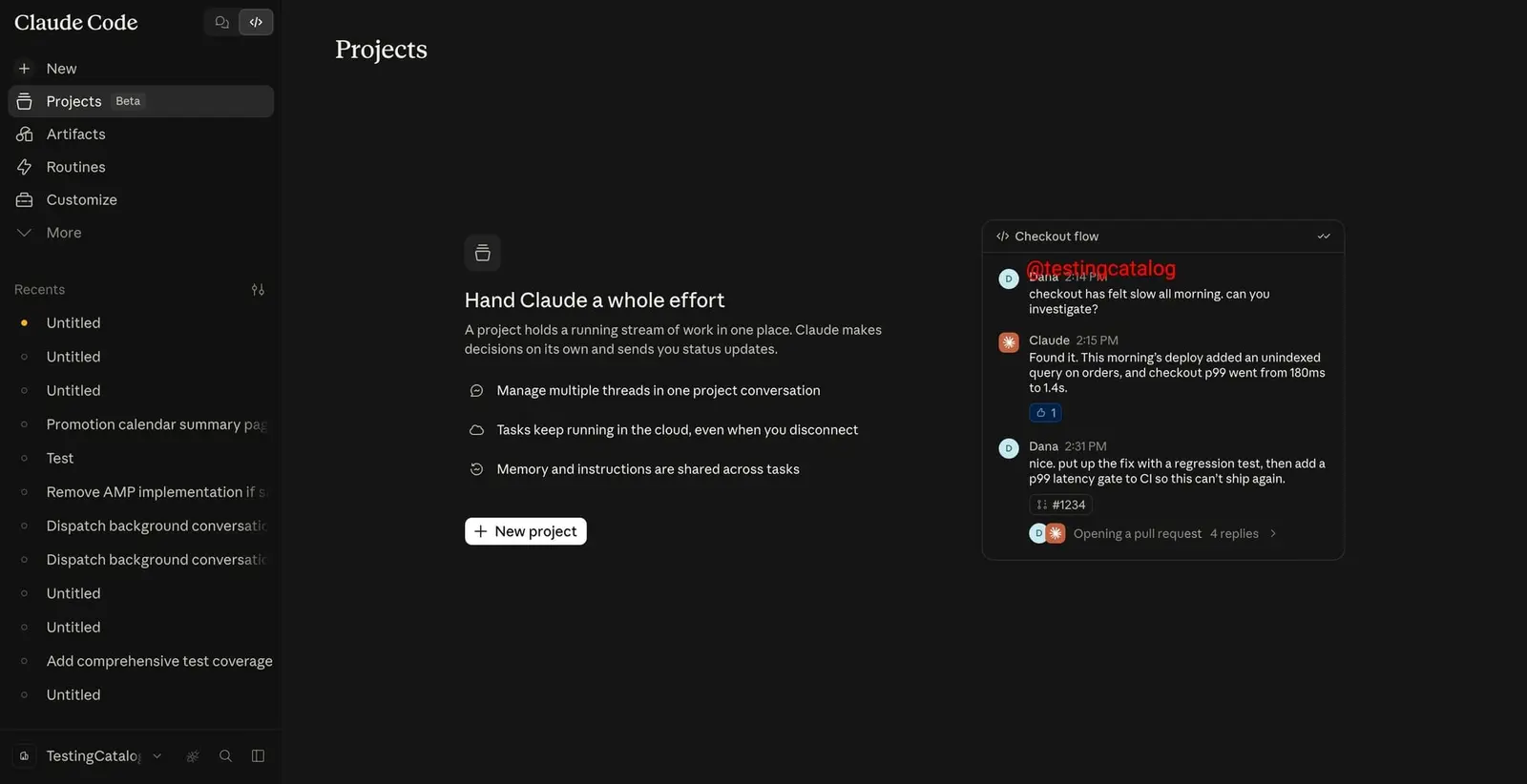
Anthropic is building collaborative projects for Claude Code in Claude Desktop in which repositories are added directly as persistent context at project creation, Testingcatalog reports. The interface recommends adding only the repositories a session requires, and suggests attaching anything else session by session as needed.
At a glance
- A project session behaves like a channel where several people and Claude are present at once, while newly described threads carve out separate sub-conversations around individual tasks inside that session.
- Shared memory and context persist between sessions, and Claude is expected to maintain the workspace itself, periodically revisiting context files and memories to reorganize and refine what the project stores.
- Access appears to be widening past friends-and-family testing, with early-access organizations potentially already using the feature, which would move a workflow Anthropic reportedly runs internally into Claude Desktop.
The shape of the product reads as a bet that AI-assisted coding turns into a group activity rather than a private one. A shared session with threads, attached repositories and self-maintaining memory sits closer to a team chat tool than to a chat window, and it points at Anthropic keeping organizational context inside Claude instead of borrowing it from Slack. That likely raises the switching cost for teams already standardized on Claude Code.
Repositories are added as persistent context when a project is created
Collaborative projects are built around shared memory and context that carry over between sessions, with several people able to work inside the same session. During creation, repositories are added directly as persistent context, so the code stays attached to the workspace instead of being re-supplied each time.
The interface steers users toward a minimal set, recommending only the repositories a session actually needs and suggesting that anything further be attached on a session-by-session basis. An earlier version of the feature, spotted as Managed Projects, has since been updated to mention that users will be able to spawn different threads.
Noah Zweben says unprompted messages are down about 45% with Claude Tag
The design extends Claude Tag on Slack, where Claude draws on channel and thread context alongside connected codebases. In the desktop version, the project session takes the role of the channel, and threads hold separate sub-conversations around individual tasks inside it.
Noah Zweben wrote that unprompted messages are down roughly 45%, describing Claude Tag as more context-aware across a user's work and more attuned to when it should stay quiet. He added that monitoring is not billed separately. Anthropic's recent focus has been on Claude Tag, and collaborative projects could bring the same workflow directly into Claude Desktop, without teams needing to run it through Slack.
Anthropic calls the model a possible future of software development
Anthropic has suggested that this collaborative model could represent the future of software development. Instead of traditional pair programming, or a single developer working alone with an AI assistant, several developers and Claude work together inside the same project session, on the same shared context. Anthropic has reportedly used the approach internally for some time.
Claude is also expected to maintain the projects itself, periodically returning to context files and memories to reorganize and refine them. The effect described is a persistent workspace that Claude keeps in order, rather than a static archive of shared chat history left over from previous sessions.
Early access without a rollout date
Availability appears to be expanding beyond friends-and-family and alpha testing, and early-access organizations may already have the feature. Anthropic has not confirmed a public rollout date, and the current description does not state pricing terms, a limit on how many repositories a single project can hold, or how threads interact with access permissions.
Up next

Gemini etched into silicon: the "Frozen v2" chip claim
Alphabet is baking part of the Gemini model straight into silicon, per Stansberry Research citing The Information. The inference chip, "Frozen v2", is claimed to be 6 to 10 times more efficient than its current AI chips.
Related stories
- Concise output style lands in Claude Code
- Linus Torvalds uses Claude Code on a hefty kernel change
- Bank hacker's Claude Code logs sat in an open directory
- Claude Code's system prompt shrank by over 80%, scores held
- Claude Design's own site closes, ZDR teams can't migrate
- Claude Dashboards shows the SQL behind every number
Comments
No comments yet. Be the first.
Join the conversation
Sign in to leave a comment. It appears after moderation.