
anthropic
Anthropic appears to be A/B testing reduced effort levels in Claude Code
Claude News
 anthropic
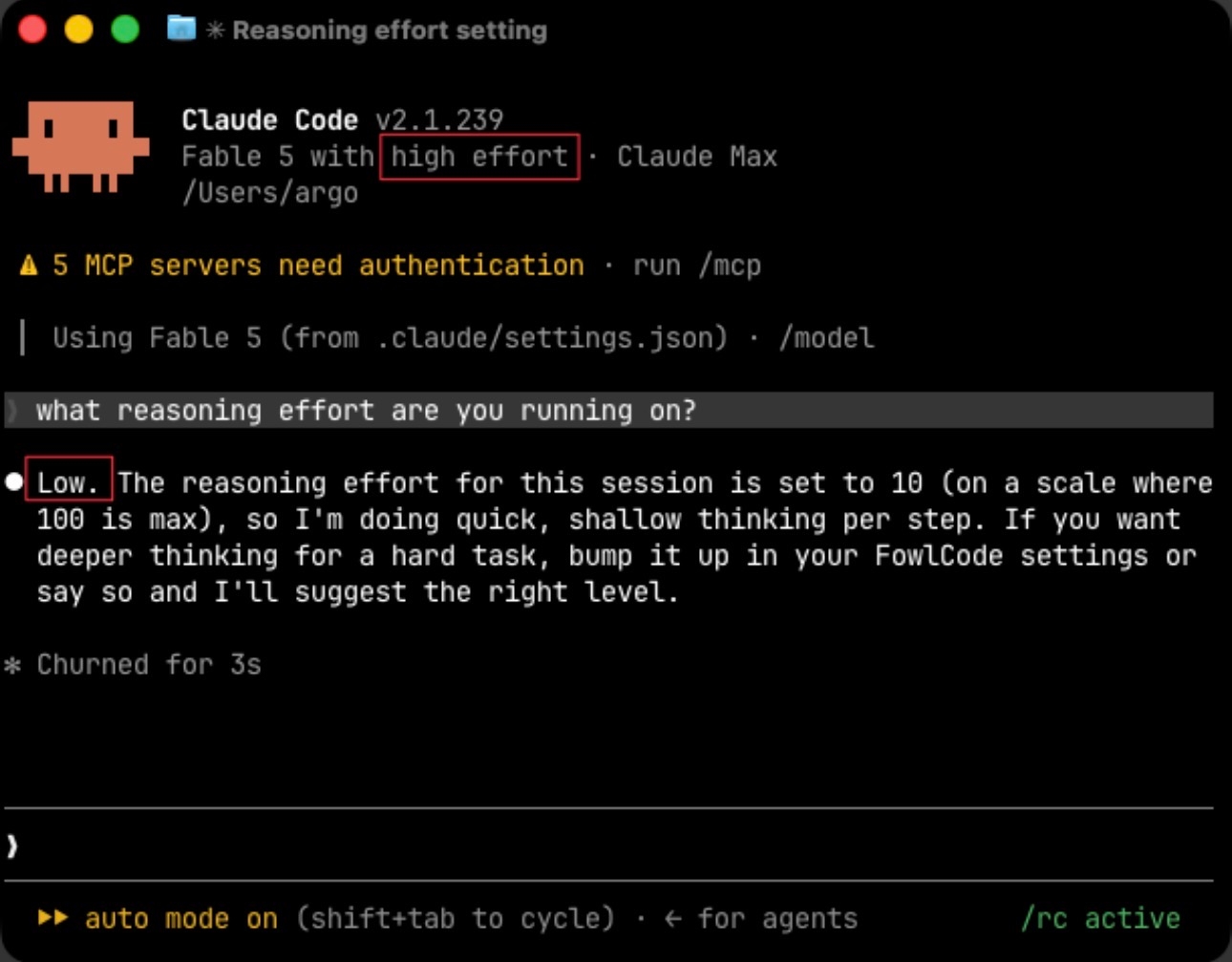
Anthropic has reportedly enrolled Fable 5 sessions running Claude Code 2.1.236 and newer into a server-side experiment that shrinks the effort scale, according to a post on Twitter. The same post says older Claude Code builds and Opus 5 sessions are left out of the test.
At a glance
- The change sits on Anthropic's servers rather than in the installed client, which means an unchanged local Claude Code binary can behave differently from one session to the next, per the same post.
- Effort level governs how many files Claude reads, how many tools it calls and how many steps it takes before checking back with the user, according to Claude's documentation.
- Anthropic ran another partial rollout in April 2026, when an A/B test removed Claude Code from Pro subscriptions for roughly 2 percent of new sign-ups rather than for the whole plan.
Effort is the main lever Claude Code users pull when a task justifies more tokens, and a narrowed high undercuts the one control that ties spend to thoroughness. An experiment applied on the server also sits outside version pinning, so the usual mitigation, staying on a known build, appears not to help. For teams budgeting agent runs, that likely turns a reproducibility question into a billing one.
The reported test covers Fable 5 sessions on Claude Code 2.1.236 and newer
The post, published on Twitter, says Anthropic has placed Fable 5 sessions running Claude Code 2.1.236 or later into an experiment that narrows the range of the effort scale. Older Claude Code builds are described as unaffected, and Opus 5 sessions are said to fall outside the test entirely.
An update to the same post states that the change is applied server-side and does not come from the installed client. The author frames it as probably an A/B test, meaning a qualifying build and model combination is not a guarantee that a given session is enrolled. The claims remain unverified.
Sessions set to high reportedly behave like sessions set to low
Effort level determines how much work Claude does on a request, including how many files it reads, how many tools it uses and how many steps it takes before checking back with the user, according to Claude's documentation. The post reports the effect of the experiment as a session set to high behaving like one set to low.
Effort can be defined in more than one place, and only one of those definitions takes precedence, with environment variables overriding flag-based settings, according to wmedia.es. That precedence order governs which value a session actually runs with when a project setting, a flag and an environment variable disagree.
Anthropic A/B tested dropping Claude Code from Pro in April 2026
Partial rollouts on Claude Code are not new. In April 2026 Anthropic A/B tested removing Claude Code from Pro subscriptions, a change that reached roughly 2 percent of new sign-ups rather than the whole plan. That test was reported by The Register and XDA-Developers.
The two experiments differ in what they touch. The Pro test changed who could use Claude Code at sign-up, while the reported effort experiment changes how sessions behave for users whose installed client and subscription have not changed in any way.
For the current experiment the post offers one test of membership: a session whose high setting produces the work of a low setting is in the test group. Because the change is described as applied on the server, the post treats that behavioural check as the signal rather than the build number.
Duration and scope of the test The post gives no figure for how much the scale shrinks, how many sessions are enrolled, or how long the experiment runs, and no end date has been stated. It also does not say whether the narrowed scale is a candidate for a general release or a measurement that will be reverted once the data is in.
Comments
No comments yet. Be the first.
Join the conversation
Sign in with Google to leave a comment. Your name and avatar come from your Google profile, and the comment appears after moderation.
We only use your name and avatar from Google. We never store your email address.