
FLUX 3 Max outpaces Seedance 2.5 over 25x in fal’s test
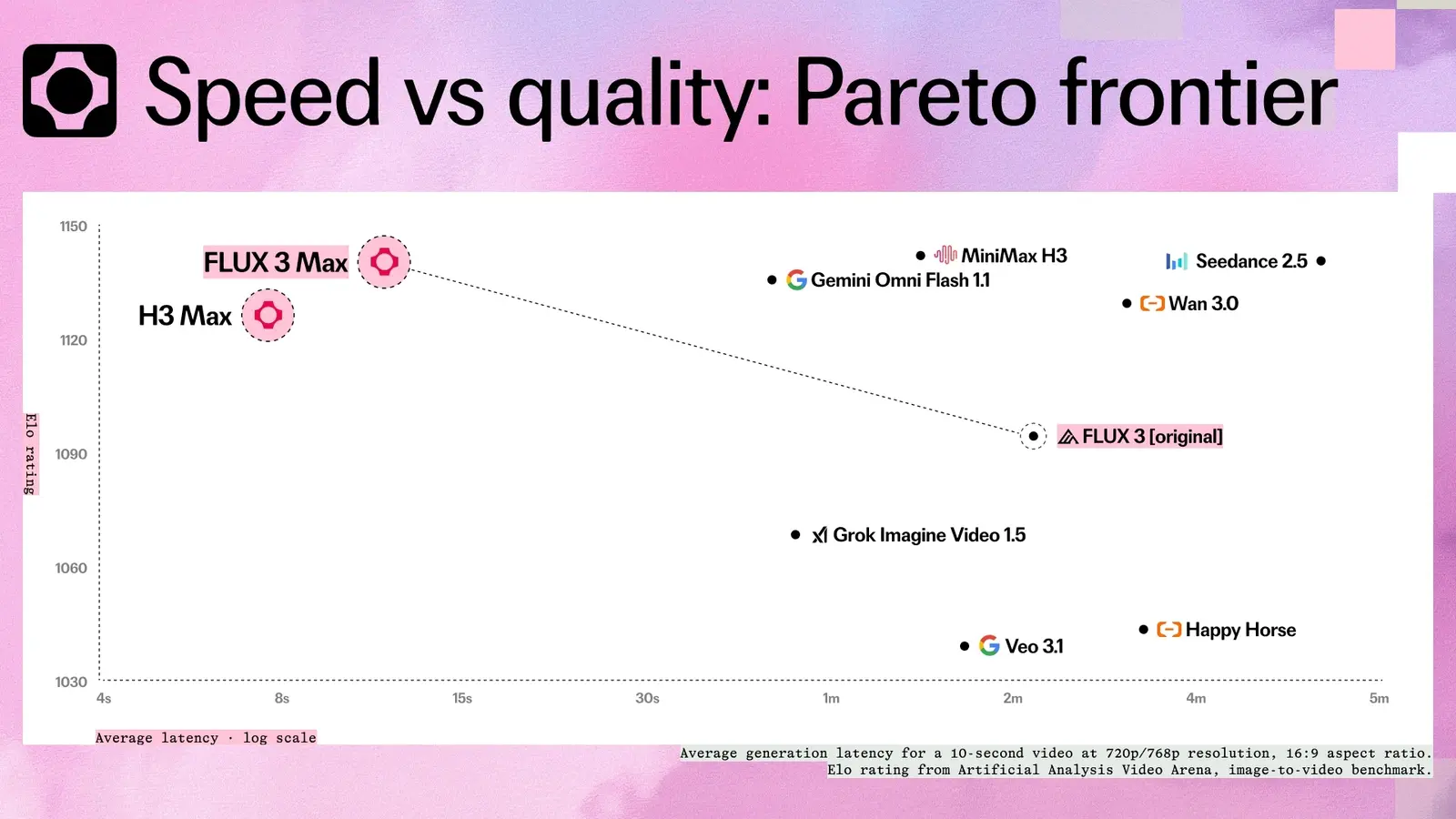
fal says FLUX 3 Max makes a 10-second video from a starting image in about 11 seconds in its benchmark. Seedance 2.5 took 277.8 seconds for the same job. fal Research post-trained the model with Black Forest Labs, starting from FLUX 3 Video, and as of October 19 it runs on fal’s API with text-to-video, image-to-video and keyframes-to-video endpoints.
fal’s model page calls it a variant of FLUX 3 Video “tuned for stronger prompt adherence and better visual quality while optimized for lower latency.” Black Forest Labs, the Freiburg lab behind FLUX, supplies the base model. fal did the post-training and the inference optimization. The company says that work makes the model better than the original FLUX 3 on both quality and speed.
For quality, fal points to a preliminary Artificial Analysis image-to-video evaluation. There it ranks FLUX 3 Max joint #1, “statistically alongside the highest-ranked models.” Testing Catalog, in a post on Threads, reported a score of 1,139 points on the Artificial Analysis image-to-video index. Its post calls the model on par with Seedance 2.5 and “up to 22x faster.” The model page says “more than 25×”. fal puts two limits on its own figures. Rankings can change as the evaluation gets more votes. The latency comparison reflects “the tested benchmark configuration, rather than a guaranteed completion time for every request,” and real generation time depends on request settings and operating conditions.
The sample response on the page is in line with the speed claim. It shows a 10.04-second clip of 241 frames at 24 fps, with an inference time of 10.26 seconds. The frame is 1280 by 704 at the default 720p, and the file is about 9.7 MB.
A request needs two things: a starting image and a text prompt. The image sets the opening composition. The prompt directs how the subject moves, what the camera does and what changes in the scene. An optional second image guides the final frame. If you need guidance at more than two points, the keyframes-to-video endpoint takes images at several points along the sequence. Clips run from 5 to 20 seconds in one-second steps, with 5 as the default. Aspect ratio is either auto, which follows the starting image, or one of 21:9, 2:1, 16:9, 4:3, 1:1, 3:4 and 9:16. Audio generation is on by default and can be turned off. The reasoning level is low or high, with high as the default. The seed is random unless you pass one. The controls table lists PNG, JPEG and WebP inputs, while the upload field also takes GIF, AVIF, HEIC and HEIF.
The prompt also directs the soundtrack. The example preloaded on the page is a 1980s-style boot commercial shot as one slow push-in. The bull rider’s spoken line (“Lost my hat. Lost my pride. Kept my boots.”) and the narrator’s tag are written directly into the prompt, next to the notes on lighting and film grain.
You pay per second of output. Promotional rates, 75% off, run from October 15 to November 7: $0.0425 per second at 720p and $0.0725 at 1080p. After that the prices are $0.17 and $0.29. A 10-second 720p clip costs about 43 cents now and $1.70 once the discount ends. fal lists 1080p as “optional 1080p upscaling” on top of the 720p default, so the higher per-second rate, about 70% above 720p at either price level, appears to pay only for an upscaling step.
When writing the motion prompt, fal’s advice is to describe what changes after the opening frame: what the subject does, how the camera moves, what happens in the environment. You don’t need to repeat every element already visible in the image. The page’s own example is four sentences long: “The camera slowly moves closer as the woman turns toward the window. A light breeze moves the curtain and a few loose strands of hair. She pauses, smiles slightly and looks outside. Quiet room ambience and distant street sounds.”
Up next
Prosecutors allege Saudi support for ex-OpenAI engineer
“Considerable support” from the Saudi government backed ex-OpenAI engineer Abdulrahman Alfozan, US prosecutors claim, and they want him held until trial as a flight risk.
Related stories
- FLUX 3 Image Klein’s 5.6B count leaves out its encoder
- Krea 3 edits a 2K image in under 8 seconds
- MiniMax M3.1 Flash hits 73.7% on DeepSWE at $0.15 input
- Gemini 4 Argon reportedly lands in Antigravity for Pro users
- Nemotron 3.5 Super VL gives NVIDIA’s 120B agent model eyes
- Gemini 4 Argon’s 1M tokens now cover prompt and answer
Comments
No comments yet. Be the first.
Join the conversation
Sign in to leave a comment. It appears after moderation.