
MiniMax M3.1 Flash hits 73.7% on DeepSWE at $0.15 input
MiniMax launched M3.1 Flash on October 19 at a flat $0.15 per million input tokens, $0.60 per million output tokens and $0.015 per million cached input tokens. The company says that on agentic tasks, total usage cost is 70% lower than on its predecessor.
Some developers have already used the model without knowing it. The MiniMax announcement says an early version ran anonymously as “Space Bunny” and processed more than 200 trillion tokens before it got a name. Testing Catalog, writing on Threads, says that anonymous run was on OpenRouter. The named model is now available through the MiniMax API, the M Plan subscription and the MiniMax Code desktop app.
Half of M3’s list price
The closest model to compare against is M3, which MiniMax released on June 1. Artificial Analysis lists M3 at $0.30 input and $1.20 output per million tokens for contexts up to 512K, and $0.60 and $2.40 from 512K to 1M. On input and output, Flash costs half of M3’s cheaper tier, and its price doesn’t change with context length.
The 70% figure covers more than the per-token price. MiniMax gives it as the overall cost of agentic tasks, and it doesn’t name the model it is measuring against. The company also says online inference runs nearly three times faster. It credits the speed to “more aggressive sparsity”, which skips computation that a given token doesn’t need. MiniMax puts output speed in everyday use at 200+ tokens per second, with a median (P50) of 170+ tokens per second.
MiniMax’s release notes list the model as “An ultra-efficient open-weight model for everyday work.” The company describes the Flash line as its “ongoing exploration of the balance between efficiency and capability.” A Pro model, “which pushes the boundaries of intelligence”, is promised for later, with no date.
What the benchmarks show
All the scores below come from MiniMax. The company groups them under four headings.
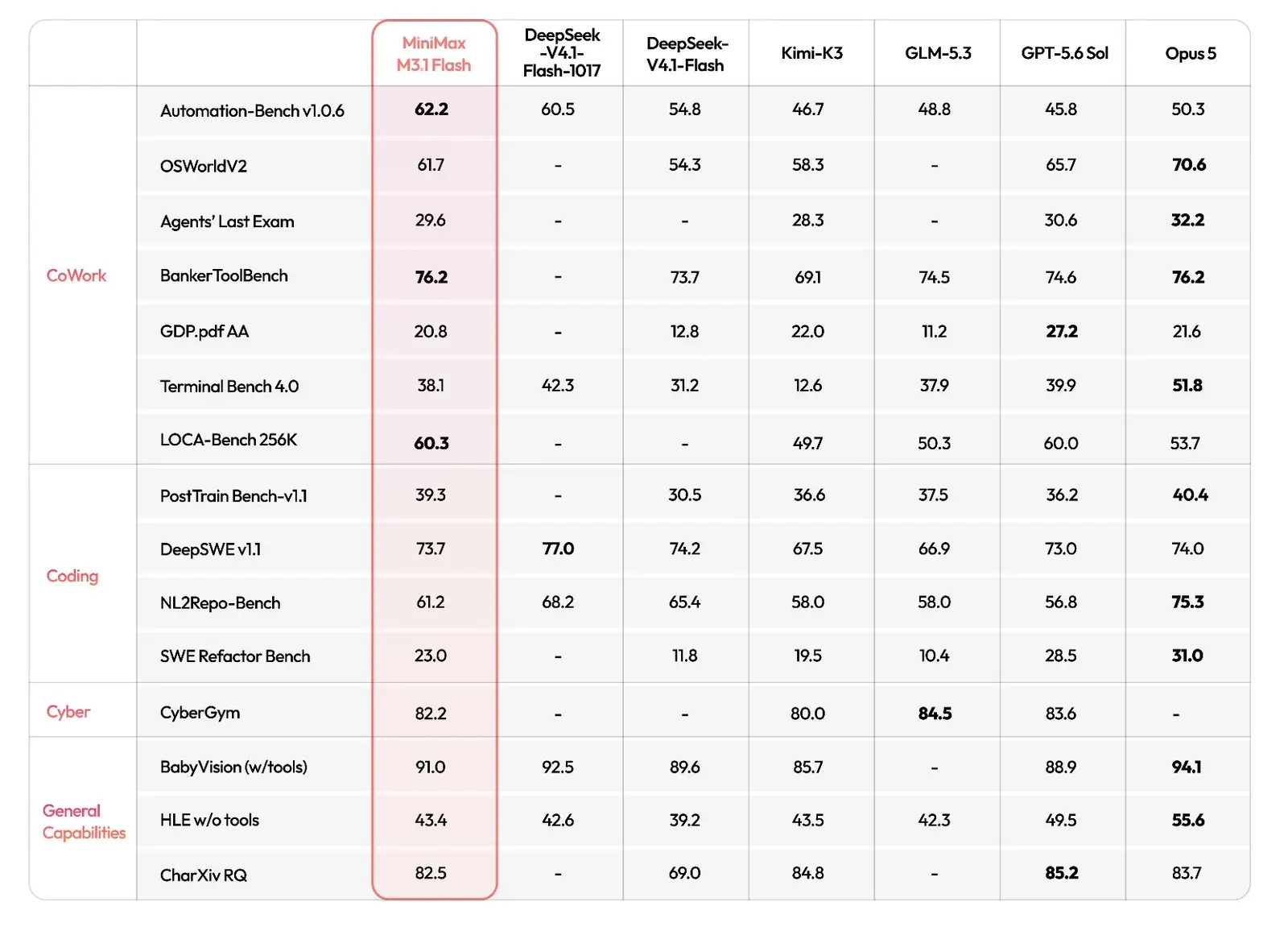
- Coding: 73.7% on DeepSWE v1.1, a benchmark where the model has to understand a codebase, build features, fix issues and check its own work by running tests.
- Computer use: 61.7 on OSWorld V2, which measures operating a computer and carrying out tasks across applications, and 29.6 on Agents’ Last Exam (ALE), which tests real professional work. MiniMax says the model ranks first among Chinese models on both.
- Enterprise automation: 76.2 on BankerToolBench, which covers multi-step planning, keeping documents consistent, financial compliance and chained tool calls. On AutomationBench-AA, MiniMax says only that the model “ranks among the top performers” and gives no score.
- Cybersecurity: 82% on CyberGym, which tests finding and validating vulnerabilities. MiniMax adds that its internal security experts rated the model strong at code auditing, vulnerability patching, penetration testing, malware analysis and reverse engineering.
DeepSWE is the one score here you can check against a direct competitor. In October, DeepSeek’s minor update, V4.1-Flash-1017, scored 77.0 on DeepSWE v1.1. Its previous Flash had scored 74.2, so M3.1 Flash at 73.7% still trails even DeepSeek’s older Flash. The Testing Catalog post rounds MiniMax’s figure up to 74%.
MiniMax’s headline cost-versus-performance claim rests on three benchmarks: Automation-Bench for agentic task execution, DeepSWE for coding and ALE for computer use. On those three, the company says M3.1 Flash performs “on par with top models at a very low task cost.” That makes cost per task the measure MiniMax is selling, ahead of cost per token.
When the weights land
The announcement says the weights “will be released later.” Testing Catalog gives a date: October 23, four days after launch. M3 went the same way. Artificial Analysis wrote at the time that MiniMax planned to release M3’s weights about 10 days after the API launch.
M3.1 Flash comes four and a half months after M3, a longer gap than earlier in the series. The release notes show M2.1 in December 2025, M2.5 in February and M2.7 on March 18, about two months apart. M2.7 is also the precedent to watch for licensing: Artificial Analysis noted that its weights came out under a commercially restricted license.
Up next
Claude Code puts staff bypass requests in Accept edits
Ask Claude Code for bypass mode from an Anthropic employee account and the session starts in Accept edits instead, per RuntimeWire’s read of the public client code. Do you let Claude Code skip permission prompts, or approve its actions yourself?
Related stories
- DeepSeek’s minor Flash update beats Opus 5 on DeepSWE
- Gemini 4 Argon reportedly lands in Antigravity for Pro users
- FLUX 3 Image Klein’s 5.6B count leaves out its encoder
- Meta’s open-weight Muse Spark Open lags Kimi K3 at coding
- Nemotron 3.5 Super VL gives NVIDIA’s 120B agent model eyes
- Krea 3 edits a 2K image in under 8 seconds
Comments
No comments yet. Be the first.
Join the conversation
Sign in to leave a comment. It appears after moderation.