
Google Play now runs vibe-coded apps without a dev account
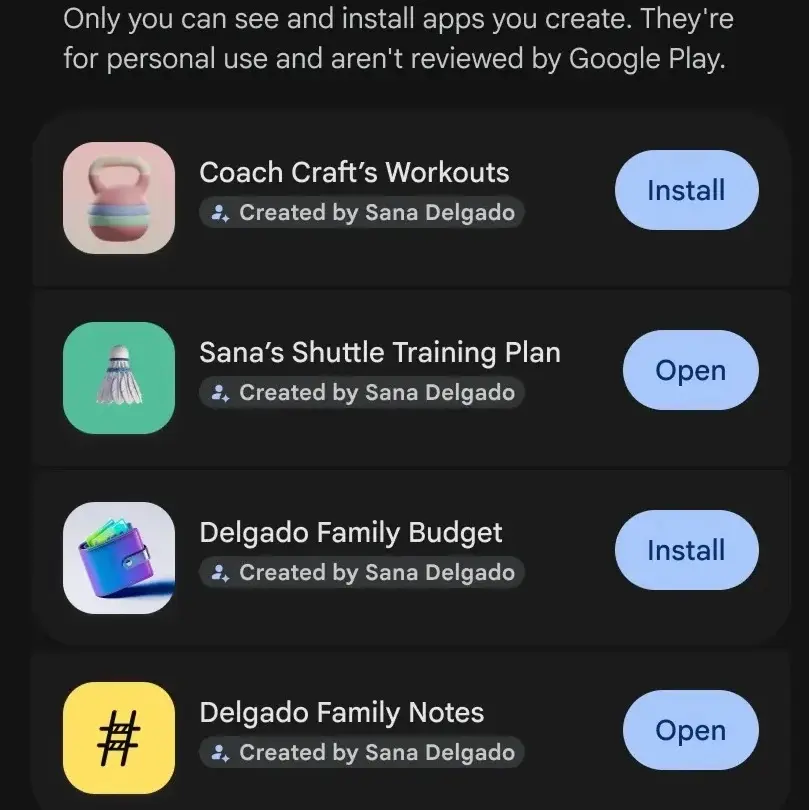
Google's new pitch for its store fits in one line: from "there's an app for that" to "there's an app for me." On October 13, Google said on its blog that you can now launch an Android app you vibe-coded in Google AI Studio on your own phone through Google Play, using only a standard Google account.
At a glance
- The rollout began on October 13 in select markets, of which Google names only the U.S., and it is open to users 18 and over without a developer account.
- Personal apps stay private and separate from the public catalog. Sharing with a close circle of friends and family is promised for the coming months, with no firmer date.
- Review arrives only at the public step: you move up to a professional developer account, and the app then faces the same Trust & Safety reviews and quality standards as any other developer's.
According to Code2native, Google announced native Android app building in AI Studio at I/O in May 2026. New signups for Firebase Studio were disabled on June 22, 2026, and AI Studio was named its successor. Google AI for Developers documentation describes the two ways out of AI Studio before this announcement. You could install over USB through WebUSB in Chrome or Edge, or publish to the Play Console internal testing track for up to 100 testers, which required a Google Play Developer account with a one-time $25 fee.
Personal apps need only a standard Google account and stay out of the public catalog
Google gives its reasoning in the post itself. Many AI Studio apps start out as personal projects, so Play now lets you launch them on your own device. The company says these apps stay private, secure and separate from the public store catalog, and that a standard Google account is all you need. No developer account is required.
The rollout started on October 13 in select markets for users 18 and over, and the U.S. is the only market Google names. According to Firstpost, personal apps don't show up in Play search or public listings and are restricted to their creators. They still have to comply with Google Play policies.
The announcement came from Sam Bright, vice president and general manager of Google Play and the developer ecosystem. Testing Catalog flagged it on Threads and summed it up as building Android apps in AI Studio and publishing them from there. It also floated a name for the result: "Vibe Store".
Friends and family come next, and a public release means a developer account and full review
The private launch is the first of three steps Google describes. In the coming months, you'll be able to share personal apps with a close circle of friends and family. If you later want everyone to have the app, Play helps you move up to a professional developer account.
From that point on, the app gets no special treatment. Google says it goes through the same Trust & Safety reviews and quality standards as every professional developer's app. The shortcut covers your own device and, later, your circle. It does not cover the public store.
The post doesn't spell out what moving up involves in practice. According to Code2native, a real production release needs a signed AAB and store assets. New personal developer accounts must also run a closed test, which as of mid-2026 meant 12 testers over 14 days. The same guide notes that the internal testing track never produced a public listing: it had no store search and no installs from strangers.
What happens between the prompt and your phone?
According to Google AI for Developers documentation, you describe the app in plain language in AI Studio's Android mode, and the Antigravity Agent generates a complete Kotlin and Jetpack Compose project. You preview it in an Android emulator that runs in the cloud and streams to your browser, so you don't need the Android SDK or Android Studio.
The same documentation lists what that emulator can't do. It has no camera, no NFC or Bluetooth, no real GPS (location is simulated) and no Google Play services. Google Codelabs walks beginners through planning in the Playground and building in Build mode, and presents the whole process as one that needs no coding experience.
Play's new role comes at the end of that chain. Think of it as a courier that, for now, delivers only to your own address. Friends and family get added to the address book later, and the public store stays behind a separate gate with its own inspection.
Firstpost cautions that building with AI does not guarantee secure, accurate or bug-free software. The cloud emulator can't test a camera or real GPS, so your phone may be the first place those features actually run. In our view, Google picked the right order: review kicks in exactly when an app leaves your own circle, though the post doesn't say whether a vibe-coded app also faces the closed-test requirement when it goes public.
When the circle gets wider
Google promises friends-and-family sharing in "the coming months", and that is the only timing it gives. According to Firstpost, Google has not detailed the process or the timeline for moving to a public release. Initial access is limited to U.S. users 18 and over, with no wider launch date set. Until then, a vibe-coded app on Play has exactly one user: the person who built it.
Up next
OpenAI data puts EU frontier firms behind global leaders
Codex and ChatGPT Work account for 85% of ChatGPT Enterprise output tokens in Lithuania and 22% in Slovenia, per OpenAI's new EU report. Across the EU sample, it's more than half. Roughly what share of your work AI use goes to agents rather than chat?
Related stories
- Google's Nano Banana 2.1 costs $0.076 per 4K image
- Alt + Space calls up Gemini on Windows
- One-click GitHub import lands in AI Studio Build
- Copilot on Windows will hand some tasks to local models
- Google's Foresight app transcribes Mac voice notes locally
- OpenAI's Decisions API beats its own engine by up to 10x
Comments
No comments yet. Be the first.
Join the conversation
Sign in to leave a comment. It appears after moderation.