
Meta’s Muse models now hit 90% on its own memory eval
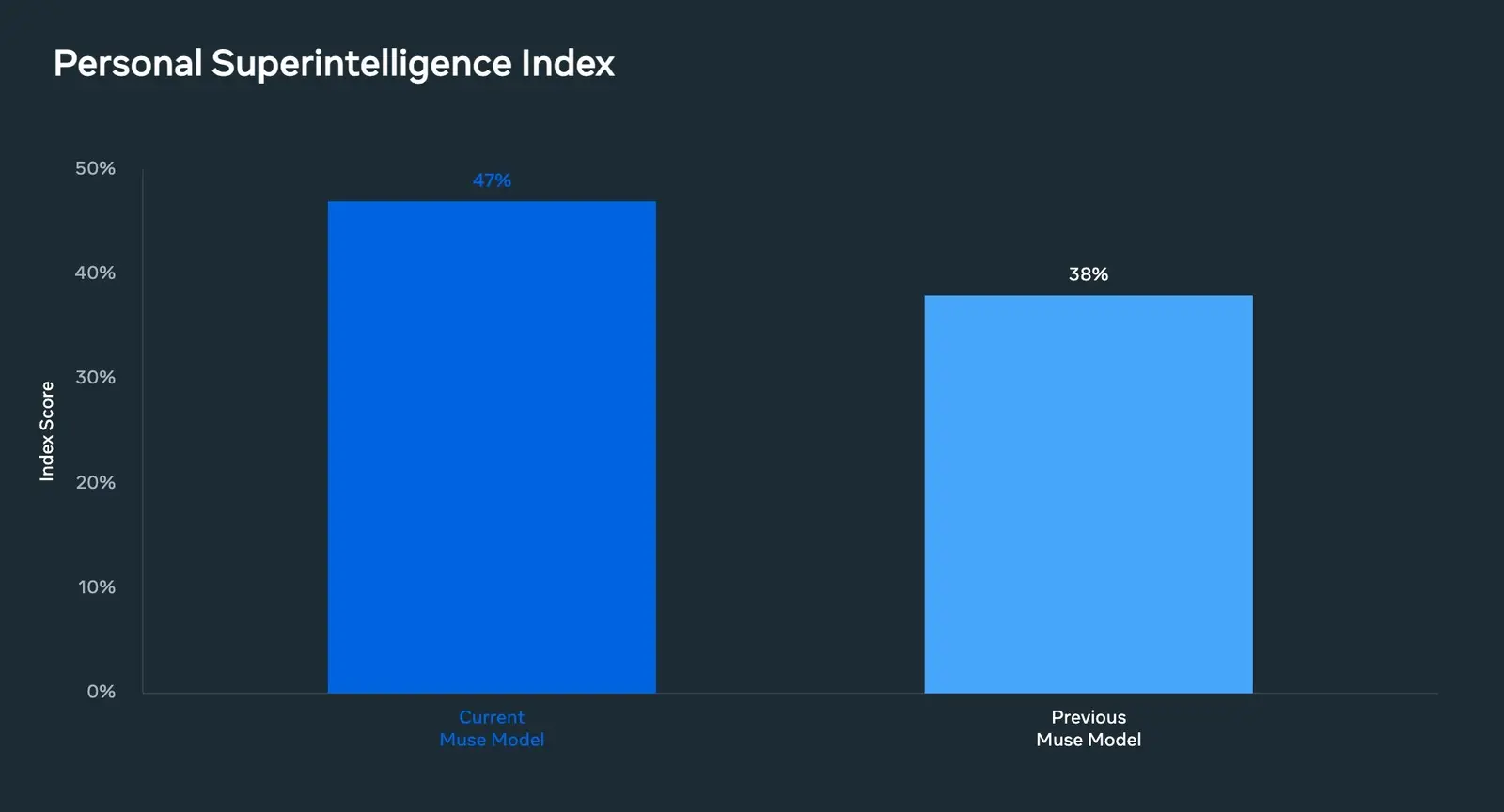
Meta on November 6 moved Muse and Meta AI onto new, unnamed models: specialized versions of its existing models, trained using its frontier Muse Wonder, that carry Wonder’s Active Memory and Active Focus. The company announced the change in a post on Meta’s research blog. If you use either app, you get these models from Friday, and every improvement Meta cites comes from its own index and internal evals.
What the numbers measure
Meta compares the new models only with the previous Muse model. On its Personal Superintelligence Index the current Muse model scores 47%, up from 38%. On the Active Memory eval it correctly uses critical context in 90% of tasks, up from 76%. Those are gains of 9 and 14 percentage points, which explains the “up 9%” and “up 14%” figures going around.
Meta also claims a “2.4x reduction in forgetting critical information.” That multiple appears to come from the same eval: the share of tasks where the model misses critical context falls from 24% to 10%.
Active Focus has just one figure: a 67% improvement in completing everyday tasks where unexpected issues come up. The New Stack points out that Meta didn’t share the baseline, so the number can’t be turned back into a completion rate.
Meta describes what the two features were trained to do. For memory: “to recognize what type of information is temporary versus permanent, to reason across time, and to distinguish between what is still relevant and what has become stale.” For persistence, the models were trained “on a variety of bottlenecks reflective of the real world” so they can “try harder, recover, or find alternatives on your behalf.” In Muse specifically, Meta says the models learned when to push on a goal on their own and when to work live with the user, and how to take corrections in the middle of a task without losing track. In Meta AI, the company promises it will break complex problems into clear steps, ask sharper follow-up questions and keep up when the user changes direction mid-conversation.
Who still gets Wonder
When Meta launched Muse Wonder and the more capable Wonder Full on October 12, it said it would later use Wonder to develop specialized models for everyone using Muse, according to its launch post. Today’s rollout is that plan arriving. Muse itself launched in September on Muse Spark, a model built for speed and low cost.
Wonder itself stays a separate tier. Subscribers still get it for harder tasks, The New Stack reports. Wonder is also available through the Meta Model API and in Muse Code, Meta’s coding agent, while Wonder Full is limited to Muse Code’s two most expensive plans. On the API, Wonder costs $4 per million input tokens and $20 per million output tokens.
The New Stack argues that training lighter models with Wonder is likely a cheaper way to reach a mass audience than serving Wonder to everyone. It also notes that Muse has a free tier, unlike OpenAI’s Dots and Anthropic’s Duet, which are available only on those vendors’ highest pricing tiers. Meta AI, which now also runs on the new models, sits inside WhatsApp, Instagram, Facebook and Messenger.
Up next

Hacktron gets Daybreak Red access to hunt OpenAI’s bugs
“How our systems interact with third-party services” is where OpenAI wants Hacktron to dig, and the team gets wider frontier model access through Daybreak Red to do it. Does your team test third-party integrations with AI agents or by hand?
Related stories
- Meta’s Muse Wonder Full reportedly stays off the API
- Perplexity puts its 4B decision model on the Mac
- Kimi K3.1 Pro rolls out on Kimi AI web and mobile
- Meta’s Muse agent leaves North America for Japan
- Ideogram Vector 1.0 splits each SVG into editable layers
- Meta’s open-weight Muse Spark Open lags Kimi K3 at coding
Comments
No comments yet. Be the first.
Join the conversation
Sign in to leave a comment. It appears after moderation.