
Mistral Large 4 weights are out, API now from $0.70 per 1M
Mistral AI on October 29 put the weights of Mistral Large 4, the 1-trillion-parameter mixture-of-experts model it nicknames Le Chonk, on Hugging Face. If your team wants it on its own hardware, Mistral AI’s model card permits commercial use under a modified MIT license, though a model-as-a-service business needs a separate commercial license from Mistral, and the reference vLLM setup splits the model across 8 GPUs.
These are not simply the preview weights opened up. Mistral announced the release as “a new and improved Le Chonk,” and Testing Catalog reports three extra weeks of reinforcement learning after the preview, aimed partly at more efficient reasoning and lower inference costs. The same report puts API pricing at a starting $0.70 per million input tokens, $0.07 per million cached input tokens and $2.10 per million output tokens. When the API preview opened on October 6, the rates were $1.36 and $4.18. Mistral Large 3, released December 2, 2025 with a 256K context window, sits at $0.50 input and $1.50 output on Mistral’s pricing page, so Large 4 at those starting rates costs 40% more on both sides, with a 1M-token window.
On the Mistral API the model is mistral-large-4. Testing Catalog also lists Mistral Studio, OpenRouter, Hugging Face, Microsoft Foundry and NVIDIA-hosted endpoints.
Serving it yourself
Under the hood: 128 routed experts with 4 active per token plus one shared expert, 49 billion active parameters per token (52 billion counting embeddings and output layers), text and image input, text output, and a 1M-token context. Mistral trained it from scratch on 3,800 NVIDIA Grace Blackwell GPUs in its own European datacenters.
vLLM is the recommended runtime, through the official image vllm/vllm-openai:mistral-large-4. The model card’s command uses --tensor-parallel-size 8, and two flags are required rather than optional: --tool-call-parser mistral and --reasoning-parser mistral, without which tool calls fail and reasoning isn’t separated from the answer. If GPU memory runs short, Mistral points to lowering --max-model-len or --max-num-seqs. A quantized NVFP4 checkpoint targets Blackwell GPUs, works with vLLM and SGLang, and in Mistral’s words gives a smaller memory footprint and faster inference with the same performance.
The checkpoint also carries its own speculative decoding head, called DSpark: three small dense layers in BF16 that draft a block of 3 tokens for the full model to verify, so outputs stay the same as without it. Mistral measured up to 1.9x higher throughput than serving the target model alone and notes that gains depend on hardware and workload. In vLLM it stays off until you add --speculative-config '{"method": "dspark", "num_speculative_tokens": 3}'. The SGLang recipe (image lmsysorg/sglang:mistral-large-4) turns it on with --speculative-algorithm DSPARK and pins --max-running-requests at 64; drop that flag and SGLang falls back to 48.
Transformers and llama.cpp (with GGUFs) are supported too, and Axolotl, Unsloth and TRL cover fine-tuning. Mistral’s own fallback advice is blunt: use the Mistral API “if local serving is subpar.”
Reasoning effort defaults to high
A single set of weights handles both instruct and reasoning work, with three effort levels set per request through reasoning_effort. The default is high, which Mistral recommends for complex prompts and agentic runs; medium is for day-to-day use and low for quick chat replies. Recommended sampling is the same at every level: temperature=1.0, top_p=0.95.
One detail affects token budgets. max_completion_tokens counts reasoning tokens as well as the visible output, and Mistral’s own examples set 4,096 for a low-effort call and 16,384 for a medium-effort JSON request. Strict JSON schemas are enforced natively, function calling is built in, and for agents Mistral advises a system prompt that describes the environment and a tool set kept to the minimum the task needs.
What the scores measure
The model card’s headline coding figure is 48% on the Artificial Analysis Coding Agent Index, effectively tied with GLM-5.3, while using 47% fewer tokens per task on average. On the broader Artificial Analysis Intelligence Index v5 the picture is more modest: a score of 26, which Mistral calls the highest among western open-weight models while acknowledging that the leading Chinese open models score higher.
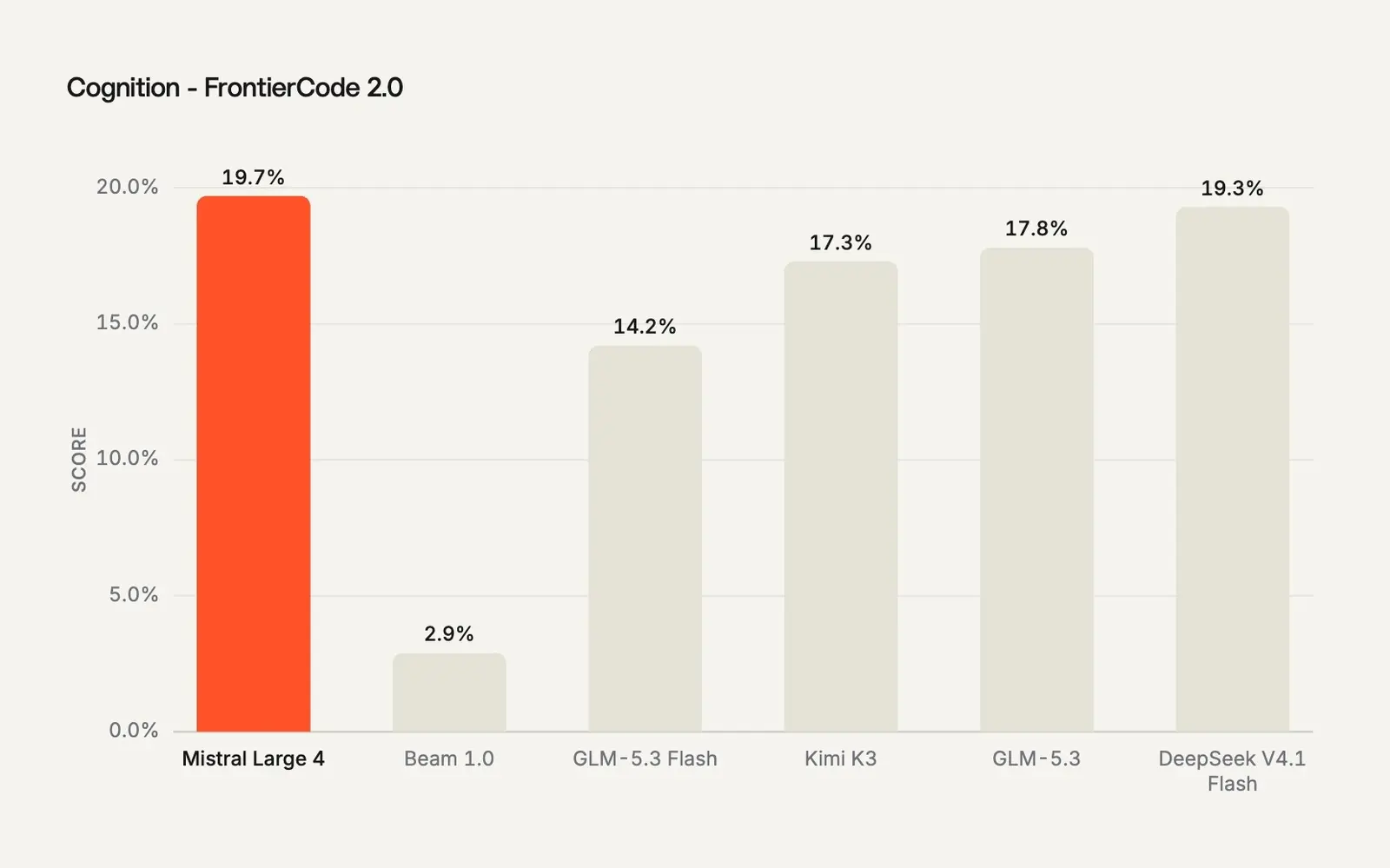
Testing Catalog adds the rest of Mistral’s numbers. The model scored 19.7% on Cognition’s private FrontierCode 2.0, which ranks first among open models, and 41% on Terminal-Bench 4.0, 13 percentage points above the preview while producing 30% fewer output tokens. In Surge Code’s blind comparisons it placed ahead of GLM-5.3, Kimi K3 and DeepSeek V4.1 Flash and behind only Claude Opus 5.5 among the models tested. Outside coding: 73.3% on Finch for finance workflows and 84.5% on BrowseComp, up from 75% at the supervised fine-tuning checkpoint.
Security work and refusals
Cybersecurity is the second focus. Per Testing Catalog, Mistral Large 4 scored 51% on the Artificial Analysis Cyber Index, which covers finding, reproducing, validating and patching vulnerabilities without breaking existing functions. Mistral says its guardrails still allow defensive work while refusing an average of 96.6% of malicious cyber requests, the highest rate it measured among open models, and attack resistance on the B3 Agent Security Benchmark rose to 97.1% from 93.3% in the preview. The company also acknowledged that live-traffic monitoring showed potential uplift for real attacks and said it is modifying the guardrails. A specialized cyber variant is in testing with vetted enterprise partners, limited to systems they own or are authorized to test.
Trying it before deploying
The Le Chonk Gallery on Hugging Face collects demo Spaces from Mistral and the community, and any Space tagged Le_chonk shows up there. For the first week of the release, Mistral’s official demos run on its API with a small shared free budget per visitor, so you can test vision, tool calls and JSON schema output before committing GPUs or an API key.
Up next
DeepSeek, Moonshot reportedly distilled GPT-6 Astra
Anyone trying Kimi K3.1 Pro this week, per The Information, is using a model trained heavily on GPT-6 Astra outputs. DeepSeek’s V4.1-Flash 1017 reportedly drew on it too. Which do you run more often, Kimi K3.1 Pro or DeepSeek V4.1-Flash?
Related stories
- Mistral Large 4 tops open models at just 15% on legal tasks
- Mistral’s 1T-parameter Le Chonk keeps only 49B active
- Mistral CEO says new model tops Chinese ones in some areas
- DeepSeek’s minor Flash update beats Opus 5 on DeepSWE
- Liquid AI’s 2B-active model beats Qwen on LiveClaw
- Xiaomi’s new MiMo models carry an unverified top-6 claim
Comments
No comments yet. Be the first.
Join the conversation
Sign in to leave a comment. It appears after moderation.