
Mistral Studio adds managed agents and one-command deploy
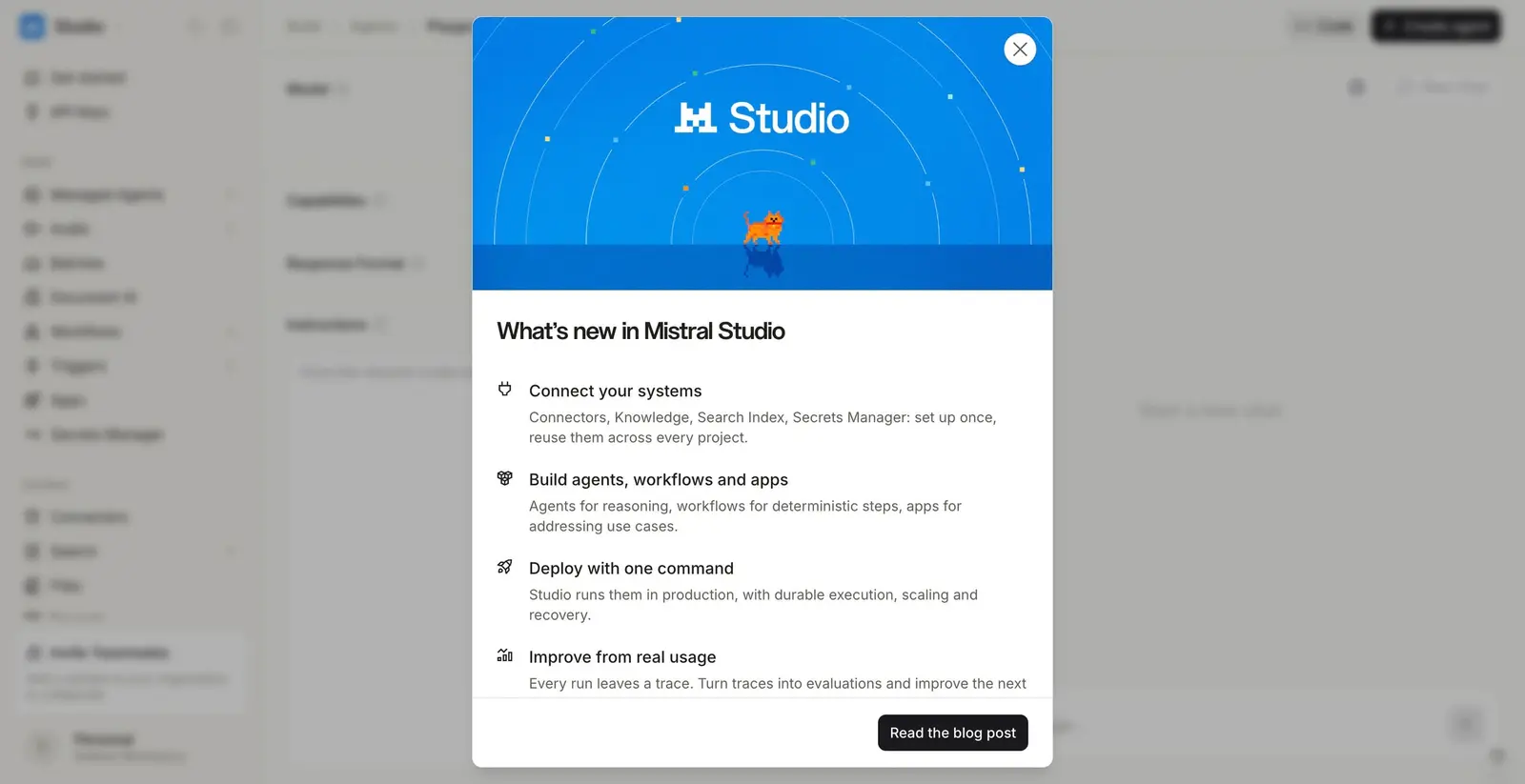
Mistral has added managed agents and hosted apps to Studio, its enterprise AI platform, along with event triggers for workflows, OpenTelemetry traces and evaluations, according to Mistral’s announcement. With a new Mistral MCP server, an agent, workflow or app written in Mistral Vibe or another coding agent goes from a local test to a Studio deployment with one command, and Studio hosts and runs it from there. The hour savings Mistral cites come from its own teams.
From a coding agent to production
Agents, workflows and apps share that deploy path and the infrastructure behind it. In Mistral’s framing, an agent investigates and acts, a workflow coordinates execution and approvals, and an app gives employees a way to use them. All three reach company data and systems through connectors and MCP servers. Testing Catalog lists the shared plumbing as Connectors, Knowledge, Search Index and Secrets Manager, which are set up once and reused across every project. Once something is deployed, Studio handles durable execution, scaling and recovery.
Managed agents take on multi-step tasks. Developers give them skills that capture a team’s procedures, sandboxes for running code, subagents to hand parts of a task to, and hooks that add custom logic at key points of a run. They run on the same runtime that Mistral says supports millions of Mistral Vibe sessions each week. Developers set limits on which tools, data and actions an agent can touch, and decide which actions need human approval first.
Workflows combine fixed rules, agent reasoning and human decisions in a single process, and a run that gets interrupted resumes where it stopped. A team can describe a process in Vibe and have it generate, test and deploy the workflow as code the team can read and edit. This release also adds triggers fired by events in enterprise systems, plus a visual graph of each workflow’s logic.
For apps, Studio provides hosting, authentication and access controls. Apps can be assembled from pre-approved, reusable components, so less new code goes through security review. An app can call agents and workflows, retrieve documents through search indexes, and go live at its own link or inside Mistral Vibe.
Traces, evals and whose hours
OpenTelemetry traces record each step of a run, including model calls, tool use and approvals, so a team can see where a process slows down or fails. Evaluations test a change to a prompt, model or tool against the team’s own datasets before it ships, and Mistral says the traces and evaluations stay with the customer. Testing Catalog sums up the loop as turning traces into evaluations that improve the next run. That matches what Studio’s Observability component promised when the platform launched: turning live production data into structured evaluation datasets.
Both hour figures come from Mistral’s own staff. One is an incident agent that follows the team’s runbook, asks for approval before sensitive actions and posts its findings in Slack. Mistral says it saves engineers “hundreds of hours each month”. The other is a workflow that sorts internal ideas and customer feedback into bugs and feature requests and routes them to the right team, which saves product operations about 35 hours a week. Customer claims run looser. Julien Smadja, VP AI, whose company runs cargo release and logistics transport orders on Studio, says each new process is “production-ready in weeks rather than months.” Mistral says ABANCA, Accenture, Alten, BNP Paribas, Capgemini, CMA CGM and Tata Consultancy Services already use Studio in production.
Where it runs
Customers can deploy both the models and the platform in their own cloud, a VPC or on-premises, use Mistral-hosted deployments, or combine them. BNP Paribas keeps it in-house. “The AI systems we build run some of our most sensitive processes, so we run Mistral Studio on our own infrastructure and keep those systems under our control,” said Su YANG, Head of Artificial Intelligence & IT Innovation at the bank.
Mistral pairs Studio with Le Chonk, its name for Mistral Large 4. The Large 4 weights are on Hugging Face under a modified MIT license. That means a team running both Large 4 and Studio on its own servers can use the weights commercially, though a business that sells the model as a service needs a separate license from Mistral.
Capgemini’s Fernando Alvarez described the pitch in terms of control: Studio “aims to let us decide exactly which systems the agents can access, and brings the observability and evaluation needed to turn a promising PoC into a system they can operate, measure, and rely on.”
Up next
Ramp sees AI token spend grow 1.5% after July’s 42%
Token spend at companies on Ramp grew 42% in July, then just 1.5% across August and September, while token volumes kept climbing. Ramp’s economist blames the price war. Did your team’s AI bill go up or down after the price cuts hit?
Related stories
- Mistral Large 4 weights are out, API now from $0.70 per 1M
- Claude vouches for Team and Enterprise users at plugin login
- OpenAI gives its Open Responses API spec to the AAIF
- Nvidia bundles open models to give agents company context
- DeepSeek prices web search at $0.75 per 1,000 requests
- Claude now picks its own agent team in Managed Agents
Comments
No comments yet. Be the first.
Join the conversation
Sign in to leave a comment. It appears after moderation.