
DeepSeek prices web search at $0.75 per 1,000 requests

DeepSeek now sells direct access to the search engine behind its chatbot. Search and Fetch, two APIs announced on October 17, cost $0.75 per 1,000 successful requests and don’t call any DeepSeek model, so agents built on rival models can use them too, the company said in its API changelog.
DeepSeek says the engine handles hundreds of millions of searches a day and indexes hundreds of billions of web pages in many languages. It also says the engine screens out SEO spam, GEO manipulation and low-quality AI-generated content. GEO, short for generative engine optimisation, means shaping pages so that AI answer engines cite them. Failed calls, empty searches and timeouts aren’t billed. DeepSeek’s Chinese price list puts the same service at 5 yuan per 1,000 requests.
The same changelog entry also moved deepseek-flash to DeepSeek-V4.1-Flash-1017, a minor update at unchanged prices. It scores 77.0 on DeepSWE v1.1, up from 74.2 for the V4.1 Flash released on September 10.
What the two endpoints return
DeepSeek’s Search & Fetch guide puts both endpoints on api.deepseek.com, at POST /v1/tools/search and POST /v1/tools/fetch. A search takes a query of 1 to 128 characters and a result count from 1 to 50, with 10 as the default. The count doesn’t change the price. Optional fields carry the user’s original question (ori_question) to help the engine read the query, an IP address (localization) to localise results, and a flag (need_content) that returns full page text. Queries accept site:, -site:, site:a OR site:b, -term, quoted phrases, -"phrase" to exclude a phrase, lang:, after: and before:.
Each result has a title, a URL, a snippet of 100 to 200 characters, a summary of typically 600 to 800 characters, and two scores. rerank_score runs from 0 to 3 and combines relevance, authority and freshness. A score of 1.5 or higher counts as high quality. authority runs from 0 to 4: 3 or higher marks a highly authoritative source, and -1 means unknown. Fetch takes a URL of up to 8,192 characters and returns the page as Markdown. On top of the account-wide limit, Fetch is also rate-limited per domain.
Until now, DeepSeek’s own agent reached this engine through a model. DeepSeek open-sourced DeepSeek Harness in August with a choice of search providers: Exa, Perplexity or DeepSeek. The New Stack reported that the DeepSeek option ran each search as a separate model request, which added latency and token costs. The Harness source code shows how. The provider sends an Anthropic-format Messages request to api.deepseek.com/anthropic/v1/messages with model deepseek-v4-flash and the web_search_20250305 server tool, capped at five uses. It then discards the model’s prose and keeps only the results. DeepSeek enables thinking by default, so until a fix merged on October 17 that extra turn also ran with thinking on. Server-side search calls made through DeepSeek Harness, Claude Code and Codex stay free until 00:00 Beijing time on November 1, when per-request billing starts.
Where $0.75 sits among rivals
The New Stack compared the price with Ceramic.ai at $0.25 per 1,000 queries and Brave at $5 per 1,000. We rechecked those and other list prices on vendors’ pages on October 19:
- Perplexity’s Fast Search: $1.00 per 1,000 invocations.
- Parallel’s Turbo and Fast tiers: $1 per 1,000 requests with 10 results, plus $1 per 1,000 extra results.
- Exa Search: from $4 per 1,000 requests.
- Tavily: a basic search costs one credit at $0.008 pay-as-you-go, or $8 per 1,000.
- Brave Answers, a separate product: $4 per 1,000 requests plus $5 per million tokens.
Vendors return different numbers of results and different content, so these are list prices and don’t compare like for like. DeepSeek charges the same per request for 1 result or 50.
From Bocha to its own crawler
DEJAN traced the engine through DeepSeek’s papers and job ads. It says the DeepSeek app’s web search ran on Bocha, a Chinese search API provider, in 2025, and that DeepSeek’s 2026 job ads describe a complete search stack: crawler, index, ranking and spam detection. The steps in between:
- January 2025: R1 launches, and the app announcement lists web search as a feature. Profound described the pipeline: the model writes keywords, a smaller model judges URLs from metadata and snippets, the chosen pages are crawled live and cleaned, and the reasoning model answers from them.
- December 2025: per DEJAN, the V3.2 paper trains search agents on real web search APIs and evaluates them with “a standard commercial search API”.
- April 2026: the V4 paper runs search agents in an in-house harness with web search and Python tools. DEJAN says it adds special tokens for writing queries and for judging how authoritative a source a question needs.
- August 2026: DeepSeek open-sources Harness with interchangeable search providers, The New Stack reported.
- September 2026: the V4.1-Flash paper refers to “our crawling system”. DEJAN says DeepSeek found that the crawler favoured text pages and rebuilt it from Common Crawl to cover more images and other media.
- October 16: the public Search and Fetch routes go live and pass the Harness team’s tests.
- October 17: the changelog announces both APIs.
This time the index is sold as its own product, billed per request and reachable without a model call. Before, developers using DeepSeek’s models needed a third-party search service or the search built into DeepSeek’s model API.
Our analysis
What we checked
On October 19 we compared DeepSeek’s live English and Chinese Search & Fetch guides with a Wayback Machine snapshot of the English guide taken at 08:43 UTC on October 17. We also read the DeepSeek Harness code, commits and release notes, and priced the old search route at DeepSeek’s published deepseek-flash rates.
- Rate limits went up after launch. The October 17 snapshot allows 5 requests per second for Search and 5 for Fetch per account. The live guides in both languages now allow 100 for Search and 25 for Fetch, counted per account no matter which API key is used. Running flat out, an account can make 8,640,000 searches a day ($6,480) and 2,160,000 fetches ($1,620).
- DeepSeek’s Harness team recorded one model-call search, run through a gateway on October 16. It used 8,154 input and 828 output tokens. The run’s cache status and thinking mode are unknown. The figures below cover model tokens only.
- The Harness team’s probes on October 16 found summaries of 1,000 to 2,300 characters, longer than the guide’s typical 600 to 800. Changing
ori_questionhad no visible effect on results, and an unresolvable Fetch host returned HTTP 500 instead of the documented 404. These findings come from their documentation; we didn’t measure them ourselves.
| Route | Pricing condition | Cost per 1,000 searches |
|---|---|---|
| Model call | Peak, cache miss | $3.44 |
| Model call | Off-peak, cache miss | $1.72 |
| Model call | Peak, cache hit | $1.04 |
| Model call | Off-peak, cache hit | $0.52 |
| Search API | Per successful request | $0.75 |
The limits rose within two days of launch. On that one measurement, the per-request price is lower than the token cost of the old route in every case except off-peak with a cache hit.
Switching Harness over
Harness 0.2.1-rc.2, released on October 17, supports Search and Fetch only behind a switch in Web Search settings labelled “Use the new Web Search API”. Model-call search, which the code calls Messages search, remains the default. DeepSeek’s design note says changing the default to the Search API is “a separate change after the launch is announced.” Until that ships, a Harness user who wants the per-request route has to open Web Search settings and turn the switch on.
Up next
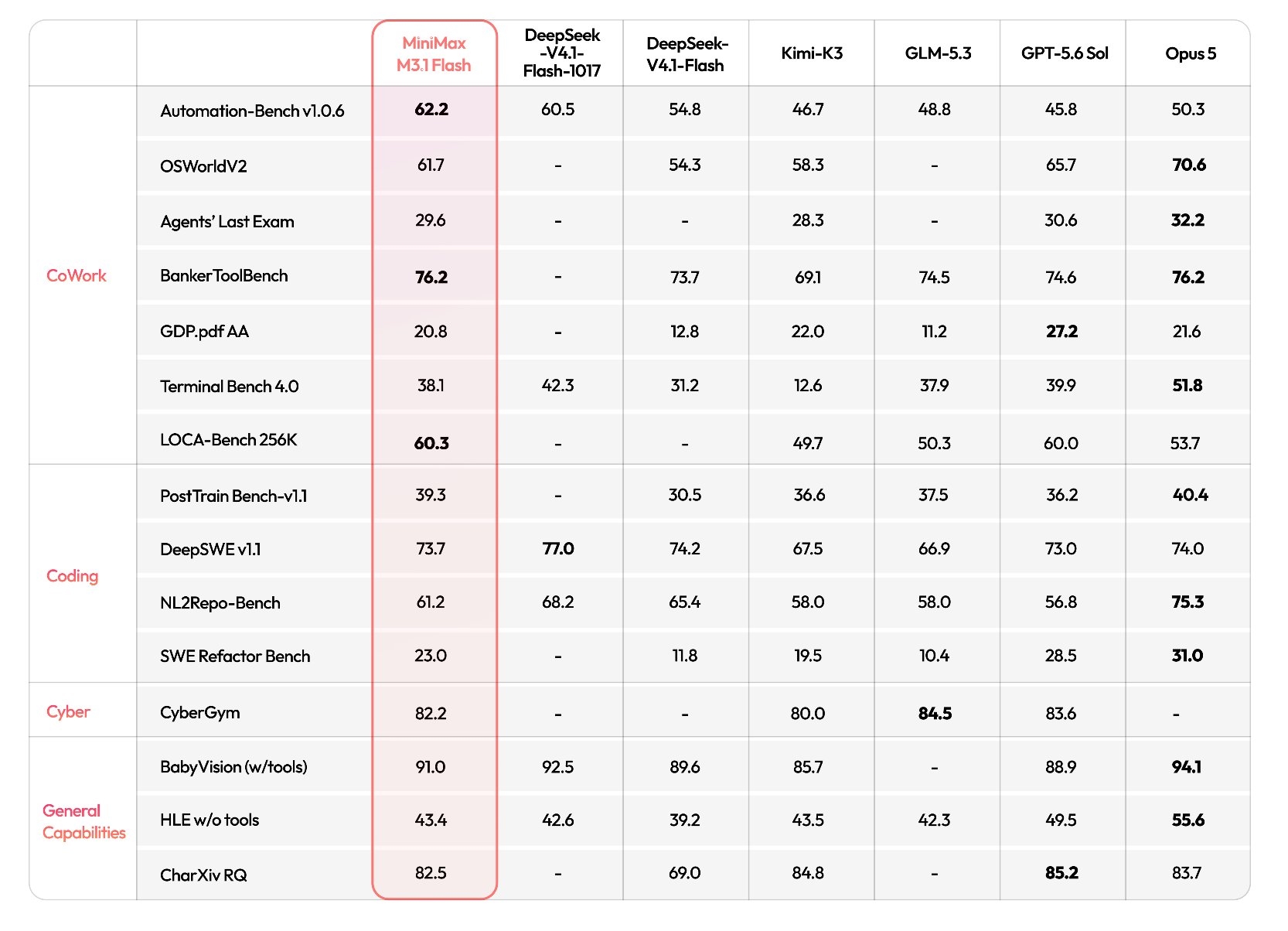
MiniMax M3.1 Flash hits 73.7% on DeepSWE at $0.15 input
Before it had a name, MiniMax M3.1 Flash ran anonymously as “Space Bunny” and processed more than 200 trillion tokens. The official version charges $0.15 per million input tokens. Would you run real code through an unnamed model like Space Bunny, yes or no?
Related stories
- DeepSeek’s minor Flash update beats Opus 5 on DeepSWE
- Claude now picks its own agent team in Managed Agents
- Claude agents get an OpenTelemetry trail for every step
- A day of OpenAI’s dot cost 307,000 tokens, all unprompted
- Microsoft-Decision-1 bills input only, at $0.042 per million
- Claude Max subscribers get up to $200 a month for the API
Comments
No comments yet. Be the first.
Join the conversation
Sign in to leave a comment. It appears after moderation.