
Muse Spark Open fits on two Mac Studios with a terabyte
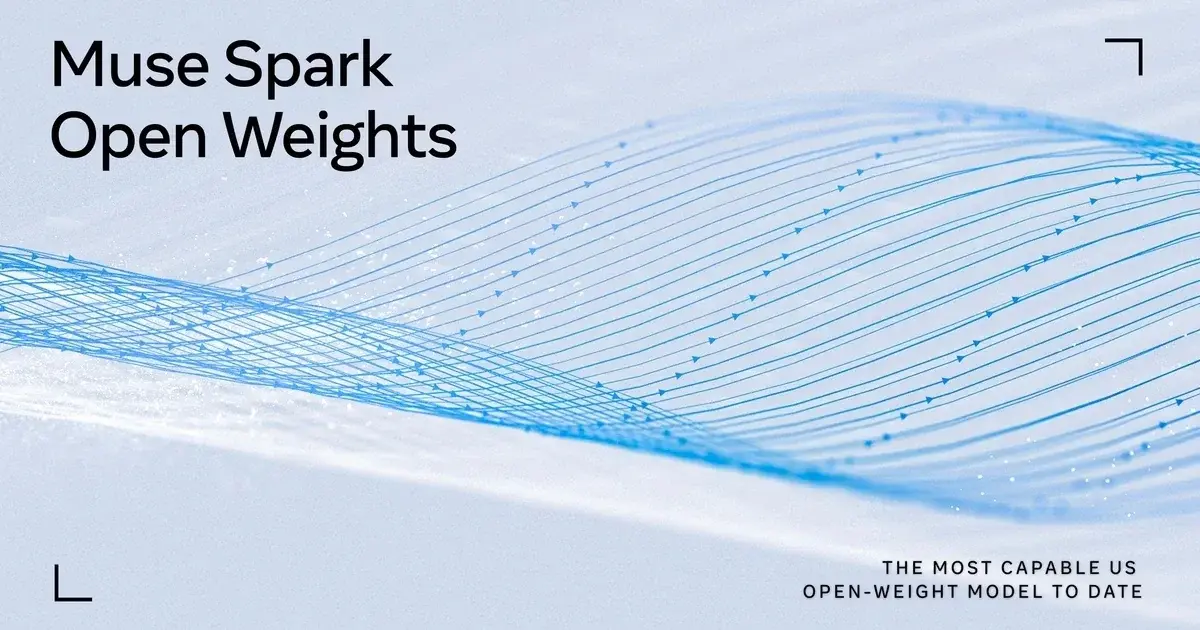
Muse Spark Open has 816 billion parameters, and only 42 billion of them are active for any given token. In its announcement, Meta says a model of this size runs on a desk, using two Apple M5 Ultra Mac Studios.
Meta released the weights on October 15 and calls the model “the most capable US open-weight model to date.” It is natively multimodal, has a 1M-token context window and is aimed at coding, agentic work, long-horizon tasks and multi-step reasoning. Mark Zuckerberg posted the same day that it “runs great on new Mac Studios thanks to work with @johnternus and Apple.” Meta for Developers said the release gives developers “more control over how they run, customize and deploy the model.”
A terabyte on the desk
The Mac setup depends on Apple’s unified memory. On the M5 Ultra, the integrated GPU can use up to 512 GB per Mac Studio, so two machines can hold the entire model. In Meta’s words, the pair “behave like one supercomputer with a terabyte of unified memory.” Meta says capacity is only half of it: the chip’s 1.2 TB/s of memory bandwidth is fast enough to read the small slice of weights each token needs. Because the model is sparse, each token touches 42B parameters’ worth of weights, not all 816B.
Meta doesn’t say what precision the Mac weights use, so how much memory is left for long-context work is unclear.
Meta does describe what it ran. It used Muse Code, powered by Muse Spark Open, entirely on-device. On Ice Cubes, an open-source Mastodon client, the model shipped real iOS changes: bug fixes, new features and a full build. It also drove DaVinci Resolve end to end, reviewing footage frame by frame to pick the strongest moments and crop them vertically. Meta gave no tokens-per-second or time-to-completion figures for any of these runs. If you want to try it yourself, Meta points to MLX, which pulls the weights directly from Hugging Face, and to an MLX adapter for running the model on Mac Studio.
How the Muse thread ran
Meta’s first Muse model was not open. Here is how the thread got from there to today’s release:
- April 8, 2026: Muse Spark, the first model from Meta Superintelligence Labs, launches. According to AI/TLDR, it was proprietary and Meta’s first frontier model not released as open weights, though Meta said it hoped to open-source future versions. At launch it scored 52 on the Artificial Analysis Intelligence Index, against 18 for Llama 4 Maverick.
- July 2026: Muse Spark 1.1 replaces it. Meta’s developer page lists it in public preview for US developers, with computer use, multi-agent workflows and coding as the emphasized capabilities.
- August 10: we reported that Meta put Muse Glimmer, a 30-billion-parameter model for always-on local agents, on Hugging Face under Apache 2.0.
- September 22: Apple’s John Ternus posts that “Mac mini and Mac Studio provide a huge leap in performance, especially for AI.”
- October 15: Muse Spark Open weights ship, tuned for the M5 Ultra Mac Studio.
AI/TLDR also reported that at the April launch, Meta published neither Muse Spark’s parameter counts nor whether it was dense or mixture-of-experts. For Spark Open, Meta gives both: 816B total, 42B active.
Terms and safety
Glimmer shipped under Apache 2.0. Spark Open ships under the Muse Model License, which Meta describes as having “limited commercial terms” that let many developers use the model for free. Testing Catalog notes that the model card sets out those commercial conditions. Meta says the open version got additional safety post-training because open weights carry their own risks. Meta evaluated it under its Meta Superintelligence Scaling Framework and says it met the thresholds the framework requires for release. Detailed results are in the model card, and Meta says a full evaluation report is coming “soon”.
Beyond the Mac
Hosted APIs come from Baseten, Fireworks AI, Groq, Modal, Nebius, OpenRouter and Together AI. Weights can be downloaded from Amazon SageMaker AI, Google Cloud Model Garden, Hugging Face and Microsoft Foundry Models. Supported engines are SGLang, vLLM, TensorRT-LLM, Hugging Face Transformers, Apple MLX, llama.cpp and Unsloth, with optimizations for AMD, Apple, Intel and NVIDIA silicon. For fine-tuning, Meta points to PyTorch’s TorchTitan.
The release also bundles custom, auto-tunable Helion GPU kernels in SGLang. On NVIDIA and AMD GPUs they deliver speedups of 1.03–3.95× at the kernel level. End to end on AMD MI350, the speedup is 3%.
Up next
Anthropic offers Blackstone a double-digit yield on chips
A “double-digit yield” is what Anthropic is offering Blackstone in its latest chip financing, per the Financial Times. The headline names no exact rate or deal size. Would you lend to an AI lab at a double-digit yield, or pass?
Related stories
- Meta’s open-weight Muse Spark Open lags Kimi K3 at coding
- Surface Laptop Ultra slows down on local AI once unplugged
- Perplexity runs its agent locally on Windows RTX cards
- Nvidia pledges an open Hugging Face
- PAIR routes subagent work to idle Macs and PCs
- Meta releases Muse Glimmer weights for local agents
Comments
No comments yet. Be the first.
Join the conversation
Sign in to leave a comment. It appears after moderation.