
Claude Code Review exits preview and runs about 3x faster
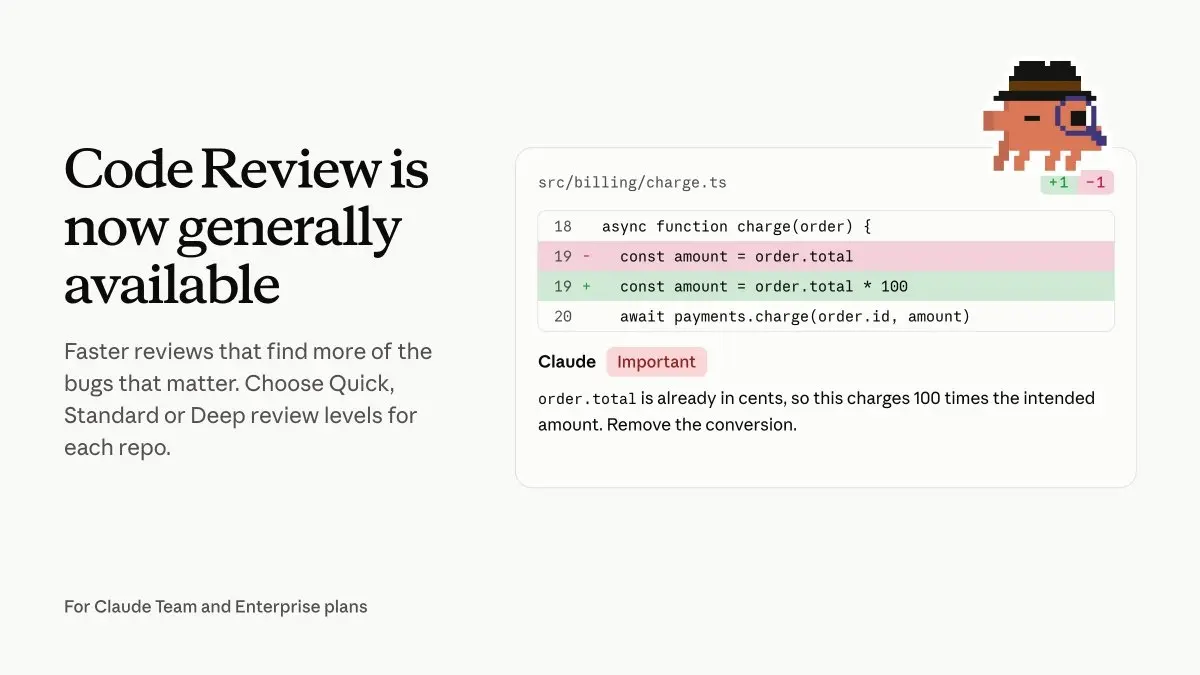
For Code Review's general availability, Anthropic gives an exact speed figure: most reviews now finish in 6–10 minutes, down from about 20 during the research preview. Its other headline claim, that the reviewer catches more of the bugs that matter, comes without any figure at all.
That gap runs through the whole announcement from Anthropic, which is short on numbers apart from timing and a credit offer.
Code Review is out of research preview and generally available to Claude Team and Enterprise organizations, with most reviews about 3x faster and a Quick, Standard or Deep review level that admins set for each repository.
Code Review is Anthropic's managed reviewer for GitHub pull requests. When it entered preview, both Anthropic's preview announcement and The New Stack described it as a more thorough, and more expensive, option than the Claude Code GitHub Action. The GitHub Action is still open source and still available.
Before → after
- Status: a research preview for Team and Enterprise → generally available on the same two plans.
- Review time: about 20 minutes on average in the preview → 6–10 minutes for most reviews, which Anthropic calls about 3x faster.
- Review depth: according to Anthropic's preview announcement, the system scaled itself, sending more agents to large or complex changes and giving trivial ones a lightweight pass → admins now choose Quick, Standard or Deep for each repository. Anthropic says every level produces high-quality reviews.
- Findings: in the preview, Anthropic's announcement described one overview comment plus in-line comments ranked by severity → each finding is now meant to state the problem, what triggers it and the fix in a few sentences.
- Pricing: the preview announcement said reviews were billed on token usage and "generally average $15–25," scaling with PR size and complexity → the GA post gives no price. Instead, eligible Enterprise organizations can claim at least $10,000 in Code Review credits by January 15, 2027, and those credits expire 30 days after they are claimed.
The GA post doesn't say whether the preview's admin cost controls are unchanged. According to Anthropic's preview announcement, those controls were monthly organization caps, repository-level enablement and an analytics dashboard.
Anthropic says preview users asked for quieter, faster reviews
Anthropic's explanation for the GA changes has two parts. Coding agents keep raising the pace at which teams write code, and the review bottleneck hasn't eased. Preview teams told Anthropic that Code Review was catching real issues before a human looked at the PR, but they wanted reviews that were quieter, sized to each change and faster. Anthropic also runs Code Review on its own pull requests and says that shows where reviews slow its engineers down.
The preview launch put more numbers behind the same argument. According to Anthropic's preview announcement, code output per Anthropic engineer had grown 200% in a year, and customers said many PRs got skims instead of deep reads. Cat Wu, head of product for Claude Code, told The New Stack that one engineer with one prompt can now produce a plausible-looking PR, and the reviewer is left to verify every edge case. She also said that people are very sensitive to false positives, which is why the tool targets logic errors and leaves style alone.
The pipeline itself has four stages, as Unite.AI describes it from the documentation. Parallel agents read the diff and the code around it, a verification step filters out false positives, findings are deduplicated and ranked by severity, and the results are posted to the PR. Everything runs on Anthropic's infrastructure. Think of a few colleagues reading the same diff separately, with a final reader who throws out anything nobody can back up.
Admins take three steps to turn it on, and developers take none
An admin enables Code Review in Claude Code settings, installs the GitHub App and selects the repositories to review. After that, reviews run automatically on new PRs, and developers don't configure anything.
The documentation adds more control than the announcement mentions, according to Unite.AI. Repositories can shape what gets flagged with REVIEW.md and CLAUDE.md files. REVIEW.md is read from the base or default branch, never from the PR's own changes, so a pull request can't rewrite its own review rules. Reviews can run once when a PR opens, after every push, or on request when anyone with write access comments @claude review.
The same source lists several limits. A review never approves or blocks a PR, and its check run never ends in failure. The reviewer is read-only and works from the diff and the code around it, so it never builds or runs anything. Drafts and forks are skipped by automatic reviews. Repositories must be hosted on GitHub, and the feature isn't available with Zero Data Retention or the HIPAA configuration.
What we don't know
The preview gave quality numbers that the GA post doesn't update. According to Anthropic's preview announcement, the share of PRs getting substantive review comments at Anthropic went from 16% before Code Review to 54% after. On PRs with more than 1,000 changed lines, 84% got findings, averaging 7.5 issues. On PRs under 50 lines, 31% got findings, averaging 0.5 issues. Fewer than 1% of findings were marked incorrect. The same announcement cited a one-line production change that would have broken authentication and was flagged as critical before merge. It also cited TrueNAS, where an early-access review found an existing type-mismatch bug that was silently wiping the encryption key cache on every sync.
None of those figures has a GA version. In our view, the 6–10 minute figure is the only GA claim you can plan around, because Anthropic has already published a before-and-after baseline for quality and chose not to report against it. Nor does the post say whether the Quick level gives up some of that catch rate, or how the three levels differ in cost.
The post doesn't explain the speedup either. On September 29 we reported that CodeRabbit's average review time on 44 pull requests fell from 13:31 to 6:33 after it moved from Sonnet 5 to Sonnet 5.5 in its own pipeline. The GA post doesn't say which model Code Review uses or whether a model change contributed to its gain.
On pricing, if the preview's $15–25 average still holds, $10,000 in credits would pay for several hundred reviews. That's our estimate, and Anthropic hasn't confirmed GA rates. The credits only last 30 days once claimed, so most of them will be spent during a pilot.
Before anyone claims anything, check three things in your setup. Your code needs to be on GitHub. Your organization can't be running Zero Data Retention or the HIPAA configuration. And you need a list of repositories you're ready to enable at once, because the 30-day expiry starts when you claim the credits. The credit terms set January 15, 2027 as the last day to claim.
Up next

FTC's demands to Anthropic run over 50 pages each
Per an Axios source, the FTC's civil demands to Anthropic and OpenAI run more than 50 pages each, and they ask for marketing materials alongside safety incident files. How often do you double-check an AI lab's safety claims yourself?
Related stories
- Sonnet 5.5 cut CodeRabbit's review bill by about 60%
- Claude Code 2.1.285 lets admins lock down API providers
- Claude Code 2.1.281 adds Bedrock guardrails to its gateway
- Claude Code 2.1.301 stops waiting out distant usage limits
- Claude Code desktop gives each parallel task its own session
- Claude Code 2.1.300 splits cache writes by lifetime in OTel
Comments
No comments yet. Be the first.
Join the conversation
Sign in to leave a comment. It appears after moderation.