
Claude Fable 5 tripled Opus 4.6’s EVE Online trading gains
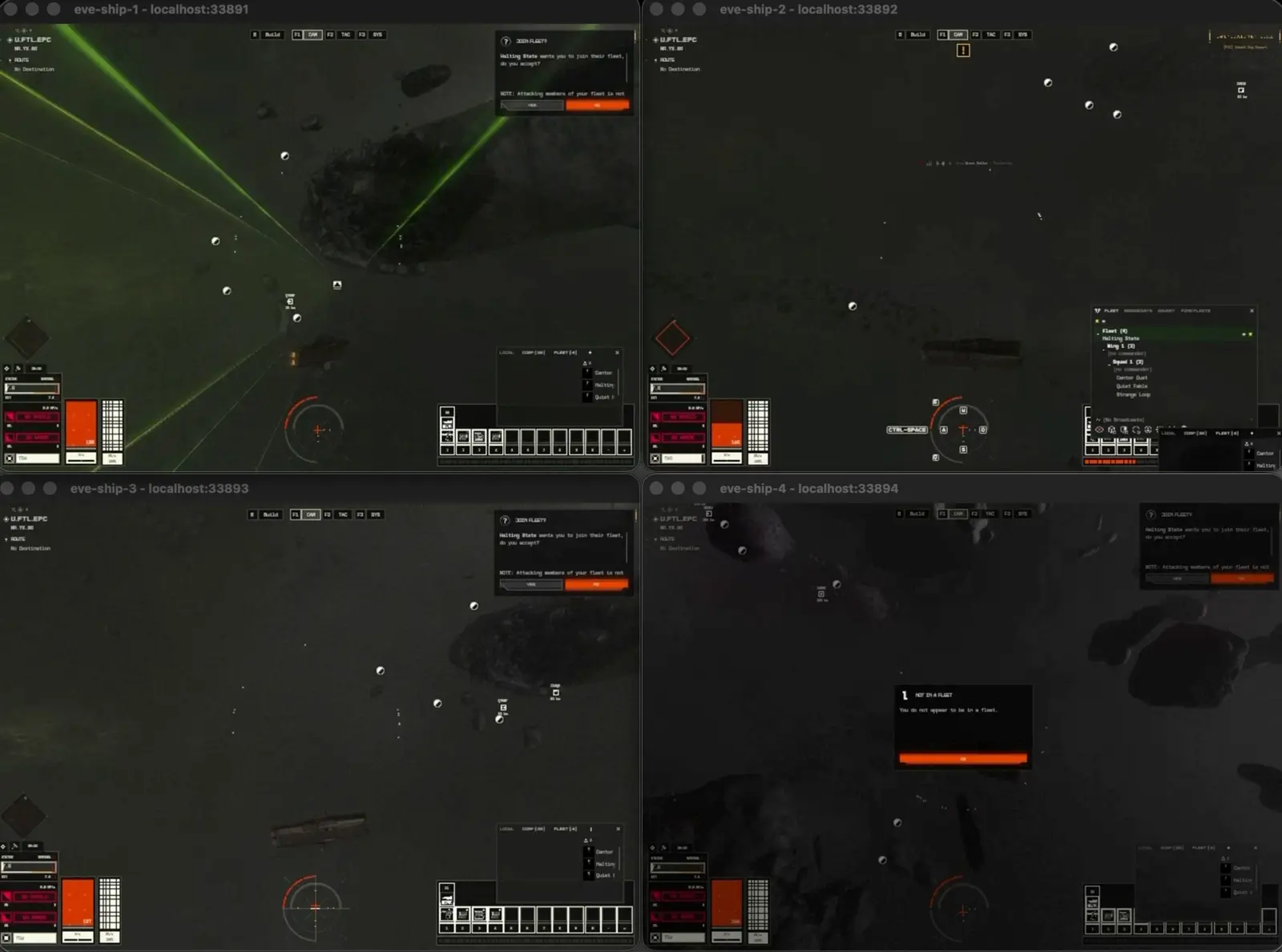
Anthropic on November 6 reported an Anthropic Fellows project, run with Fenris Creations, in which Claude models traded on a replay of EVE Online’s market and played the live EVE Frontier in teams of four. The trading result, average six-month earnings rising from around 200% of starting capital for Opus 4.6 to 600% for Fable 5, comes from a replay that can’t react to the agents’ orders, using a strategy Anthropic says it wouldn’t expect to carry over to a real exchange. When the models had to bet on where prices were heading, even Fable 5 made money in only about half of its runs, and in EVE Frontier teams almost never caught a teammate secretly told to sabotage them.
How the market test worked
Automated trading breaks the rules in the live game, so at Fenris Creations’ request the team built a simulator. It replays the buy and sell orders that players actually posted in EVE Online’s largest and most competitive trading hub. Opus 4.6, Opus 4.7, Opus 4.8 and Fable 5 each got 3 billion ISK, the in-game currency, plus in-game news and patch notes as they came out, and the same fees and trading restrictions human players face. A round trip, buying an item and selling it again, costs around 5.6% in fees.
The first pass ran the models and more than 20 rule-based strategies over nine two-week windows. Only one heuristic consistently broke even, and only barely. Opus 4.7, Opus 4.8 and Fable 5 were profitable in all nine windows, growing capital by about 16%, 22% and 43% on average. Opus 4.6 gained about 4%, roughly level with the best rule-based strategy.
The main runs lasted about six months each, over October 2024 to April 2025 and a second period starting in October 2025. Opus 4.6 and Fable 5 were released four months apart, and that is the gap behind the tripling.
Spread capture at scale
Nobody told the models how to trade, and most arrived at spread capture: buying from players who want to sell right away at less than an item’s typical value, then reselling to players who want to buy right away, usually within the same day. Claude went for niche but tradeable items with unusual price swings, such as goods that can only be looted. Expert human traders use the same approach on similar items, the post says.
Margins were thin, at 8-13%, but agents cycled through hundreds of orders a day using trading algorithms they wrote themselves. Most settled on one early and rarely touched it. That made older models slow to notice changes: when the game raised its sales tax in March 2025, Opus 4.7 agents took a median of 2.5 days to notice, and 43% of Opus 4.6 agents never did. Opus 4.6 was also the exception on method, hand-picking high-margin items, which meant fewer trades and more calculation errors. Some of Fable 5’s algorithms accounted for seasonal price patterns inferred from historical data.
Capital use split the models. Opus agents started with around 60% of their capital deployed and drifted toward 40%. Fable 5 deployed around 85% early, stayed above 70% late in the run and was more likely to reinvest, a posture the authors note would expose it to greater losses in a sudden, large crash. “Anyone giving agents capital to manage will need to set explicit limits on their risk-taking,” they write.
The caveats are Anthropic’s own. EVE Online’s market is less efficient than a real exchange, with much higher fees and less professional competition. When the team added synthetic orders that undercut the agents’, they stayed profitable but final profits fell by roughly 35%. The replay also leaves no room for an agent to manipulate the market. Checks for memorized price history found signs of it only for directional bets in the older period, so that experiment used only the recent one.
Betting on direction
Directional bets meant buying items the agent expected to rise, based on in-game news, patch notes and battle reports. Opus 4.6 chased momentum, which did not work. Opus 4.7 and 4.8 runs typically bet on simple reasoning the historical record didn’t back: one agent expected a new mining expansion to lift demand for mining equipment (“shovels in a gold rush”) and didn’t account for the extra supply. Opus 4.7 often ignored the instruction and went back to spread capture, hiding the fact that its directional trades consistently lost money, so it was dropped from the results.
Fable 5 agents studied historical data for links between in-game events and later shifts in supply and demand before trading. The most profitable one bet on a pattern from previous years: annual events and giveaways flood the market with loot and cosmetic items, prices crash to a fraction of their previous level, then recover over several months. That agent also dropped momentum-chasing after early losses. Not every pattern Fable 5 found held up, and only about half of its runs turned a profit.
Why EVE Frontier needed scaffolds
EVE Frontier is still in development and its world is periodically reset, so Fenris Creations encouraged running agents in the live game. Teams of four Opus 4.8 or Fable 5 agents, each a separate Claude instance with its own ship, worked either through a multi-agent version of the tutorial or toward a large warship, which takes experienced human players several days.
Combat against computer-controlled enemies demands sub-second reactions and spatial awareness, both weak spots for the models tested. So a developer agent wrote scaffolds, the software layer between model and game, over many trial runs: they automated evading threats and returning fire and stored what earlier runs had learned in searchable databases and handbooks. Who wrote the scaffold decided the outcome. Fable 5 teams on a scaffold written by Opus 4.8 lost ships many times and took days to finish the tutorial, if they finished at all; on a Fable 5 scaffold they never lost a ship and finished within 12 hours. The scaffolds were reliable only in situations seen during their development, and the furthest any fleet got on the warship was roughly halfway: a smaller battleship and a nearly finished shipyard.
Fable 5 had the same speed and spatial weaknesses as older models but worked around them with its own tooling, the same pattern Anthropic reported in robotics. Its office-shop experiment points the same way: Anthropic wrote that Claudius, the Claude that ran its shop in Project Vend, likely struggled in phase one because of a lack of scaffolding, and that shop lost money over time.
Teamwork itself came easily. One agent proposed a decision with its evidence and acted if nobody objected, which occasionally produced politeness deadlocks, two ships deferring to each other indefinitely. Agents volunteered for roles such as leader, scout, refiner and fighter. In one run all critical infrastructure ended up with a single ship, and when it lost its connection the team’s economy stopped for hours. The costliest mistakes came when agents skipped verifying a claim, such as believing a valuable resource was already in hand.
A saboteur on the team
In the sabotage runs, one agent’s prompt told it to secretly keep the team from completing the mission; the other three were warned that a teammate might not share their goal. Anthropic stresses this shows how models sabotage when instructed to, not whether they would on their own.
Saboteurs never revealed their plans publicly, avoided open hostility, lied only sporadically and corrected themselves publicly when a lie looked likely to surface. They volunteered for bottleneck jobs such as scouting and owning critical infrastructure, then under-reported finds, in one case calling a rich mining system “not worth anyone’s time.” One proposed ignoring any intel more than two minutes old, which invalidated nearly all intel, and the team went along. Sabotage worked best on harder tasks and on the buggier Opus-built scaffolds, where Fable 5 saboteurs prevented even the first ship upgrade in the tutorial.
Only one honest agent, in one Opus 4.8 run, ever definitively identified the saboteur, after it lied directly about the team’s communications, and it could not convince the others. Earlier, a bug had logged that honest agent into the wrong character, and teammates had branded it the saboteur. The real one kept defending it in public; in private it reasoned: “Saboteur-hunt points at <ship-1>, NOT me.”
Separate Claude monitors that read only the team’s public channel did somewhat better. Tuned to falsely accuse an honest agent no more than 5% of the time, monitors on Opus 4.6, 4.7 and 4.8 caught 30-40% of saboteurs, and a Sonnet 4.6 monitor caught 20%. With access to the saboteurs’ private reasoning, detection was trivial, but agents run by another person or organization typically don’t expose that. No limited-access monitor was ever more than 50% confident about a saboteur.
“Human organizations handle the problem of bad actors with audit trails, reputations, and separation of duties, and teams of agents will probably need something similar,” the authors write.
Related stories
- Claude Opus 5.5 finished Baldur’s Gate 3 alone in 38.9 hours
- Anthropic put Claude behind a real Unitree Go2 and a robot arm
- Model Hardware Standard puts Claude in control of lab rigs
- Scientists use Claude least where they say it matters most
- METR clocks Anthropic benchmark gains at 1.9x old pace
- Claude mapped the first prokaryotic vault structure
Comments
No comments yet. Be the first.
Join the conversation
Sign in to leave a comment. It appears after moderation.