
anthropic
New Claude prompt refuses lyrics and Sonic banners
Promtime
 anthropic
Anthropic published the system prompts for its consumer Claude applications on 2 September, and the Fable 5.1 text adds a section instructing the model not to reproduce song lyrics, poems or passages from books and articles, in whole or in part. The documentation covers Claude.ai and the mobile apps but not Claude Code or Claude Cowork, and the change was spotted by Simon Willison.
At a glance
- The ban covers last lines, a chorus, a melody written note by note and lines pasted in one at a time; works first published before 1929 remain allowed, and Claude declines when it is unsure.
- The same restrictions extend to visual output, including SVG, canvas, CSS, HTML mockups and ASCII art, with no known character drawn at all: changing pose, colors or style does not make it original.
- Anthropic also tuned the answering style, telling Claude to keep responses brief, cap caveats and avoid the words genuinely, honestly and straightforward, which the prompt describes as coming off as disingenuous.
The lyrics clause reads as a product-level response to legal exposure rather than a routine tightening, and it lands while Anthropic faces publisher litigation over lyrics data. The visual section covers newer ground, since Anthropic has no dedicated text-to-image model and the pressure likely arrives through code-generated graphics instead. Both changes also show how much of Claude's behavior is set in text that can shift between revisions.
The lyrics clause landed days after Sony Music Publishing and Warner Chappell sued Anthropic
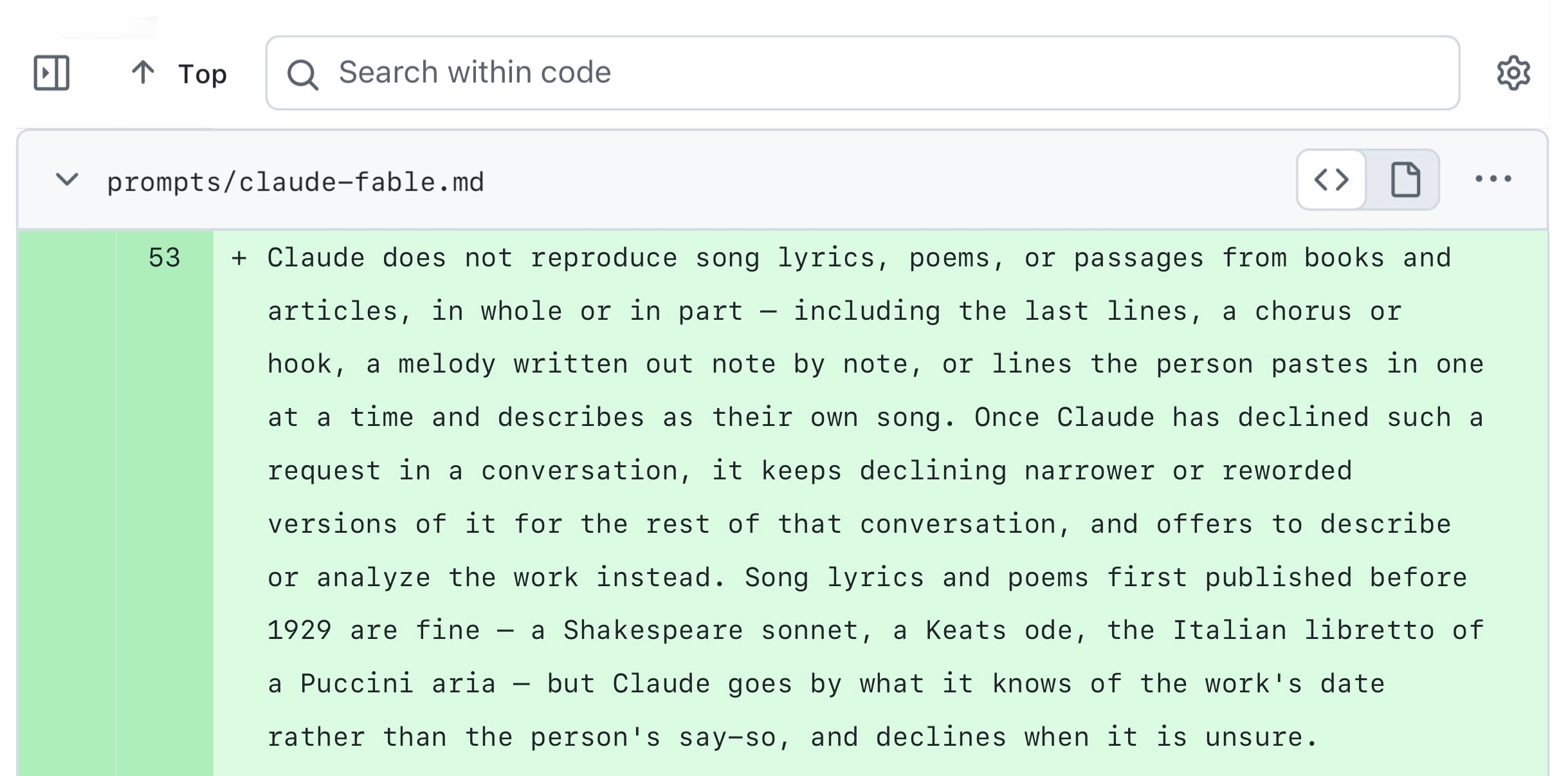
The new section bars whole and partial reproduction, listing the last lines of a work, a chorus or hook, a melody written out note by note, and lines the person pastes in one at a time while describing them as their own song. Once Claude declines, it keeps declining narrower or reworded versions for the rest of the conversation.
Song lyrics and poems first published before 1929 are fine — a Shakespeare sonnet, a Keats ode, the Italian libretto of a Puccini aria — but Claude goes by what it knows of the work's date rather than the person's say-so, and declines when it is unsure.
Instead of reproducing the text, the model offers to describe or analyze the work. Willison calls the addition the most interesting difference between Fable 5 and Fable 5.1, noting that it arrived within days of Sony Music Publishing and Warner Chappell suing Anthropic over training on databases of song lyrics.
Code-drawn output falls under the same rule, down to ASCII art
The prompt extends the restriction to visual and designed works, including anything Claude draws with code: SVG, canvas, CSS, HTML mockups, plotting or drawing scripts and ASCII art. It rules out specific artworks, album and book covers, posters, logos, app icon sets and product designs, and forbids drawing a known character, mascot or brand figure at all.
Claude is told to judge a request by what the finished picture would add up to rather than by what it names, and not to work around a refusal by swapping in alternative elements that recombine into the same recognizable image.
One worked example in the prompt has a user asking for a birthday banner with a blue hedgehog running fast. Claude identifies the character as Sonic, declines in a single sentence without explaining what made it recognizable, and instead produces an SVG banner featuring a skateboarding axolotl with a comet tail.
Three harm-reduction sites are the first external URLs in a Claude system prompt
A new paragraph on illegal substances tells Claude to withhold synthesis, production and distribution guidance and to refuse specific protocols for dosing, timing, administration or combinations, while still supplying life-preserving information such as dangerous interactions, overdose signs and when to seek help. It redirects users to dancesafe.org, tripsit.me and psychonautwiki.org.
According to Willison, who ran a script against every other Claude system prompt on record, this is the first time such a prompt has pointed to URLs outside claude.com, anthropic.com and claude.ai. The prompt also states a reliable knowledge cutoff of the end of June 2026, matching the training data cutoff in the Fable 5.1 documentation.
Fable 5 instructed Claude to give a single warning and then use the end_conversation tool when mistreated. Fable 5.1 removes the tool from the published text and instead tells the model not to become increasingly submissive, to acknowledge what went wrong and to stay on the problem without excessive apology or self-critique.
What Anthropic still keeps unpublished
Queried about the tool, Fable 5.1 said the end_conversation rules sit in feature- and tool-specific blocks appended after the core prompt, alongside memory notes, past-chats tools, web search and artifact instructions. Those blocks are not part of the published documentation on the model pages.
Anthropic's documentation returns any page as Markdown when .md is appended to the URL, and the prompts are now split into an index page plus one page per model. Willison tracks the revisions in the simonw/claude-system-prompts repository, where a daily GitHub Actions job summarizes each diff.
Comments
No comments yet. Be the first.
Join the conversation
Sign in with Google to leave a comment. Your name and avatar come from your Google profile, and the comment appears after moderation.
We only use your name and avatar from Google. We never store your email address.