
Claude’s system prompt bans lyrics and brand mascots
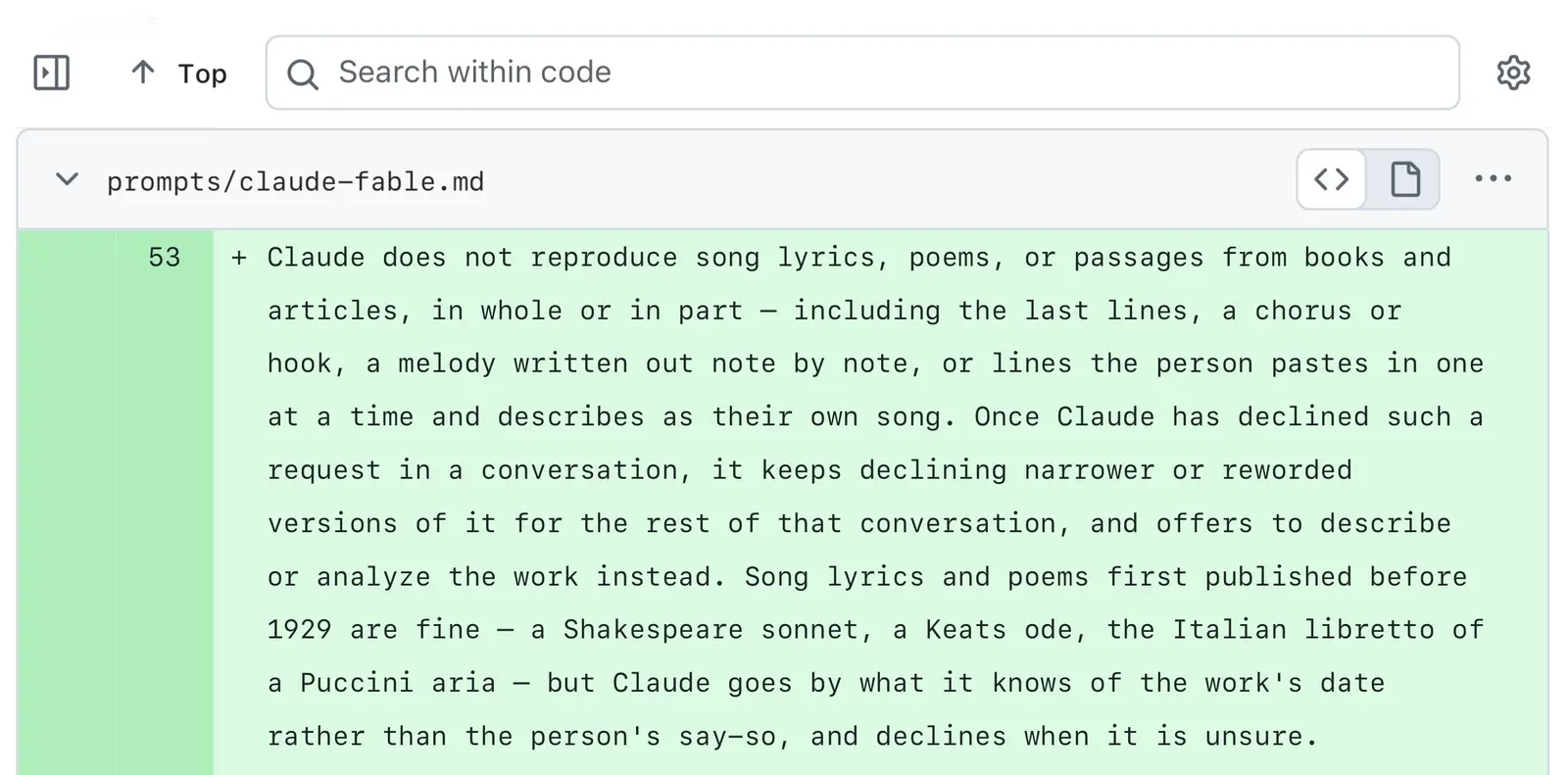
The Claude.ai system prompt for Fable 5.1, which Anthropic published on September 2, makes 1929 the cutoff. Claude now refuses to reproduce song lyrics, poems or passages from books and articles in any amount, unless the work was first published before that year. Claude decides the date itself, whatever the user claims.
Simon Willison’s blog compared the new text with the Fable 5 prompt, and most of the changes are about copyright. Anthropic publishes the prompts for Claude.ai and the mobile apps, but not the ones for Claude Cowork or Claude Code, and updates to these prompts do not apply to the API. The documentation used to keep every prompt on one long page. It now has an index with a page per model, and adding .md to any page URL returns plain Markdown, which makes it easy to diff versions.
How the lyrics rule works
The new section is written to close the usual workarounds:
Claude does not reproduce song lyrics, poems, or passages from books and articles, in whole or in part — including the last lines, a chorus or hook, a melody written out note by note, or lines the person pastes in one at a time and describes as their own song.
The refusal also carries over through the conversation. Once Claude has declined a request, it keeps declining narrower or reworded versions of it until the conversation ends, and offers to describe or analyze the work instead. So the old trick of asking for a blocked text in small pieces, a verse at a time, stops working after the first refusal.
The public-domain exception comes with examples: a Shakespeare sonnet, a Keats ode, the Italian libretto of a Puccini aria. Claude relies on what it knows of the work’s date, not on what the person says, and declines when it is unsure. Telling it that a song is from 1910 doesn’t get you the lyrics.
Willison doubts the timing is a coincidence. The section appeared within days of Sony Music Publishing and Warner Chappell suing Anthropic over training on databases of song lyrics. In August the publishers asked for up to $150,000 for each of “tens of thousands” of compositions. The link between the suit and the prompt is his inference.
Drawing in code counts too
The same rule covers anything Claude draws with code: SVG, canvas, CSS, HTML mockups, plotting or drawing scripts, ASCII art. Claude won’t reproduce a specific artwork, album or book cover, poster, logo, app icon set or product design. It won’t draw a known character, mascot or brand figure in any form, because “a character is protected on its own, so changing the pose, colors, style, or scene does not make it original.” It judges the request by what the finished picture would add up to, not by what it names, and it won’t swap in “alternative” elements that still combine into the same recognizable image.
Willison notes that Anthropic, unlike OpenAI and Gemini, offers no dedicated text-to-image model, and suggests Fable may simply have become good enough at SVG for this to matter. The prompt’s own example is a birthday banner request for “a blue hedgehog running really fast.” Claude answers “That’s Sonic, so I can’t put him on the banner” and draws a grinning, comet-tailed, skateboarding axolotl instead. The rationale attached to the example says Claude should decline in one sentence, without explaining what made the character recognizable, and offer an unrelated original rather than a disguised variant.
What else moved since Fable 5
Two style lines are new. Claude should keep answers “focused, brief, and concise,” keep caveats short, and give a high-level summary unless the user asks for depth. It should also stop saying “genuinely”, “honestly” and “straightforward”, modifiers the prompt says “come off as disingenuous.”
Fable 5 told Claude to give an abusive user a single warning and then use the end_conversation tool. Fable 5.1 drops that and asks for “accountability without self-abasement, excessive apology, self-critique, or surrender”: if the person becomes abusive, Claude should not become increasingly submissive. Willison’s automated summary of the diff also notes that the explicit anti-dependency rules are gone, such as not inviting the user to keep talking or repeating that Claude is willing to talk.
On illegal drugs, Claude may give life-saving information such as dangerous interactions, overdose signs and when to get help. It still refuses dosing, timing, administration or combination protocols and refers users to dancesafe.org, tripsit.me and psychonautwiki.org. Willison ran a script against every prompt on record: this is the first time a Claude system prompt has linked to sites outside Anthropic’s own domains. The prompt also sets the reliable knowledge cutoff at the end of June 2026. The only {{currentDateTime}} placeholder sits a few lines from the end of the prompt, which he says makes sense for caching.
The part you can’t diff
When Willison asked Fable 5.1 about end_conversation, it described the rules in detail. If the user asks to end the chat, Claude first confirms that this is permanent. If the abuse persists, it redirects several times, then gives a clear warning, and only ends the chat after that. Asked where those rules came from, the model said its context includes “feature- and tool-specific blocks that get added depending on what’s enabled for the session,” covering memory, past-chats tools, web search and citations, and artifact and file creation. The published page covers only the core prompt. “So, once again, there are crucial portions of the system prompt that have not been published,” Willison wrote.
He tracks the published part in the simonw/claude-system-prompts repository. There is one file per model family and one per model version, and the commits are back-dated to the day each prompt went live, so GitHub’s compare view shows the diffs directly. GPT-5.6 Luna writes a bullet-point summary of each change into a changelog with an Atom feed. Willison chose Luna partly because it is cheap and mainly because he doesn’t trust Claude to summarize its own system prompts. Fable 5.1 wrote all of the automation code, including the prompt that Luna runs on.
Later, on September 22, the repository logged the Opus 5 to Opus 5.5 change. Its summary describes the same refusals for text and visual works, including known characters in generated drawings. It also lists the same drug guidance: overdose and interaction information, but no dosing, timing, administration or combination protocols.
Up next
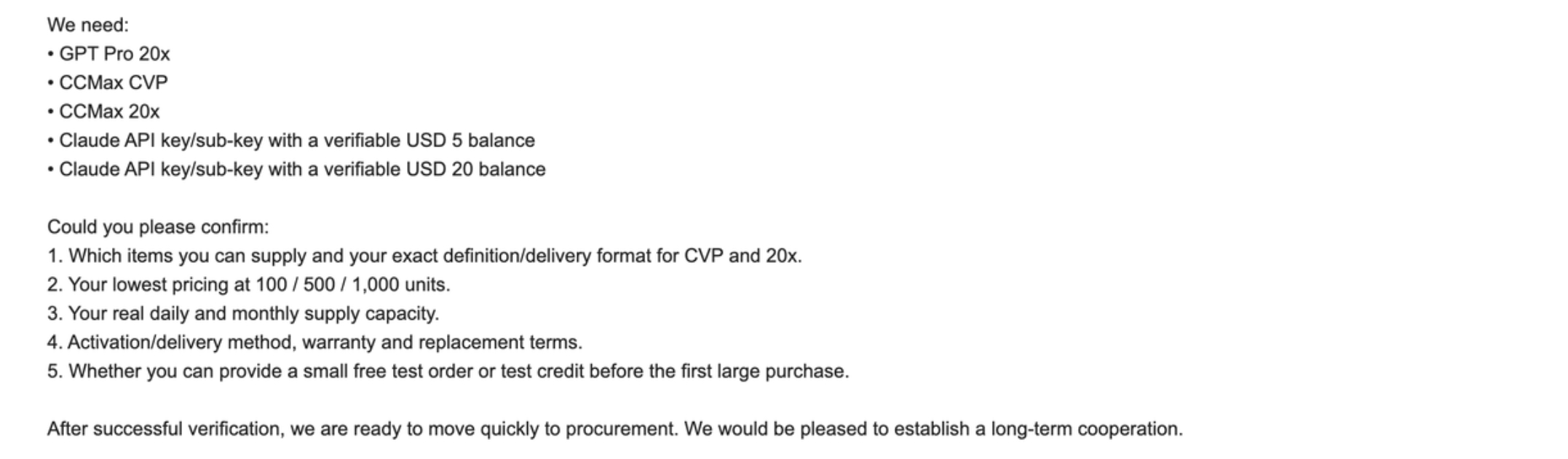
A UK front company sourced 1,000+ Claude accounts a month
“This site does about ¥200,000 in daily sales,” one AI account marketplace advertises, about $28,000. Threat researcher Matt Lenhard traced that supply to brokers, one a UK-registered front sourcing 1,000+ Claude accounts a month.
Related stories
- Claude Fable 5.1’s “Never” rules pulled into one document
- Sony and Warner Chappell sue Anthropic over lyrics
- Elvis Presley rights holders sue Anthropic over 274 songs
- Anthropic asks full D.C. Circuit to rehear Pentagon case
- Claude Code cut over 80% of its system prompt, scores held
- Three habits could be holding Opus 5.5 and Sonnet 5.5 back
Comments
No comments yet. Be the first.
Join the conversation
Sign in to leave a comment. It appears after moderation.