
ABC Legal runs 50+ Claude agents built by non-developers
ABC Legal runs more than 50 agents built with Claude Managed Agents in production, and most of them were assembled by staff in finance, marketing and operations rather than by the development team. The legal document delivery company deployed the platform after rolling out Claude Enterprise to its 1,100 employees earlier this year, according to a case study published by Claude.
At a glance
- Every agent is defined as a JSON config file, a Markdown system prompt and deployment scripts kept in a git repository, so nothing changes except through a pull request that someone approves.
- As of July 2026 the team tracks up to roughly 50% reduction in the cost of the human tasks some agents cover, before heavy optimization, and about 310 employees using Claude daily.
- A 15-person steering committee drawn from finance, marketing, operations and development, none of them software developers, had working agents within a week, and more than 50 were running company-wide within a month.
The interesting part is not the agent count but the control surface. By forcing every agent through git, ABC Legal appears to have traded a low-code adoption curve for an approval workflow its engineers already trust, which is what makes handing production automation to accountants and marketers defensible. The cost of that choice shows up in onboarding: the hurdle CTO Brandon Fuller describes is git, not the AI.
Fuller built the starter kit in a week, with templates for event-driven and scheduled agents
One template covers event-driven agents, which start when something happens, such as a new job arriving or a document coming back from a court. The other covers scheduled agents that run hourly, daily or weekly. Both live in dedicated git repositories alongside the company's software.
Each agent lives in its own folder with a standard structure: a JSON config file, a system prompt in Markdown, deployment scripts and operational documentation. Merging a change into the main branch deploys the agent automatically, which gives every agent version history, code review, rollback and an audit trail.
Builders do not write software. They clone the repository, copy a starter template and describe the job to Claude Code, which returns the config, prompt, credential store and memory the agent needs. Fuller says he had to explain to committee members what a pull request was; several assumed it meant running.
Charvis, the operations review agent, agrees with the compliance team about 98% of the time
The AI Code Reviewer checks every pull request across four codebases for security bugs, performance regressions and committed credentials, and engineers wait for its verdict before merging. The eFiling Rejection Diagnoser fires when a court rejects a filing, reads the job, checks the court's rules and posts a diagnosis to Slack in about a minute, work that used to take hours.
The EvidenceChain Delivery Agent pulls a database report for matching jobs, retrieves each PDF with a built-in browser and delivers the files to a customer's FTP server daily. The account manager who built it in about an hour had never automated anything and described the task to Claude Code.
Other agents verify incoming jobs against court websites, work the attorney network to cover hearings, parse remittance emails into NetSuite payment files for one-click Slack approval, and post weekly Google Ads recommendations. Charvis checks completed service jobs, and the Service-Overdue-Nudger drafts tiered daily outreach for human approval.
Docketly keeps about 145 delivery rulesets as YAML files in git
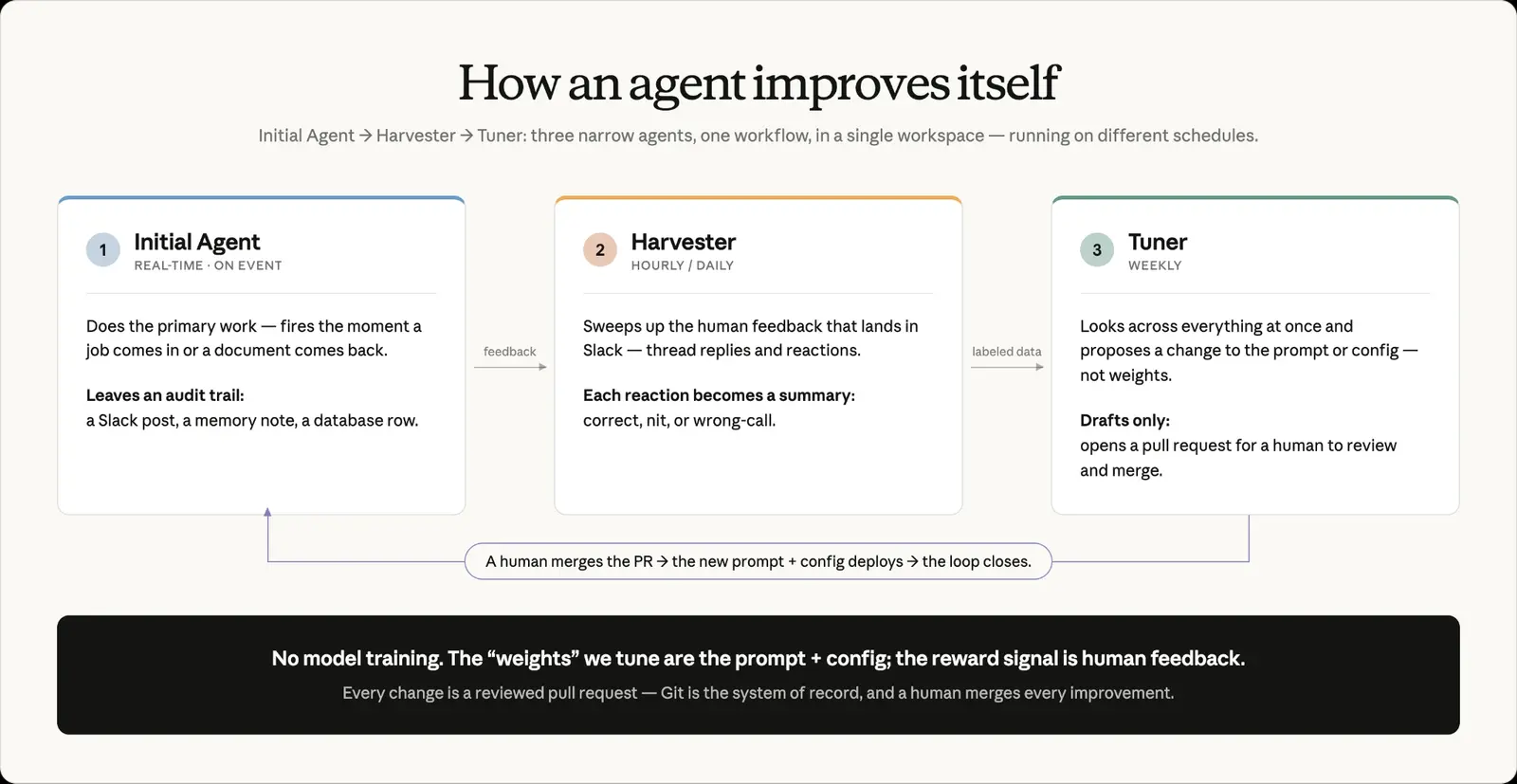
Agents that collect graded feedback use a three-role architecture: an initial agent does the work and logs an audit trail, an hourly harvester turns Slack replies and emoji reactions into labeled data points, and a weekly tuner drafts prompt and config changes as a pull request. Agents start by posting recommendations for human review and act alone only after matching human decisions.
At Docketly, ABC Legal's 50-person sister company, about 145 delivery rulesets sit in git as YAML files. Four agents run that loop, ending with one that pushes the merged config to the production database, and human review is the only manual step.
Claude Sonnet is the default model, Claude Haiku handles high-volume fast tasks and Claude Opus is used when deeper reasoning justifies the cost. Each agent reports its value back to a data warehouse in hours and dollars, against an efficiency ratio that often starts underwater before evals and cheaper models flip it positive.
Four projects still in flight. The pipeline includes a service photo reviewer, a PagerDuty triage agent, a daily KPI digest and expanded tuner loops on existing agents. The team is also looking for more X-as-code candidates: notification templates, event routing rules and dispatch logic that agents can read and propose changes to. The case study gives no timeline for any of them.
Up next
Four Claude memory tools compared by LoreConvo's builder
A four-way comparison of Claude memory tools, written by LoreConvo's builder, gives claude-mem the community crown at 45,000 GitHub stars, though its remote backup keeps your sessions in a third-party bucket.
Related stories
- Claude's commerce blueprint ships two reference agents
- Five agent tools reach Claude deployments hosted on Azure
- Enterprise auth for MCP connectors is GA in Claude
- Claude integration launches within Notion
- Anthropic introduces self-hosted sandboxes and MCP tunnels for agents
- Anthropic's test agents filled out US visa applications
Comments
No comments yet. Be the first.
Join the conversation
Sign in to leave a comment. It appears after moderation.