
claude-code
An undocumented Claude Code command outlives the 5-hour cap
Claude News
 claude-code
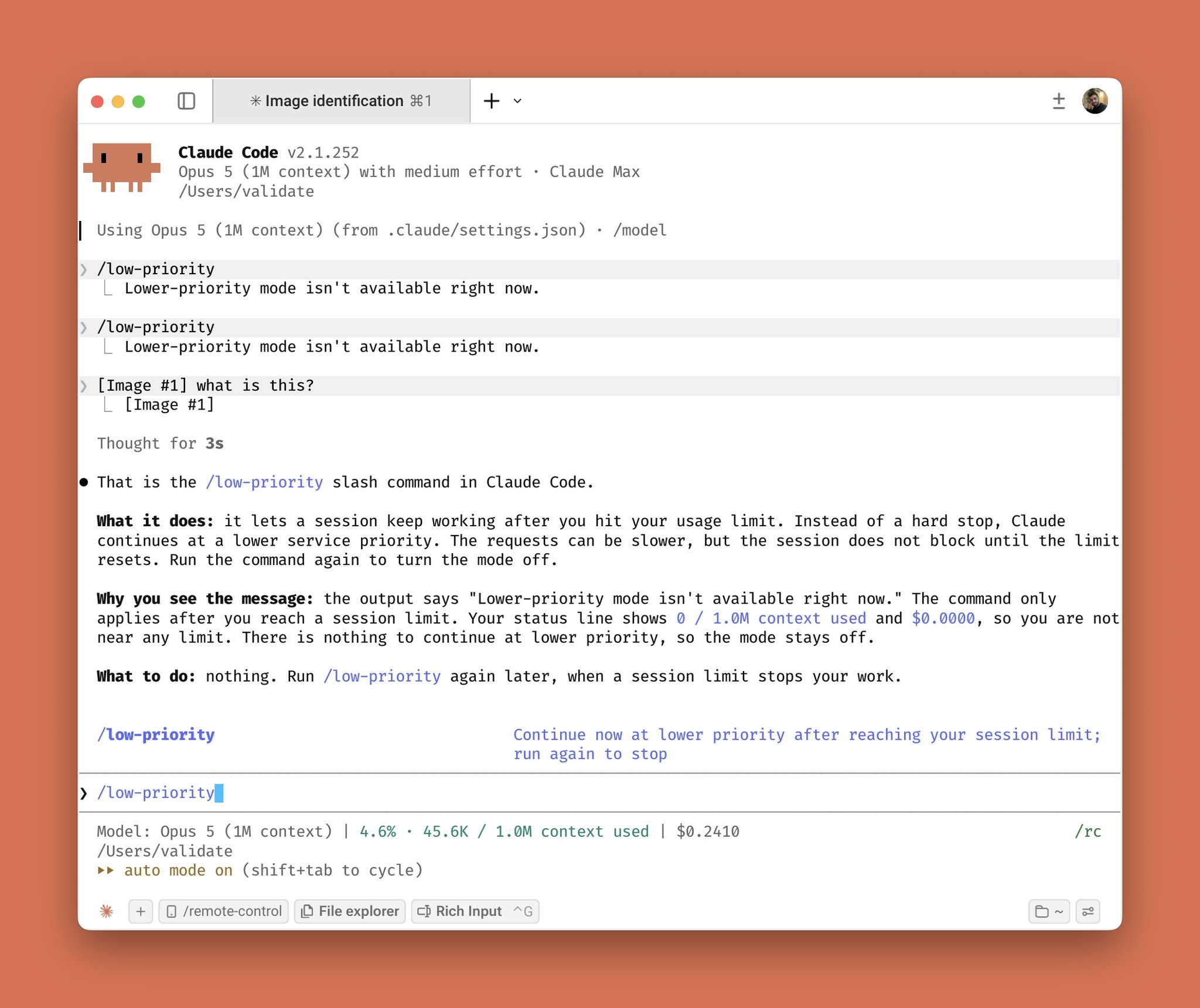
Claude Code ships an undocumented slash command, /low-priority, that keeps a session working past the 5-hour usage limit by serving its requests from spare server capacity instead of blocking them. The command is registered as a built-in in the client at version 2.1.266, and was flagged in a post on X.
At a glance
- The mode does not lift the ceiling: it continues work after the session limit is reached, drawing on a weekly allowance that Anthropic tracks server-side separately from the 5-hour window.
- Requests wait for unused capacity, so responses can stall, and the client shows a banner reading "Working at lower priority, waiting for capacity" while a session sits in one of those pauses.
- Availability is controlled by a server-side flag, so some users see the option while others receive a message saying that lower-priority mode is not available to them.
The design reads as a way to keep heavy sessions alive without loosening the published caps: the 5-hour window and the weekly limit stay where they are, and the extra work runs on capacity that is otherwise idle. For users on the paid plans, that likely turns a hard stop into a slower one, paid for in unpredictable latency. Shipping it undocumented and behind a flag also means the behaviour most accounts meet at the cap is unchanged.
/low-priority is registered as a built-in command in Claude Code 2.1.266
The feature was verified in the Claude Code binary at version 2.1.266, where /low-priority is registered as a built-in command. It is not mentioned in Anthropic's documentation and has never appeared in the Claude Code changelog, yet it is present and fully implemented in the current release of the client.
Internal type documentation shipped with the client describes usage that "runs past a window's cap" during lower-priority episodes. That wording confirms the mode is designed to continue work after the session limit is reached rather than to expand the limit itself.
Users on Reddit and X who found /low-priority report that the command appears only after a session limit message has already been shown, and that it does not autocomplete in the command list alongside the other built-in slash commands of Claude Code.
Lower-priority work runs on a separate weekly allowance tracked server-side
Lower-priority mode draws on a separate weekly allowance tracked on Anthropic's servers, distinct from both the 5-hour session window and the standard weekly limit, which continues to apply on top of it. The client displays how much of that allowance remains as a percentage, and shows a message reading "You've used this week's lower-priority allowance" once it runs out.
The mechanism itself is narrow. Because requests wait for unused capacity rather than being served immediately, responses can stall, and the client shows a banner reading "Working at lower priority, waiting for capacity" during those pauses, with the session past the cap served from spare capacity instead of being blocked.
A capacity timeout pauses the mode for a cooldown period
The mode ends automatically under several conditions: the weekly limit being reached, the lower-priority allowance being spent, purchased usage credits taking over, an account switch, or a conversation reset. A further condition is a session that waits too long for capacity without receiving any while running in lower-priority mode.
In that last case the feature pauses for a cooldown period and becomes available again once the pause has elapsed. Availability otherwise rests on a server-side flag, which is why some users see the option in Claude Code while others receive a message saying that lower-priority mode is not available to them.
The two unpublished figures Neither the size of the weekly lower-priority allowance nor the length of the cooldown that follows a capacity timeout has been published, and the client reports the allowance only as a percentage. The mode is absent from both the documentation and the changelog, so any widening of the server-side flag that decides who gets it would likely show up in sessions before it shows up in writing.
Comments
No comments yet. Be the first.
Join the conversation
Sign in with Google to leave a comment. Your name and avatar come from your Google profile, and the comment appears after moderation.
We only use your name and avatar from Google. We never store your email address.