
Claude Fable 5.1 in Copilot won’t run without retention
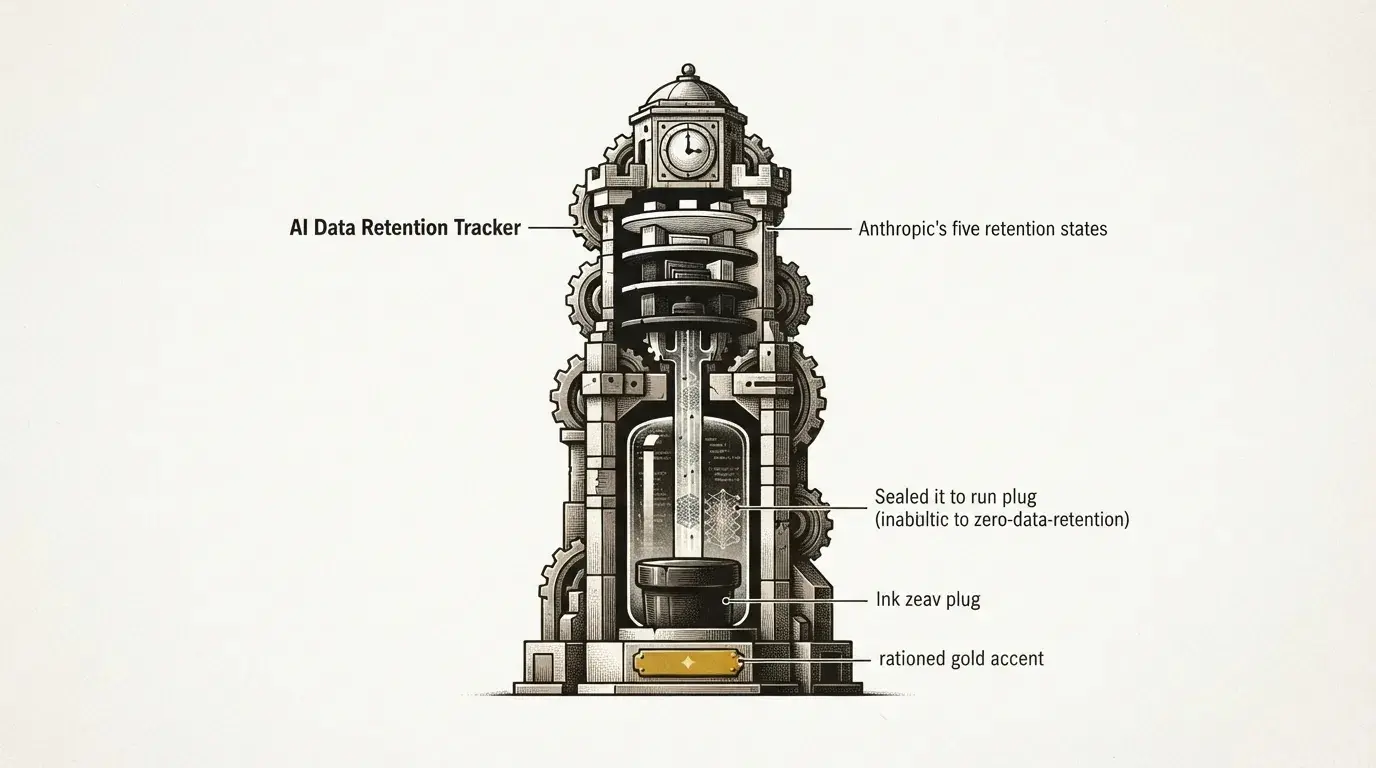
Four of the five Anthropic model-and-tier combinations in the first release of ProvenBrief’s AI Data Retention Tracker, published September 10, keep prompts by default. The newest of them, Claude Fable 5.1 in GitHub Copilot, won’t run at all unless Anthropic keeps prompts and outputs.
The tracker builds each cell only from the provider’s own dated pages: help center, privacy center or changelog. A cell counts as retention-by-default when, once the model is in use, no available setting stops prompts from being stored. Under that test, retention on Anthropic’s commercial surfaces takes three forms. It can be a default you have to override, a condition you accept before the model will run, or a floor you can’t go below. The fifth cell is every other Claude model in Copilot, and those run under zero data retention (ZDR): Anthropic doesn’t store prompts or responses after the request is answered.
Claude Enterprise conversations and projects are the default-you-override case. They’re kept indefinitely unless an owner changes that. Since March 16, 2026, owners have been able to set a custom retention period, with a minimum of 30 days counted from last activity. On the tracker’s retention-window chart, Enterprise therefore sits at 30 days, level with the strictest cell, even though its default has no end date.
Fable in Copilot: retention as the price of entry
Fable 5.1 reached general availability in Copilot on September 1 for the Pro+, Max, Business and Enterprise plans. Under the GitHub changelog, it and Fable 5 are the only two Claude models in Copilot that require Anthropic to keep prompts and outputs, which Anthropic needs to run its safety classifiers. On Copilot Business and Enterprise, administrators have to turn the model on themselves, and turning it on counts as accepting the retention requirement. The changelog says how long the data is kept for neither Fable model. It does say the retained data isn’t used to train Anthropic’s models. The tracker treats retention and training as separate questions for that reason: a prompt can be stored and still never become training data.
Some enterprises can still get ZDR. Approved customers’ requests go to ZDR endpoints under an exemption that covers Fable 5.1 and Fable 5 “through the end of the calendar year,” which means December 31, 2026. There’s no setting for it. Eligibility goes through the GitHub account team, and GitHub Support can neither check eligibility nor turn access on. That matches how Anthropic handles ZDR on its own platform, where it’s enabled per organization through the account team.
Copilot is a carve-out from a broader rule. Anthropic’s platform documentation says prompts and outputs on covered models “are retained for 30 days to support our safety work, on every platform where these models are offered,” and that includes Amazon Bedrock, Google Cloud Agent Platform and Microsoft Foundry. When Anthropic set the rule in June for all traffic on Fable 5 and Mythos 5, it cited defence against misuse and “complex and novel” cyberattacks. CNBC reported that Anthropic also promised not to use the data for any “non-safety-related purpose,” including model training.
Is there a HIPAA-safe corner?
Healthcare customers sign a Business Associate Agreement (BAA), the contract HIPAA requires before a vendor handles protected health data. Anthropic’s BAA terms are blunt: Covered Models “require 30-day data retention and aren’t available with zero data retention (ZDR) enabled.” The same document says Claude Code is covered under the BAA only when ZDR is on, and spells out the result: those services can’t use Covered Models under the BAA. Several Claude Code surfaces don’t work with ZDR at all, including desktop remote mode, the web beta and Computer Use.
That leaves a HIPAA customer with three options and no fully covered one. Chat on a Covered Model means 30-day retention and no ZDR. Claude Code means either ZDR or no BAA coverage. The remote and web Claude Code surfaces qualify for neither. For every Covered Model under a BAA, and for Fable 5 and 5.1 in Copilot outside the exemption, the tracker’s two basic questions get the same answer. Is ZDR something you can buy for this model? Currently, no.
121 days, with no fixed end
The tracker’s second metric, ZDR Lag, counts the days from a model’s launch until a typical paying customer can run it with zero retention. For Fable 5.1, approved enterprises got ZDR on launch day. A Copilot Business organization without approval can’t get ZDR for at least the 121 days between the September 1 launch and December 31, and the wait may run longer. Once the exemption ends, staying on either Fable model in Copilot requires Enterprise Frontier Safeguards (EFS). The only date given for the EFS rollout is “later this fall”, so the condition for keeping access has no date of its own.
EFS is pitched as “complete privacy (the same as a zero data retention policy).” Data sits in cloud infrastructure the customer fully controls, while automated safety monitoring keeps running. Anthropic announced it on September 1, the same day Fable 5.1 shipped in Copilot, as the replacement for the June rule for business customers. Per CNBC, the company said the change followed “a lot of feedback,” and Kate Jensen said Anthropic had spent hundreds of hours working with customers on it. Under EFS, businesses decide how their data is reviewed, stored and managed. They can run automated safety monitoring with no human review by Anthropic, at no charge, either directly or through a cloud provider. OpenAI is trying the other approach with Private Safety Processing, which does safety monitoring without keeping the data. It’s in limited testing.
EFS is being released in phases, and Anthropic is aiming for broader availability this fall. The Copilot exemption ends on December 31. CNBC also reported that the June retention policy still applies to non-enterprise subscribers who use Anthropic’s Mythos-class models.
Up next
Claude Managed Agents get auto mode and a session viewer, Video
With “auto”, Claude reviews each tool call in Claude Managed Agents against your intent in user.message events and decides whether to run it, deny it, or ask you for input. Anthropic announced the mode on X.
Related stories
- 30-day retention is out for Anthropic’s enterprise users
- Anthropic plans to loosen data retention on top models
- Pentagon to finish cutting Anthropic loose by month’s end
- Claude for Legal adds ready-made artifacts for cite checks
- Claude gets 40% off for every level of US government
- At Enveda, Claude drafted a filing in 4 hours vs 3 months
Comments
No comments yet. Be the first.
Join the conversation
Sign in to leave a comment. It appears after moderation.