
Claude plans can eat over 40% of Anthropic's compute
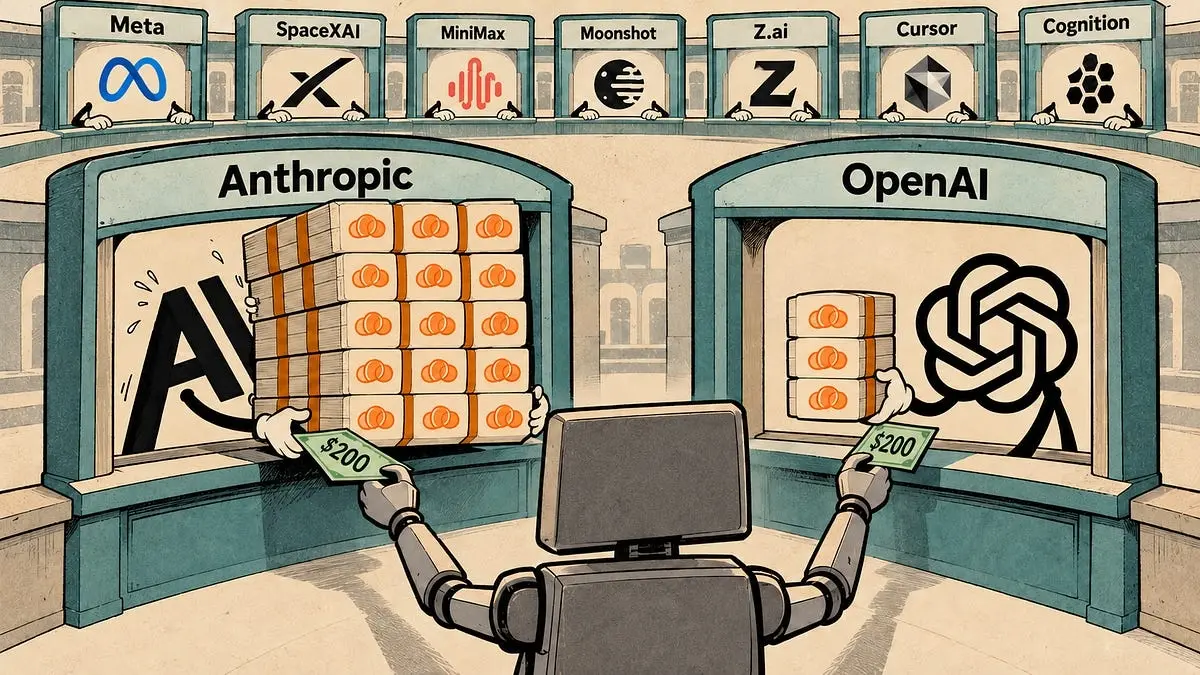
By SemiAnalysis's rough numbers, Claude subscriptions bring Anthropic just 10% of its revenue but can take up more than 40% of its inference compute. They also lower blended revenue per MW by about $36M. Subscribers get the other side of that subsidy: Opus 5.5 on a Claude plan gives about 5x the API-equivalent value of OpenAI's GPT 6.1 Sol.
At a glance
- SemiAnalysis built a dashboard that rechecks the cost of every plan, model and token type, covering OpenAI and Anthropic plus Meta, SpaceXAI, Cursor, Cognition, Z.ai, MiniMax and Moonshot.
- Assuming 100% utilization and 92% API gross margins, maxing out Opus 5.5 on a Claude plan works out to a -369% gross margin for Anthropic, against 1% for Fable 5.1.
- Limits can change quietly. One of three test accounts on the same subscription had about 20% lower limits, and the provider confirmed it was part of an "extremely tiny" A/B test.
SemiAnalysis argued in June that subscriptions are heavily subsidized but still make sense as a way to win customers and as marketing. The firm says OpenAI's generous resets helped drive the recent surge in Codex adoption. It also says they forced Anthropic to walk back planned subscription nerfs more than once.
At the mid tier, Opus 5.5 gives about 5x the value of GPT 6.1 Sol
Both companies market their mid-tier models as the daily driver for most users. SemiAnalysis found the big gap at this tier: on a Claude plan, Opus 5.5 offers about 5x the API-equivalent value of GPT 6.1 Sol across the board.
You could object that 6.1 Sol is much cheaper per token than Opus 5.5, so a dollar comparison flatters Anthropic. SemiAnalysis says the gap is still massive when you compare raw token counts instead.
At the top tier, GPT-6 Astra and Fable 5.1 have quite similar limits, but Fable can only use 50% of a Claude limit. On a $200 Anthropic plan, half of your limit would still be left after $2,485 worth of Fable 5.1. The equivalent OpenAI plan runs out after $2,897 of Astra.
OpenAI's one counterargument is that its Pro plans have no 5-hour limit, so you can more easily use a higher share of your monthly limit. SemiAnalysis does not think that offsets the ~4x higher API-equivalent value of Opus 5.5 on Claude plans. Per dollar, the Chinese labs average a little less than the ~12x you get from OpenAI.
OpenAI halved the value of its $200 plan and added a $500 tier
OpenAI used to sell its tiers by multipliers. The $20 Plus plan promised "Expanded Codex usage", the $100 Pro plan "5x more usage than Plus" and the $200 Pro plan "20x more usage". Then OpenAI removed all relative usage from its pricing page.
SemiAnalysis's tracking confirmed the 50% value cut for the $200 plan announced by Tibo. Plans bought before the cut keep the old limits until October 29, and new ones start lower. OpenAI halved the tokens for each model tier. It also cut cached input pricing for 6.1 Sol, so the API-equivalent value of Sol-class models fell by over 50%.
The new $500 plan offers only 21% more Astra than the old $200 plan, and its Sol-class value is actually lower. Its headline feature, 300 TPS Ultrafast, is still being tested.
Before the cut, Pro 100 gave ~2x more per dollar than Plus on Astra, and Pro 200 gave another ~2x on top of that across all models. Now Pro 100, 200 and 500 give the same tokens per dollar for every model. Plus matches them on Sol but is worse on Astra. Anthropic already gave every tier the same per-dollar value.
Opus 5.5 got about 20% more tokens on Max plans, which did not cover its price cut
Model prices keep falling. Fable 5.1 cut cache reads by 75% versus Fable 5. Opus 5.5 cut input and output pricing by 20% versus Opus 5, and cache reads by 60%. GPT 6.1 Sol cut cache reads by 50% versus GPT 6 Sol, which was itself 60–67% cheaper than 5.6 Sol.
When prices fall and limits stay put, the dollar value of a plan shrinks. OpenAI left Sol token limits on the $200 plan unchanged when 6.1 Sol came out, and its API-equivalent value dropped ~30%. Anthropic did not raise Fable limits for 5.1. It did raise Opus limits with 5.5, by ~20% on Max and ~50% on Pro, but that did not fully offset the price cut.
SemiAnalysis describes two strategies. Anthropic lowers a plan's API-equivalent value for its more premium models. The drop is small from Sonnet 5.5 to Opus 5.5 and large with Fable 5.1. OpenAI, in the firm's words, picked the nuclear option of cutting to Fable-level limits across the board.
The margin math shows the stakes. Assuming 100% utilization and 92% API gross margins, maxing out Opus 5.5 means a -369% gross margin and Fable 5.1 means 1%. At a more realistic 20% average utilization, those become 6% and 80%.
SemiAnalysis prices each token type by counting how many tokens move the meter one notch
Plans show only a 0 to 100% meter over 5-hour and 7-day windows. Each SemiAnalysis experiment isolates one token type. Uncached input uses excerpts from War and Peace with a random tag on every call. Cache writes use the same prompt marked for caching, cache reads use a fixed tag, and a technical essay forces long outputs.
One request often leaves the meter where it was, so the firm counts the tokens between two meter moves and drops the partial steps at each end. Think of measuring fuel use by the kilometres between ticks of the gauge, not trip by trip. Steps are added until the range is within ±5%. If 500M cache read tokens never move the meter, cache reads count as free.
Each percentage then becomes dollars: 1% of a $200 plan's monthly limit is $2. The agentic workload mix comes from SemiAnalysis's own September usage ratios.
The method can catch quiet changes. One of three accounts on the same subscription, a significantly older one, had ~20% lower limits. The provider said it was an "extremely tiny" A/B test, that it "didn't just decrease limits wholesale", and that it was testing "how to better balance when people hit limits".
SemiAnalysis admits its yardstick has limits. API-equivalent value misleads when a model is an unusually good or bad deal at API prices, and the industry lacks reliable data on token efficiency. In our view, the Opus figure is the fragile part of the deal: at -369% on a maxed-out plan, heavy Opus users are basically running on Anthropic's dime, and the A/B test shows limits can be adjusted without notice.
What October 29 changes
OpenAI $200 plans bought before the cut keep their old limits until October 29. SemiAnalysis is still testing the 300 TPS Ultrafast limits on the $500 plan and the limits for ChatGPT subscriptions used in third-party apps like Devin. No publication date has been given for those results. The firm says it will add new providers, plans and models to its dashboard as soon as they are released.
Related stories
- Anthropic deleted the post that called a cut a 25% raise
- Claude Max subscribers are auditing Anthropic's meter
- Cheaper rivals outdraw Anthropic's best model, FT says
- Anthropic will refund users hit by extra-usage overcharges
- Anthropic's billing system tried to charge a Korean user $16.6 million
- Unnamed corporation spent $500M on Claude in one month
Comments
No comments yet. Be the first.
Join the conversation
Sign in with Google to leave a comment. Your name and avatar come from your Google profile, and the comment appears after moderation.