
Empero releases Qwythos-9B trained on Claude traces
Laboratory Empero has introduced Qwythos-9B, a reasoning model based on Qwen3.5-9B, fine-tuned on over 500 million tokens of Claude Mythos and Claude Fable traces. The model uses full-parameter fine-tuning and is released under an Apache 2.0 license.
Using the lm-evaluation-harness, the model outperforms the base Qwen3.5-9B: +34.3 points on MMLU (0.575 vs 0.232), +30 points on gsm8k-strict, and +19 on gsm8k-flex. On gpqa_diamond, the result is 5 points lower than the base model.
The context window is extended to 1,048,576 tokens via YaRN rope-scaling with a factor of 4, built on top of the native 262,144 tokens. It includes native function calling: in a 7-prompt test involving a Python executor and web search, the model provided correct answers with links in every case.
The model is intentionally uncensored and optimized for cybersecurity, biomedicine, and pharmacology. Weights are available on Hugging Face.
Up next
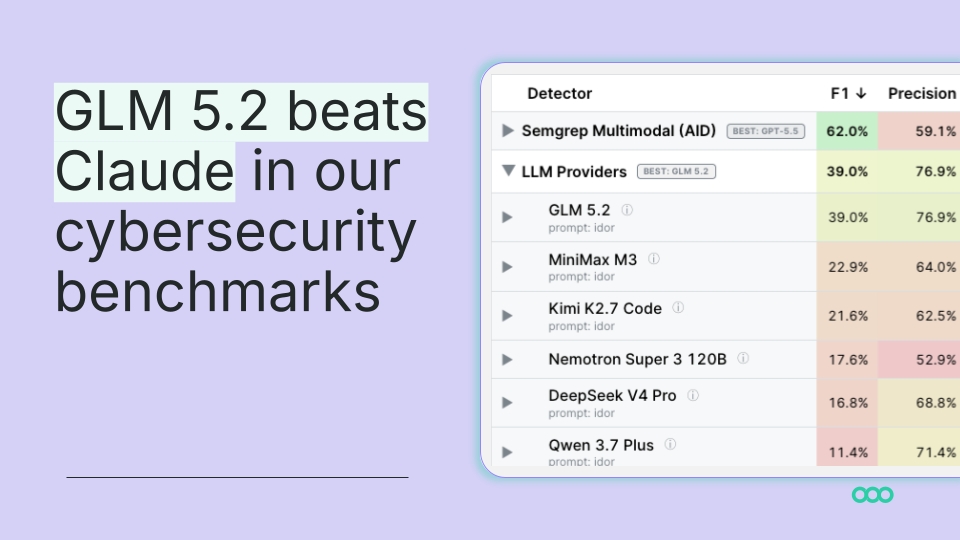
Semgrep: GLM-5.2 outperforms Claude Code in IDOR detection
Open-weights GLM-5.2 hit a 39% F1 score on IDOR detection, beating Claude Code on Opus 4.8 (28%) using the same prompt. It cost roughly $0.17 per bug found. Crucially, GLM-5.2 ran without the endpoint discovery scaffolding that the Opus-based pipeline utilized, relying only on the code and a hint.
Related stories
- Kimi K3.1 Pro lands just behind Opus 5.5 on Terminal-Bench
- Claude, GPT, Gemini install Sentry and Playwright every time
- Revolut moves 2,000 engineers from Claude Code to GLM
- Intent-lens spells out Claude Code calls before they run
- Codedict cuts Claude Code tokens 63%, but cost only 26%
- Hidden Claude Mythos 5.5 line found on Anthropic’s site
Comments
No comments yet. Be the first.
Join the conversation
Sign in to leave a comment. It appears after moderation.