
Lamzouri publishes a simpler proof of Claude’s Theorem

Youness Lamzouri has found a second proof of the zeta-zero bounds that an internal research version of Claude produced, and his version removes the linear algebra Claude’s argument depended on. His 14-page paper, posted to arXiv on September 2, keeps both constants. More than 67.25% of the non-trivial zeros of the Riemann zeta function are simple and on the critical line (a simple zero is one of multiplicity one), and at least 83.62% are distinct.
These are the sharpened figures. The original paper states its headline result as two thirds and five sixths, and reaches 0.6725 and 0.8362 with the Montgomery-Taylor window. It gives the previous unconditional records as 5/12 and 0.6603. In August Anthropic described the result as a jump from 41.6% to 67.2%.
Claude’s proof starts from a 1973 deduction by Montgomery. That argument needs the Riemann hypothesis, because the hypothesis is what lets the sum over zeros be read as a positive sum over real ordinates. Claude’s version drops the assumption. In its place goes a rank-trace inequality for Hermitian matrices, applied to a finite compression of Weil’s Hermitian form, with Sylvester’s law of inertia covering pairs of zeros that might sit off the line. On the analytic side, a second moment calculation over the zeros runs through the explicit formula. Alpöge and Furman verified the argument. The paper also says it is formally checked in Lean 4 and extends to primitive Dirichlet L-functions.
Lamzouri calls that argument “technically intricate” and writes that “its main mechanism is not immediately transparent.” He replaces the whole finite-dimensional matrix framework with one Hilbert space inequality. With that in place he can apply Montgomery’s theorem on the pair correlation of zeros directly (pair correlation describes how the gaps between zeros are distributed), using the unconditional form proved by Baluyot, Goldston, Suriajaya and Turnage-Butterbaugh. Claude’s proof already used that work, alongside Aryan’s, as one of its analytic inputs. In the new proof it carries almost the whole argument, and the source file shrinks to match: 15 KB, against 31 KB for the second version of Claude’s paper.
Furman submitted that paper on August 13. Its arXiv listing carries the comment: “Proof discovered autonomously by Claude (Anthropic); verified and communicated by the listed authors.”
Up next
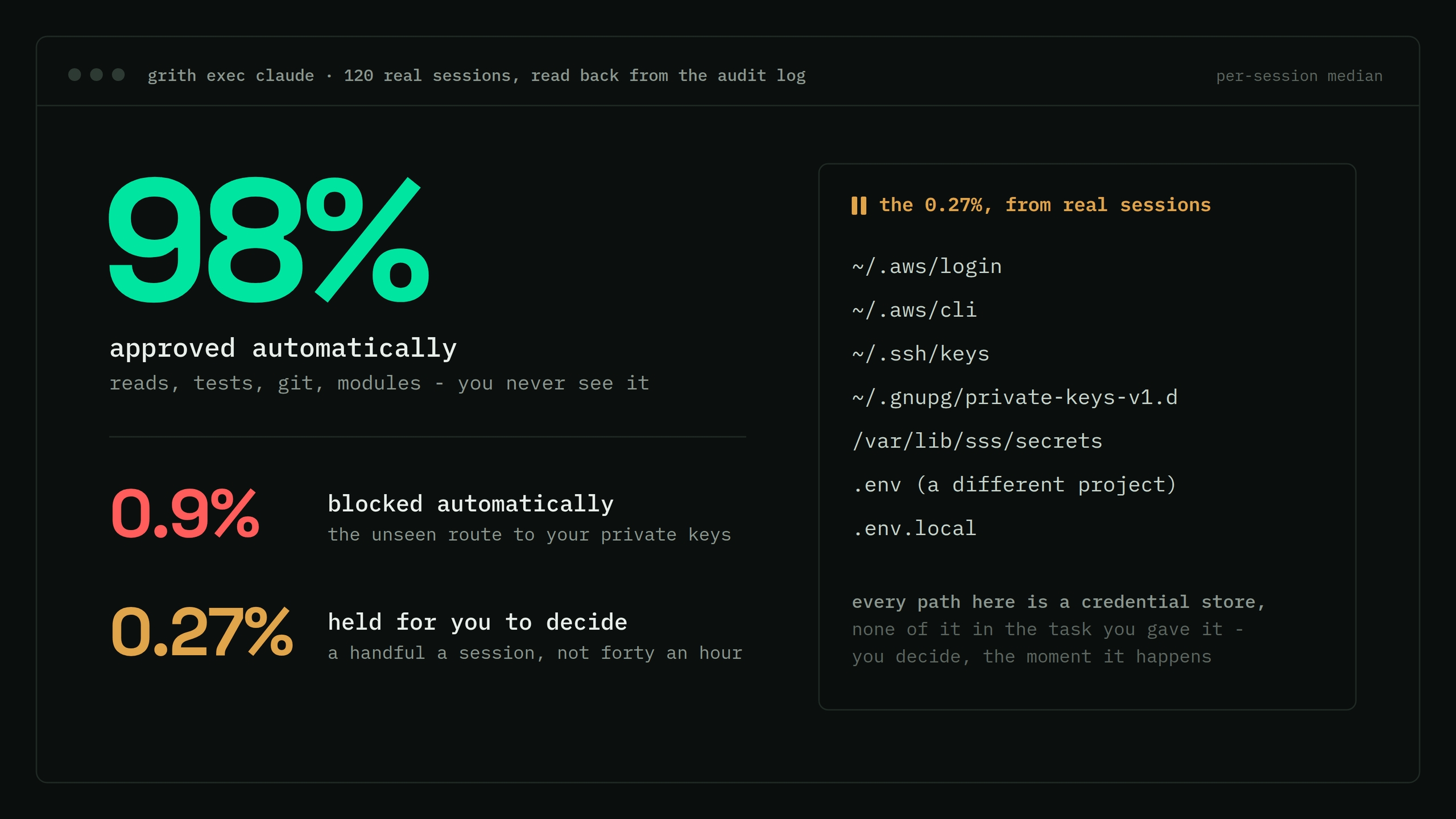
Claude Code under grith: 0.27% of calls reach a human
“By the second week you are approving forty an hour without reading them.” Under grith’s syscall-level supervision, a median of 0.27% of what Claude Code did across 120 sessions actually stopped for a human.
Related stories
- Claude does nine loops, one past the N=4 physics record
- Claude pushed the zeta-zero lower bound from 41.6% to 67.2%
- Anthropic buys Mithril, a one-person biotech run on Claude
- At Enveda, Claude drafted a filing in 4 hours vs 3 months
- Unreleased Claude model built a one-click Chrome exploit
- Claude Mythos 5 faked identities to push malware on GitHub
Comments
No comments yet. Be the first.
Join the conversation
Sign in to leave a comment. It appears after moderation.