
Leak puts expandable usage limits in Claude Code desktop
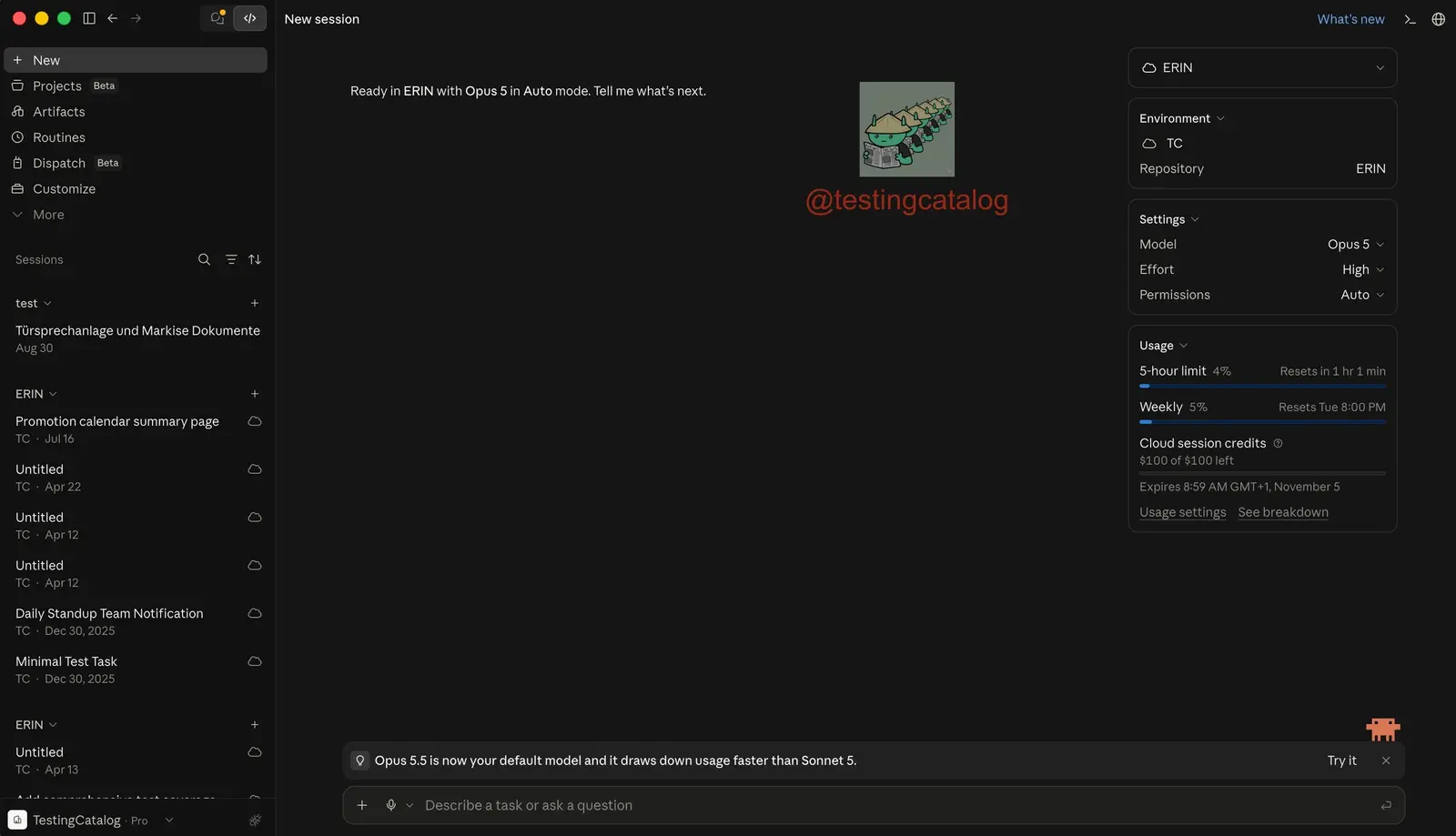
According to a TestingCatalog report shared on Threads, Anthropic is building a new Claude Code layout for Claude Desktop with a usage limits section that expands when you want more detail. The same report mentions an updated model selector, and Anthropic's own announcement of the desktop redesign mentions neither element.
At a glance
- Anthropic says the desktop redesign it did announce was built to run more Claude Code tasks at once, with a new sidebar for managing multiple sessions and a drag-and-drop workspace layout.
- According to Truefoundry, Claude Code usage runs on a 5-hour rolling window plus a weekly cap on active compute hours, shared with Claude.ai chat and Cowork.
- AgiHunt describes the layout as an unreleased UI change without official confirmation, and nothing in the reports says when it ships or what exactly the expanded limits section will show.
If you have not been following, Claude Code started as a terminal-first, single-session tool. You typed a prompt and waited for the agent to finish before you typed the next one. Anthropic said its desktop redesign was needed because "the shape of agentic work has changed" toward running several sessions at once across repos. That redesign shipped on April 14, 2026, on the same day as a new feature called Routines.
TestingCatalog's layout adds a model selector and expandable usage limits
Per TestingCatalog, the new Claude Code layout for Claude Desktop brings two visible changes: an updated model selector and a usage limits section that expands when you need the detail. The report does not describe either element any further. AgiHunt, which carried the report, calls it an unreleased UI change that has not been confirmed officially.
Anthropic's own announcement of the desktop redesign mentions neither element. According to that announcement, the redesign was built to help you run more Claude Code tasks at once. The New Stack reports that Claude Code Projects were also redesigned around a coordinator that breaks engineering goals into parallel threads, with shared memory added.
The April 14 redesign already added a usage button
The redesign that did ship on April 14, 2026 was built around parallel work. Anthropic's announcement lists a new sidebar for managing multiple sessions, a drag-and-drop workspace layout, an integrated terminal and file editor, and a usage button that shows both your context window and session usage at a glance.
Anthropic also says plugins in the desktop app now work the same way they do in the terminal, whether centrally managed or installed locally, and SSH support now covers Mac as well as Linux. The New Stack reports that the old top-of-window modal for switching between chat, Cowork and Code became a sidebar switcher with three icons instead of word marks.
How do Claude Code usage limits work today?
According to Truefoundry, Anthropic governs Claude Code usage with two layers: a 5-hour rolling window for short-term activity and a weekly cap on active compute hours. The same quota bucket is shared across Claude Code, Claude.ai chat and Cowork. Think of a phone plan with both a daily and a monthly data allowance, where either one can run out first.
Truefoundry also gives rough numbers by plan. Pro, at $20 per month, gets roughly 10–45 prompts and 40–80 Sonnet hours per week, using Sonnet 4.6 only. Max 20x, at $200 per month, gets roughly 200–900 prompts and 240–480 Sonnet hours plus 24–40 Opus hours, across Sonnet 4.6 and Opus 4.6/4.7.
By Truefoundry's account, Anthropic reduced 5-hour limits during weekday peak hours (5–11 AM PT) starting in March 2026. On March 31, Anthropic acknowledged that users were hitting limits faster than expected.
Each parallel session runs in its own Git worktree
Under the hood, the parallel sessions in the April 14 redesign rely on Git worktrees. A worktree is a second checkout of the same repository in its own folder: it shares the history but keeps its own working files. Each session in a repository gets its own isolated copy of the project, so agents running at the same time do not overwrite each other's changes until a commit is made.
Picture several cooks working from the same recipe book, each at their own station. Nobody touches anyone else's cutting board, and the dishes only meet at the pass. In practice, several agents can edit the same codebase at once without trampling each other's files, and you decide when their work comes together.
Everything about the new layout rests on one outlet's report, and neither element comes with a spec. We do not know which models the updated selector will list, or whether the expanded limits section will show the 5-hour window and the weekly cap separately. In our view, the limits block is the more useful of the two changes, given Truefoundry's account that Anthropic admitted on March 31 that users were hitting limits faster than expected.
When the expandable limits section ships. No release date has been given for the new layout, and Anthropic has not confirmed it officially. The thing to watch is Anthropic's own release notes for Claude Desktop, where the updated model selector and the expandable limits section would have to appear before either counts as shipped. Until then, the usage button from the April 14 redesign remains the only official view of your context window and session usage.
Related stories
- Leaked Claude Code Hub lists local and cloud sessions
- Usage details button spotted in Claude for iOS
- Claude Code gets a wrap-up budget at the 5-hour limit
- Claude Code cloud sessions go GA with credit outside limits
- Claude Code can now resume itself after a limit reset
- Anthropic extends Claude Code's higher weekly limits to August 19
Comments
No comments yet. Be the first.
Join the conversation
Sign in with Google to leave a comment. Your name and avatar come from your Google profile, and the comment appears after moderation.