
Opus 5.5 aced a test suite at 3.4x GPT-6 Sol's cost
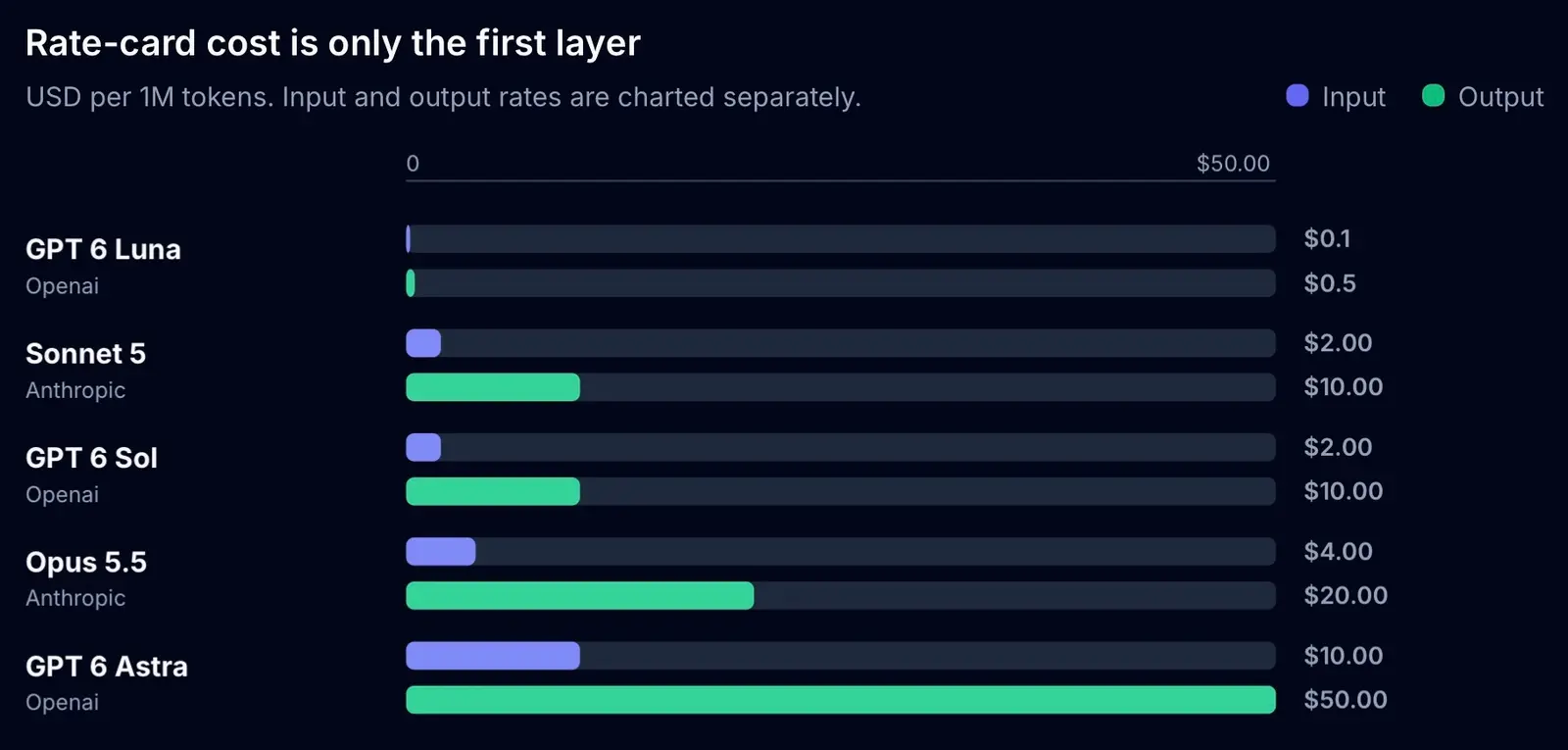
Claude Opus 5.5 and GPT-6 Sol both scored 49 out of 49 with zero errors on the same deterministic test suite. Even so, the Opus run cost $0.05422 against $0.015922 for Sol, 3.4 times more per correct answer, according to a cost analysis by Aipricing. The authors argue that the number to compare is dollars per accepted task, and on these short tasks the cheaper rate card still won.
At a glance
- Claude Opus 5.5 and GPT-6 Sol launched on September 22, 2026, and Opus 5.5 charges exactly twice Sol's rate for fresh input, cache writes and output, while cache reads cost the same.
- In the control run Opus used 5,330 prompt and 1,645 completion tokens against Sol's 3,426 and 907, so it paid the higher rate on more tokens instead of fewer.
- The suite was short and machine-graded, Anthropic's benchmark lead comes from its own launch table, and the breaking API changes in Opus 5.5 can add retries that no rate card shows.
If you have not been following, both launches came with price cuts against their predecessors. Anthropic says Opus 5.5 costs 40% less to run than Opus 5 and performs at the level of Claude Fable 5.1 on most work. According to VentureBeat, Sol's $2 and $10 per 1M tokens is exactly half of GPT-5.6 Sol's $4 and $20, and lands directly at Claude Sonnet 5 pricing, which Anthropic made permanent in August.
At equal token volumes, Opus 5.5 costs twice as much as GPT-6 Sol
For standard short-context API work, GPT-6 Sol costs $2 per 1M input tokens, $0.20 for cached input, $2.50 for cache writes and $10 for output. Claude Opus 5.5 costs $4 for input, $0.20 for cache reads, $5 for five-minute cache writes and $20 for output. Anthropic also charges $8 per 1M for one-hour cache writes.
Cache reads are the one line where the two match. Sol applies a higher rate once a request exceeds 272,000 input tokens, while Opus 5.5 publishes one standard rate across its 1M-token context. At equal volumes Sol wins, so Opus has to cut the amount of work per task to earn back its premium.
Opus 5.5 matched Sol's 49/49 score and used more tokens doing it
The Aipricing control sent both models through the same exact route on a deterministic suite. Both scored 49/49 with zero errors. Opus used 5,330 prompt and 1,645 completion tokens, Sol used 3,426 and 907, and the run cost $0.05422 for Opus against $0.015922 for Sol. On these short machine-graded tasks, Opus did not make up its rate premium through efficiency.
The same run showed progress over the previous Opus. Opus 5 scored 48/49 for $0.09366, so Opus 5.5 came out 43% cheaper per correct answer. That is close to Anthropic's estimate of about 40% for a typical default-settings workload.
Anthropic breaks that estimate down into standard input and output rates 20% below Opus 5, cache reads 60% below, and fewer tokens per task. Aipricing treats the 40% as a provider estimate, not a universal invoice discount, and says the 49-task result says nothing about repository-scale coding.
Anthropic's launch table puts Opus 5.5 at 66.4% on Terminal-Bench 4.0, against 37.3% for Sol
In the same table Anthropic reports 54.4% on FrontierCode against Sol's 47.5%, and 57.8% on CursorBench against 41.7%. Aipricing calls these useful shortlist evidence and says they fall short of a neutral head-to-head test. Anthropic publishes the table, effort settings differ by result, and each vendor uses its own harness and cost assumptions.
Anthropic also claims that default-effort Opus 5.5 beats GPT-6 Astra at about one-fifth of the cost, but that claim covers selected FrontierCode and GDPval comparisons only. At equal token volumes, the standard input and output prices of Opus 5.5 are 60% below Astra's short-context rates. Any saving beyond that has to come from fewer tokens, calls, retries or failures.
The Hermes subscription plugin meters about 1.7 times the Claude Code TUI
The OpenClaw build checked on launch day did not yet list Opus 5.5 in its Anthropic model catalog. OpenClaw can run Claude through the official CLI with claude -p, and its documentation says that route draws on the signed-in subscription's Agent SDK limits. Aipricing advises waiting for a tested compatibility path or validating a deliberate override.
Hermes has a separate experimental Claude Subscription DirectSDK plugin. Its September 22 catalog lists claude-opus-5-5[1m] and requires Hermes 0.21.4 or newer plus a logged-in Claude Code CLI. The plugin's own test found metering equal to claude -p, about 1.7 times the interactive TUI meter. On identical coding tasks, Hermes sent about 0.6 times as many tokens as native Claude Code.
The two effects can offset each other, and only a paired workload test settles the bill. The plugin is also separate from the direct Anthropic OAuth path in Hermes, which Hermes documents with different plan and extra-usage behavior. Check which provider is selected before you count a subscription as included usage.
Effective task cost adds retries, failed runs and review minutes to the token bill
Aipricing's model of an agent bill adds up model tokens, cache writes, tool fees, retries, failed runs and reviewer time. If Sol needs ten calls where Opus needs five, the nominal 2x gap can disappear. If both finish in the same number of calls, Sol usually keeps its edge. A cheap run whose patch fails tests may save nothing.
Picture two plumbers. The one charging half the hourly rate is the cheaper hire only if he does not need a second visit. Opus 5.5 always uses adaptive thinking and rejects requests that try to disable it. It does not support forced tool choice, it ties thinking blocks to the model and conversation, and it moves progress text between tool calls into thinking blocks.
Anthropic's API and Google Cloud also reject one older version of the computer-use tool. A harness that mishandles any of these changes can retry, lose reasoning state, show silent progress or fail a tool round, and every extra loop raises the effective cost.
The 3.4x figure comes from 49 short machine-graded tasks, and the benchmark lead comes from a table Anthropic publishes with its own harness and effort settings, so neither settles repository-scale work. Oddly, the numbers that matter most to subscription users, the 1.7x meter and the 0.6x token ratio, come from the Hermes plugin's own test and not from Anthropic. Your own traces are likely the only neutral data you will get.
Before OpenClaw lists Opus 5.5
No date has been given for OpenClaw adding Opus 5.5 to its catalog. Until then, Aipricing suggests a controlled pilot that keeps the task set, repository commit, tool list, permissions, cache state, effort and stop policy the same for every model. It should log successful tasks, tokens, cache reads and writes, tool calls, wall time, retries, failures and review minutes. Keep GPT-6 Luna or Claude Sonnet 5 as cheaper controls.
Related stories
- Opus 5.5 leads the index and burns 260M tokens doing it
- Fable 5.1 tops Artificial Analysis at 66, costs 20% more
- Claude Sonnet 5 increases performance at a higher cost per task
- New Claude models consume more tokens but cost less per solved task
- Anthropic will bill again for requests its safeguards block
- Opus 5.5 finds new bugs for CodeRabbit and misses old ones
Comments
No comments yet. Be the first.
Join the conversation
Sign in with Google to leave a comment. Your name and avatar come from your Google profile, and the comment appears after moderation.