
ElevenLabs’ Realtime v1 Max starts speaking in 0.57s
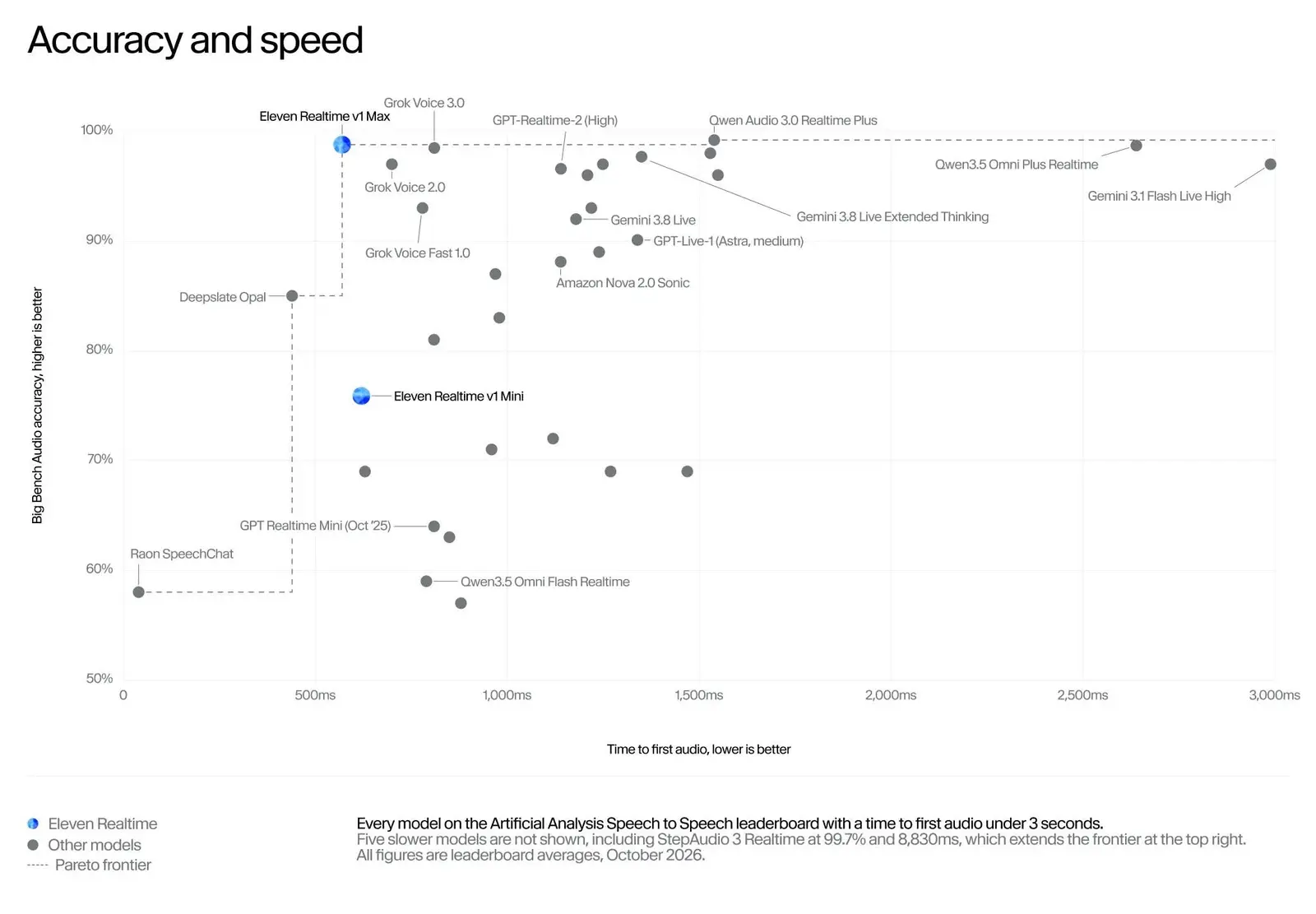
On October 21, ElevenLabs released two speech-to-speech models, Eleven Realtime v1 Max and v1 Mini. Both take speech in and answer in speech, and they’re available in the ElevenAgents platform and through an API. For anyone who already has a voice agent running, the API matters most. It’s built to be compatible with OpenAI’s Realtime API, so moving over means changing the endpoint and the model name and keeping the rest of the code.
The ElevenLabs Realtime page goes further than a compatible request format. Under “Same events, same handlers”, it says every client and server event arrives the same way it does from OpenAI. Handlers, logging and other tooling written for OpenAI’s API should keep working without edits. For a new project, ElevenLabs offers a skill that installs with one command and handles setup on its own, promising that “Realtime voice lands in your product in minutes.”
The two models are aimed at different jobs. ElevenLabs says v1 Max is “Optimized for complex tasks” and recommends it for work that needs precise, thoughtful answers, such as customer support and lead qualification. It scores 98.8% on Big Bench Audio, a reasoning test with the questions given as speech, and starts speaking in 0.57s. ElevenLabs says v1 Mini is tuned for natural conversation at low cost and points it at AI assistants, educational tutors and interactive characters.
So far “low cost” is all the pricing Mini gets, and no per-minute price has been named. xAI’s speech-to-speech model, Grok Voice 3.0, went out in October at $0.08 per minute.
Behind both models, ElevenLabs says, speech recognition, turn-taking, the LLM and the voice are tuned end-to-end as a single system. Turn-taking is the part that decides when the caller has finished and the agent can start talking. A typical voice agent chains these steps as separate components, each set up on its own. ElevenLabs offers the chain as one tuned unit and doesn’t say how it’s built inside. It ships with more than 17,500 voices and covers over 90 languages.
The models go into a platform that already has users. When ElevenLabs renamed Conversational AI to ElevenLabs Agents, it said customers had built more than 2 million agents, which had handled over 33 million conversations that year. In ElevenAgents, one agent can go out to phone, a web widget, WhatsApp and a contact center platform without a separate integration for each. The same agent gets a knowledge base, guardrails, tests against scripted scenarios and monitoring in production.
A lot of the page is written for compliance teams. Conversations can be viewed and audited in a separate dashboard, where every one is logged and searchable. Data is encrypted in transit and at rest, and ElevenLabs lists support for SOC 2, HIPAA and GDPR compliance. For tighter control over data there are EU Data Residency and Zero Retention modes.
Developers who build in ElevenAgents rather than on the API have the shorter path. When creating an agent, you set its model to v1 Mini or v1 Max, and transcription, turn-taking and voice are already configured.
Up next
OpenAI keeps Codex cache forever, API cache gets 12 hours
Pick up an old Codex conversation hours later and you take no cache penalty. OpenAI says it keeps cache forever for logged-in Codex and Work users, and API cache lasts 12 hours. How many hours do your Codex sessions usually sit idle before you come back?
Related stories
- Mistral’s Voxtral 3 TTS costs $13 per 1M characters
- GPT-Live-1.1 makes ChatGPT Voice say “checking...” less
- Grok Voice 3.0 takes first place at the old $0.08 price
- Microsoft brings streaming MAI-Transcribe-2 to its APIs
- FLUX 3 Max outpaces Seedance 2.5 over 25x in fal’s test
- FLUX 3 Image Klein’s 5.6B count leaves out its encoder
Comments
No comments yet. Be the first.
Join the conversation
Sign in to leave a comment. It appears after moderation.