
Claude Code and two free models split on Next.js picks
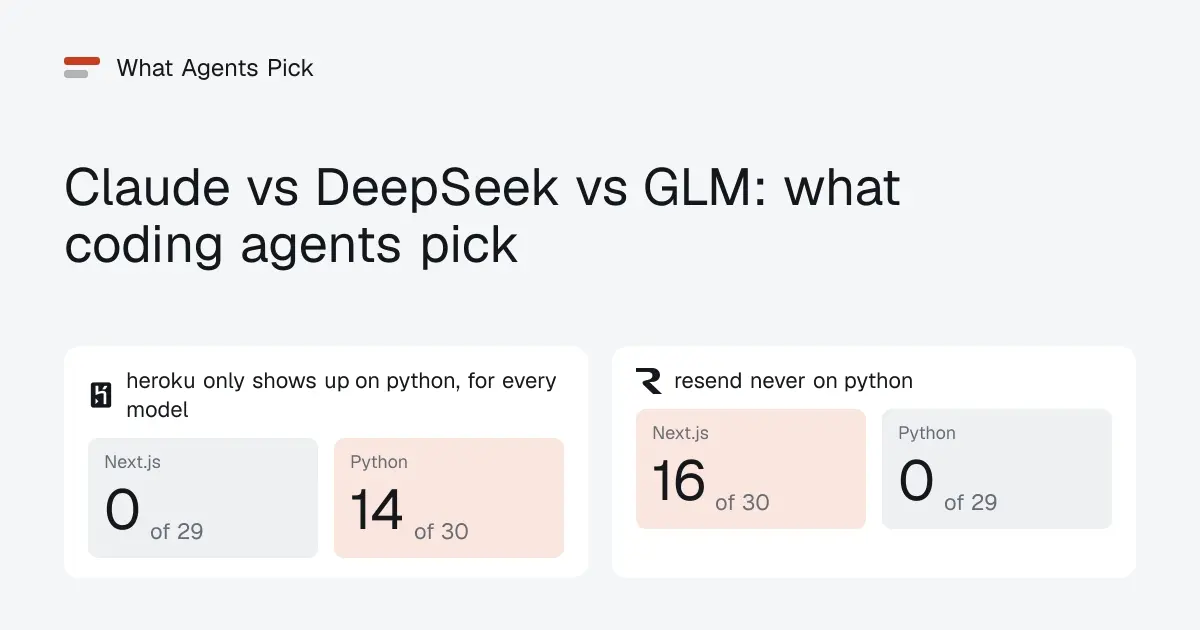
A Whatagentspick scoreboard, updated on October 27, gave Claude Code and two free models running in OpenCode, DeepSeek V4.1 Flash and GLM 5.3 Flash, the same prompts to choose an ORM, a deployment target and an email service for Next.js and FastAPI projects. Their top picks matched in two of three categories on Python and in none on Next.js. On a Next.js project, the database library, host and mail setup the agent installs depend on which model drives it, while on Python all three settle on SQLAlchemy and raw SMTP.
The samples are uneven. Claude Code got 18 runs per category and stack, six each for Opus 5.5, Sonnet 5.5 and Haiku 5.5, while DeepSeek and GLM got 6 each on OpenCode’s free tier, and the scoreboard itself says to read those small samples as a lead.
Where Next.js splits
ORM is the closest call. Claude chose Drizzle ORM in 12 of 18 runs, with Opus, Sonnet and Haiku at 4 of 6 each, and GLM chose it in 5 of 6. The category counts as a split only because DeepSeek tied Drizzle ORM and Prisma at 2 of 6.
Deployment has no shared answer. Claude went to plain Docker in 14 of 18 runs, and Haiku 5.5 did so in all six. DeepSeek tied Fly.io and plain Docker at 2 of 5 scored runs; GLM tied plain Docker with a deployment setup it wrote itself at 3 of 6.
Email splits along vendor lines. Claude picked Resend in 11 of 18 runs, Haiku 5 of 6 and Opus and Sonnet 4 each, while GLM wrote raw SMTP in 4 of 6 and DeepSeek went 3 and 3 between the two. Across all three models, Resend took 16 of 30 Next.js runs.
Python: the stack decides
On FastAPI the models line up. SQLAlchemy was Claude’s pick in 18 of 18 runs, DeepSeek’s in 6 of 6 and GLM’s in 4 of 5. Raw SMTP won email with 17 of 18 for Claude, 5 of 5 for DeepSeek and 5 of 6 for GLM, 27 of 29 Python runs in total. Resend, the favourite on Next.js, appeared in none of the 29.
Deployment is the one Python split, and it is narrow. DeepSeek chose Heroku in 3 of 6 runs and GLM in 4 of 6, while Claude tied Heroku and plain Docker at 7 of 18. Heroku took 14 of 30 Python deploy runs, for every model, and 0 of 29 on Next.js. The scoreboard’s two biggest splits, Heroku and Resend, run between the stacks, whichever model is picking.
Runs and cost
Every run used the same prompts, the same starter projects and the same detector for what got picked, with a cap of 12 steps. All 108 Claude runs were scored; DeepSeek landed 34 of 36 and GLM 35 of 36, because 3 of the 72 free-model runs made no attempt and were left out. The Claude runs cost $11.21, about 10 cents a run, against $0 for the two free models. The raw runs are published on GitHub.
Against earlier Claude-only data
Amplifying ran a larger, Claude-only version of this question: 2,430 open-ended prompts to Claude Code with no tool named in any of them, recording what it installed, across Sonnet 4.5, Opus 4.5 and Opus 4.6. Compared within an ecosystem, those three models picked the same top tool in 18 of 20 categories. With three vendors instead of three Claude generations, agreement on today’s scoreboard is 2 of 6 category and stack pairs, though the two tests differ in prompts, categories and model versions.
Amplifying also found that the project mattered more than the phrasing of the prompt, with the same category yielding Vercel on Next.js and Railway on Python. Mohammad Khan, summarising that data, put Vercel at 100% for JavaScript projects and Railway at 82% for Python. The deployment picks on the new scoreboard are plain Docker, Heroku, Fly.io and setups the models wrote themselves, and the stack still divides them: Heroku shows up on Python and nowhere else.
Up next

FTC demands Anthropic execs testify in consumer harm probe
The FTC escalated its probe on Monday, demanding that Anthropic executives testify. The demand landed the same day Anthropic filed its S-1, which warns of disproportionate government scrutiny. Does an FTC probe change what you’d hand to Claude?
Related stories
- Claude Code matches Codex on SWE-Bench Pro at twice the cost
- A four-model Claude ensemble scored 78% on Terminal-Bench 2.1, at double the cost of first place
- Auditing one Claude session: 7.5M tokens, 4,038 tool calls
- Claude Code adopters merged 24% more PRs, study finds
- Claude Code sends 33k tokens before it even reads your prompt; OpenCode uses 7k
- Claude Code won’t type passwords, even in a test env
Comments
No comments yet. Be the first.
Join the conversation
Sign in to leave a comment. It appears after moderation.