
anthropic
Claude Fable 5.1 cracks Urquhart's Cyphral Distich
Claude News
 anthropic
Claude Fable 5.1 has produced a solution to Sir Thomas Urquhart's Cyphral Distich, a 64-number cryptogram unread since the 17th century, in 44 minutes and 176,000 tokens with no intervention from the operator, according to the run and decipherment published by Vals, whose author set the model an open task and then left it alone.
At a glance
- The cipher's key turned out to be the book that printed it: each of the 32 numbers in a line indexes a word inside the matching Proquiritation, and its first letter is kept.
- Two lines of 32 letters each read as a rhyming prayer for Charles II, matching the poem's promise of the author's mind and the distich form Urquhart advertised.
- The same rule applied to pages instead of paragraphs decoded the 285-number Cyphral Octastich in The Jewel of 1652 down to nine unreadable letters in its fifth line.
The result matters less as cryptanalysis than as a measure of attention. The Distich stayed open because reading Urquhart's Proquiritations closely enough to count them was tedious work nobody had a reason to do, and the model did it because it was asked. That appears to generalise to a wide class of archival puzzles, forgotten conjectures and unread source texts, where the missing ingredient was never technique but somebody willing to keep looking at material of no obvious payoff.
The 32 numbers in each line index the 32 Proquiritations printed before the cipher
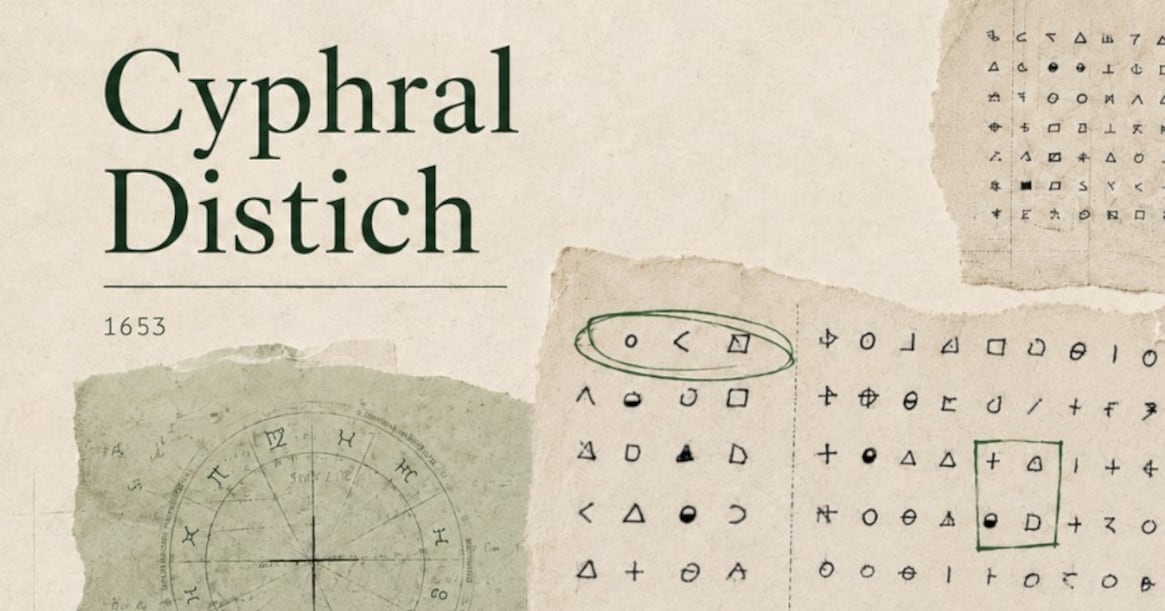
The cryptogram closes Urquhart's Logopandecteision, printed in London in 1653: two lines of 32 numbers, 64 in all, with no key attached. Notes and Queries posed it as an open problem in 1899, and Klaus Schmeh later listed it among his Top 50 unsolved encrypted messages.
Earlier work applied frequency analysis, plain substitution and homophonic substitution, each assuming a cipher alphabet that had to be reconstructed from outside the book. Two printed hints pointed elsewhere: the 32 Proquiritations standing immediately before the cipher, and the poem's promise that an honest reader will find "his own heart's wishes, and the Author's minde".
The rule reads the i-th number of a line as a word index into the i-th Proquiritation and keeps that word's first letter. Both lines come out at exactly 32 letters: O GOD UPHOLD KING CHARLS THE SECOND AND MAKE HIM THE SUPREME RULER OF THIS LAND, a couplet rhyming on "and" and "land".
The Jewel's 284 numbered pages key a 285-number royalist prayer
Urquhart left a second cryptogram in the same style, the Cyphral Octastich in The Jewel of 1652: 285 numbers across eight lines and a Decagram, equally unsolved. The Jewel has exactly 284 numbered pages, and the k-th number works as a word index into page k.
In the EEBO-TCP text, 231 of 275 readable positions are exact first-occurrence hits, meaning Urquhart usually took the first word on a page starting with the letter he needed; the other 44 sit one to three words off for identifiable transcription reasons. Decoded, the poem is an ottava rima prayer for Charles II, written in London in March 1652.
Nine letters remain unreadable: positions four to twelve of line five, keyed to pages 149 to 157, yield C-O-N-E-R-T-H-T-O. Line four enciphers IRSH rather than IRISH, and from position 159 onward every number keys to the previous page, a shift under which lines six to eight and the Decagram decode cleanly.
Months of attempts with other frontier models produced no verified solve, according to the author
The elicitation was minimal: a goal, some encouragement, a pointer to Fable's published math results, and two constraints. The model was told to avoid ciphers that already have solutions or admit many plausible answers, and to skip the hardest targets, Kryptos K4 among them.
The author writes that months of similar attempts with other frontier models produced no verified solve, and that Fable 5.1 surveyed candidate problems and abandoned those that would not move before noticing the clue here almost immediately. The same write-up frames the outcome as persistence rather than cryptanalytic depth, since the clue was simple once the count of numbers was matched to the count of paragraphs.
The run also produced a verification script printing all 285 octastick positions with page, word, letter and offset, plus a page parser and analysis tools. The reading of "sweigh" as the Scots swey rests on the Dictionary of the Older Scottish Tongue.
Confirming the nine letters
A check of Google Books, HathiTrust, the Internet Archive and the National Library of Scotland turned up no free page images of a 1652 Jewel, and the octastick sits on a final quire that the TCP copy lacks. Settling the nine letters and the off-by-one positions requires a physical copy or the 1983 Jack and Lyall edition.
Comments
No comments yet. Be the first.
Join the conversation
Sign in with Google to leave a comment. Your name and avatar come from your Google profile, and the comment appears after moderation.
We only use your name and avatar from Google. We never store your email address.