
A UK front company sourced 1,000+ Claude accounts a month
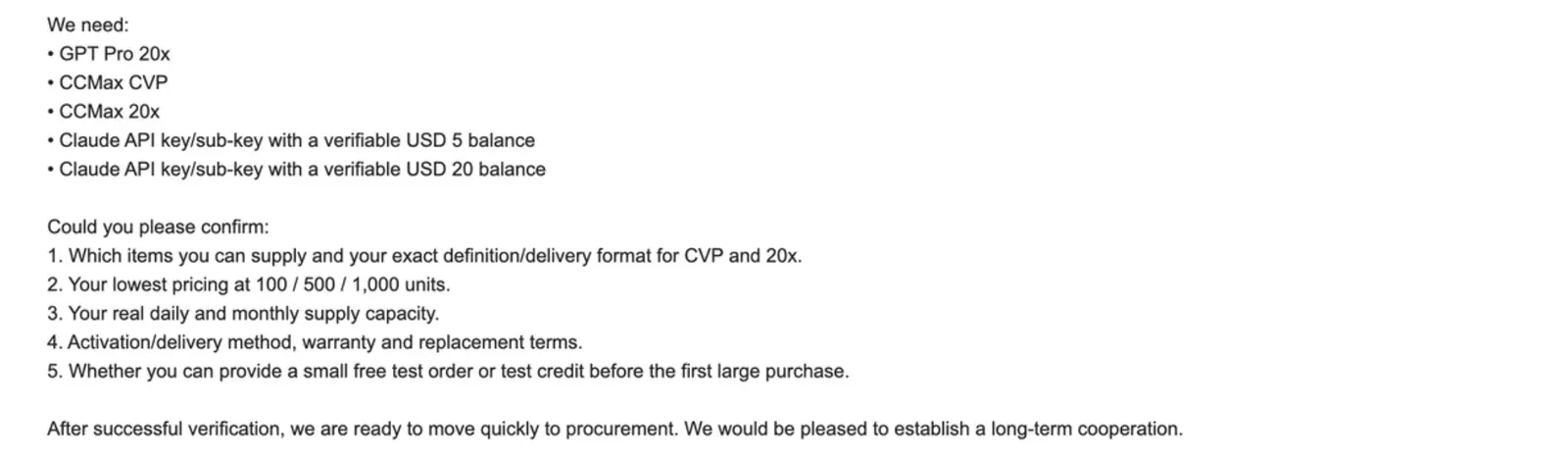
Threat researcher Matt Lenhard found a UK-registered company that presented itself as a software design studio and was in fact a Claude account reseller. The company emailed brokers to source more than 1,000 Claude accounts a month. His write-up for Vectoral, published September 3, uses shelf prices captured on August 30 to map the wholesale trade that supplies Chinese relays. Part of what that trade sells is developers’ own API keys and session cookies, taken by info stealers or in supply-chain attacks and resold straight to brokers or relays.
Lenhard sorts the buyers into three groups: foreign model labs that want accounts for distillation, relay operators looking for more token supply, and consumers who want cheap access or a way around geo restrictions. One of those buyer groups also shows up in Anthropic’s own account. Speaking to CNBC, Anthropic’s threat intelligence head Jacob Klein said firms like Moonshot AI spin up “tens of thousands, if not hundreds of thousands of fraudulent accounts” using stolen cards and compromised logins.
Wholesale below list, retail above it
The Chinese shops sell wholesale to relays, and a relay only makes money if it buys tokens below cost. Lenhard’s earlier relay research, published June 28, tracked 49 of these “transfer stations”. They pool many accounts behind one API. The cheapest of them, Now Coding, sells at a median 97.8% off official prices, and the ten busiest get a combined 3.6 million visits a month.
zhanghao66, which calls itself the lowest-price wholesale AI account shop, claims about ¥200,000 in daily sales, or roughly $28,000. It lists 37 SKUs, and Claude Max drops from ¥770 to ¥725 when you buy thirty units. On henduohaopifa, Claude Pro costs ¥168, Max 5x ¥880 and Max 20x ¥1,320. All three are recharges: the seller adds the subscription to the buyer’s existing account, the usual route around card and geo blocks. The Telegram merchant AI HOME advertises “Pro 20x finished accounts, only ¥200” and speaks to relay operators directly: “brothers running relay stations can pick these up.” Under one of its ads, someone pointed out that the suppliers next door were cheaper. A fourth shop, maihaoguanjia, carries about sixty SKUs and advertises KYC verification bypasses.
The same goods also sell retail on Goofish, Alibaba’s consumer resale marketplace. A search for “Claude Account” returns 306 listings. The median Claude Pro is ¥150 (about $21), against zhanghao66’s wholesale ¥128. Max 5x and 20x listings together have a median of ¥750 (about $105). Goofish shows no sales counts, but its “wants” counters add up to about 11,000. Warranties are priced in: one seller’s no-warranty tier refunds ¥10 if the account gets banned. Another offers invoices and corporate bank transfer.
plati.market, the Russian equivalent, works the other way round. A search for “Claude” returns 436 listings from 210 sellers, with 254,000 displayed sales between them. The largest single listing shows 88,084 sales, and one ChatGPT listing shows 115,207. Here Claude costs more than Anthropic charges:
- Claude Pro, one month: ₽1,999 (about $24) against a $20 list price, 20% over
- Claude Max 5x, one month: ₽13,999 (about $169) against $100, 69% over
- Claude Max 20x, one month: ₽23,999 (about $290) against $200, 45% over
Lenhard puts the gap down to who is buying. The Chinese shops supply relays, while plati sells to individual Russian buyers who cannot get a card to clear.
Where the accounts come from
Lenhard lists five sourcing methods. Standard recharges are sometimes credit card fraud but often just a geo workaround. Finished accounts arrive already registered and often already subscribed. Sellers also cash in on regional, carrier, handset, education and device promotions, and ridesharing spreads one account across several users. The fifth method is account takeover, which Vectoral says it is tracking as an emerging tactic that is becoming more common. Someone’s API key or session cookie is picked up by an info stealer or in a supply-chain attack, then sold to a broker or relay.
Lenhard’s broader thesis is that tokens now work like a pseudo-currency. That puts labs, inference providers, gateways and coding agents in a position similar to banks, in a segment that traditionally has not had to deal with fraud. He points out that if someone got into his bank account, ACH payments are reversible and any wire would notify him right away. “If they got my Anthropic account or API key, on the other hand …”
Up next
Claude, ChatGPT and Grok broke the same morning
“Not a good day for AI chatbots”: Claude, ChatGPT and Grok all threw errors Thursday morning, per MacRumors. Anthropic’s status page logged elevated errors on Claude, and the bots are coming back online.
Related stories
- Anthropic says Moonshot’s Kimi K3 was distilled from Claude
- Federal Register searched comments with Alibaba’s Qwen
- Claude opened the door to an OpenAI employee’s ChatGPT
- Stolen session keys are draining Claude Max accounts
- China’s vulnerability database flags a “backdoor” in Claude Code
- Anthropic’s IPO filing warns its models may resist shutdown
Comments
No comments yet. Be the first.
Join the conversation
Sign in to leave a comment. It appears after moderation.