
Anthropic files public S-1 for Nasdaq listing as ANT

Anthropic publicly filed its S-1 with the SEC on October 26 to list Class A shares on the Nasdaq Global Select Market as ANT. The audited net loss in it, $80.7 billion for the first half of 2026, is mostly a valuation effect: $72.4 billion comes from marking up convertible notes as Anthropic’s valuation rose, while the operating loss for the same six months was $693 million on $16.3 billion of revenue.
The share count and the price range have not been set yet, Anthropic’s announcement says, and Goldman Sachs and Morgan Stanley will hand out the preliminary prospectus. The public filing follows a confidential draft submitted on June 1. That leaves the more than $1.5 trillion cited by The Guardian as the value analysts and investors had previously put on the company, with no offering price behind it. The Series H round, sold between May and June, set a $965 billion post-money valuation. Bloomberg describes the filing as moving Anthropic a step closer to being “the first company focused primarily on developing the most advanced artificial intelligence models to go public.”
Where the $80.7 billion comes from
Before going public, Anthropic raised part of its money through convertible notes and SAFEs, instruments that turn into shares later. The filing carries them as liabilities at fair value, so every rise in Anthropic’s enterprise valuation makes them more costly to settle and lands in the income statement as a loss. For the six months to June 30 that line came to $72,388 million, or 89.6% of the net loss by our arithmetic. Another $8,757 million of other expense is a second valuation item: initial fair value recognition and later changes in the assets and liabilities under the 2026 note purchase agreements with Google and Amazon. Of that, $8.4 billion landed in the second quarter alone. Interest income of $1,111 million and $21 million of tax account for the rest.
The business underneath lost only $693 million, an operating margin of minus 4% on revenue of $16,286 million. Revenue was 14 times the $1,163 million of the first half of 2025, growth the filing states as 1,300%. By our reading, that is the 14-fold increase in the New York Times headline. Full-year 2025 revenue grew 11.9 times.
On Anthropic’s own adjusted measures, the half was profitable. Adding back $2,185 million of stock-based compensation and $126 million of non-cash charitable contributions turns the operating loss into adjusted operating income of $1,618 million, a 10% margin. Adding back the $72,388 million note remeasurement and $8,720 million of mark-to-market instruments as well gives adjusted net income of $2,671 million. Both measures were negative in every earlier period the filing shows, including 2025, at minus $4,854 million and minus $4,448 million.
In 2025 the same split shows up at a smaller scale. The net loss was $42.0 billion, $34.3 billion of it from the note remeasurement, against an operating loss of $8.06 billion and revenue of $4.585 billion.
Anthropic has left third-quarter revenue and run-rate revenue as of October 31 blank for now. But it states that Q3 revenue was 86 times the $197 million of the fourth quarter of 2024. By our arithmetic that implies about $16.9 billion, somewhere between $16.8 billion and $17.1 billion allowing for rounding. That is consistent with the $16.8 billion Bloomberg reported from Anthropic’s investor pitch, and more than the entire first half.
Who controls ANT
Class A buyers get one vote per share. Anthropic is a public benefit corporation, required to balance its stockholders’ financial interests with the interests of those materially affected by its conduct and with its stated purpose, “the responsible development and maintenance of advanced AI for the long-term benefit of humanity.” The Long-Term Benefit Trust, intended to operate as an independent body of financially disinterested trustees, holds Class T stock and through it elects the Class T directors, who will make up a majority of the board.
Just before the offering, a single Class F share goes to an LLC whose initial members are Dario Amodei, Daniela Amodei and Anthropic’s five other co-founders. It carries 50.1% of the voting power on matters put to stockholders generally, including the election of the directors the trust does not pick. Neither Class T nor Class F has economic rights. Employees other than the co-founders receive Class E stock that votes only on limited matters, and strategic partners mostly hold non-voting Class N shares, which generally convert to Class A when sold to an unaffiliated third party. Under Nasdaq’s governance rules, Anthropic counts as a “controlled company.”
The compute bill
The filing breaks out compute commitments by counterparty. They include at least $44.9 billion with Microsoft between November 2026 and May 2033 and at least about $114.5 billion with Google between April 2026 and July 2033, plus an estimated $125 billion to $150 billion of additional Google TPU compute for 2028-2031 that is left out of the commitments table. Amazon accounts for at least $110.0 billion between May 2026 and April 2036. The deal with SpaceX.AI, formerly X.AI, runs up to $120.5 billion into 2029, about $3.1 billion a month once all capacity is delivered, which Anthropic expects in December. Either party can cancel it on 90 days’ written notice after January or March 2027.
Other lines include up to about $44.6 billion with Nscale, about $41.3 billion with Lambda, more than $20 billion with AMD if the initial tranche is taken, and about $161.2 billion of rent on Broadcom equipment leases, excluding interest. Anthropic has not yet filled in its aggregate committed-spend total. Leaving out the TPU estimate, the Microsoft, Google, Amazon and SpaceX.AI commitments come to $389.9 billion by our count.
Our analysis
What we checked
On October 26 we read the S-1 as filed, rebuilt the first-half 2026 income statement from its tables and checked the figures against earlier reports of the prospectus.
The loss itself holds up. The Wall Street Journal saw the prospectus before it went public and reported more than $80 billion; the audited figure is $80,748 million, which headlines round to $81 billion. What changes is how to read it. Most of the loss is Anthropic’s own rising valuation passing through its books, and two earlier accounts need correcting:
- The 2025 gap between net and operating loss had been described as writedowns of liabilities tied to fundraising. The filing says the convertible notes were marked up as the enterprise valuation rose, so a higher valuation produces a bigger reported loss.
- The Guardian reports that Anthropic was designated a supply chain risk, which it calls a first for an American company, that this bars military agencies from contracting with it, and that Anthropic has challenged the decision. The filing gives the fuller record. In February the President directed all federal executive agencies to stop using Anthropic’s technology, and the Secretary of War said that “no contractor, supplier, or partner that does business with the United States military may conduct any commercial activity” with the company. On August 27 a district court granted summary judgment “largely in our favor,” as Anthropic puts it. On September 25 the D.C. Circuit ruled 2-1 that the Section 4713 designation “was proper,” and Anthropic has petitioned for rehearing en banc. Separately, in June the Commerce Department imposed worldwide export restrictions on the Fable 5 and Mythos 5 models, and Anthropic disabled them for all customers until those restrictions were lifted.
Up next
Anthropicanalysis
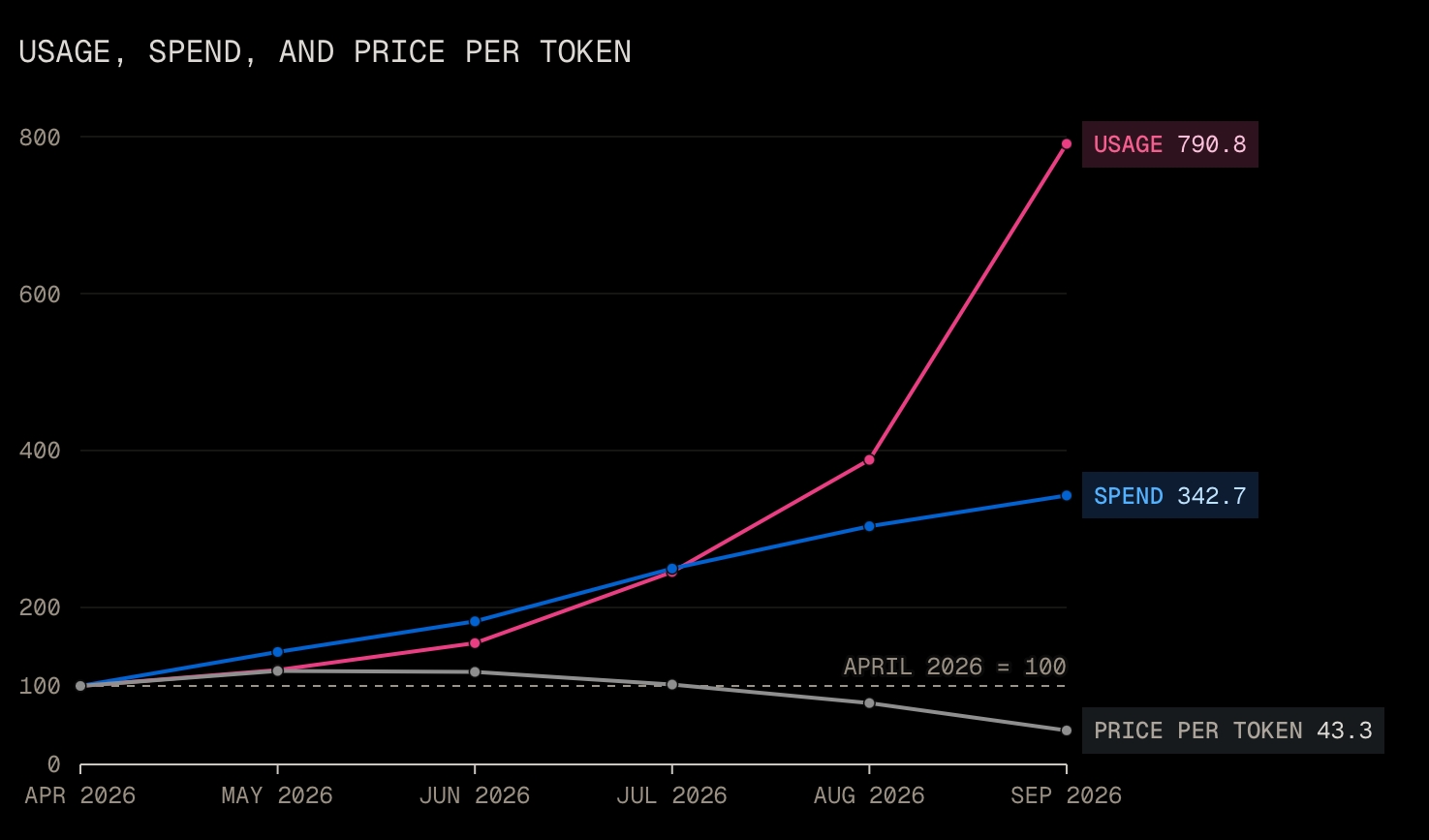
Opus 5.5 cut cache reads from $0.50 to $0.20 per MTok
A coding agent rereads the whole chat each turn, so cache reads are 96-99% of its token bill, one analysis finds. Opus 5.5 cut them from $0.50 to $0.20 per million tokens. Is your Claude Code usage billed through the API or a subscription?
Related stories
- Over 80% of Anthropic’s Q3 revenue came from new models
- Anthropic’s S-1 caps SpaceX compute spend at $120.5B
- Anthropic’s S-1 shows a net loss over $80B in six months
- Anthropic’s IPO filing: $42B net loss, $518B compute bill
- Anthropic pledges 5% of its shares to a public benefit fund
- Junior technical hires at Anthropic fell from 27% to 9%
Comments
No comments yet. Be the first.
Join the conversation
Sign in to leave a comment. It appears after moderation.