
anthropic
Claude's file checker reads C2PA credentials
Claude News
 anthropic
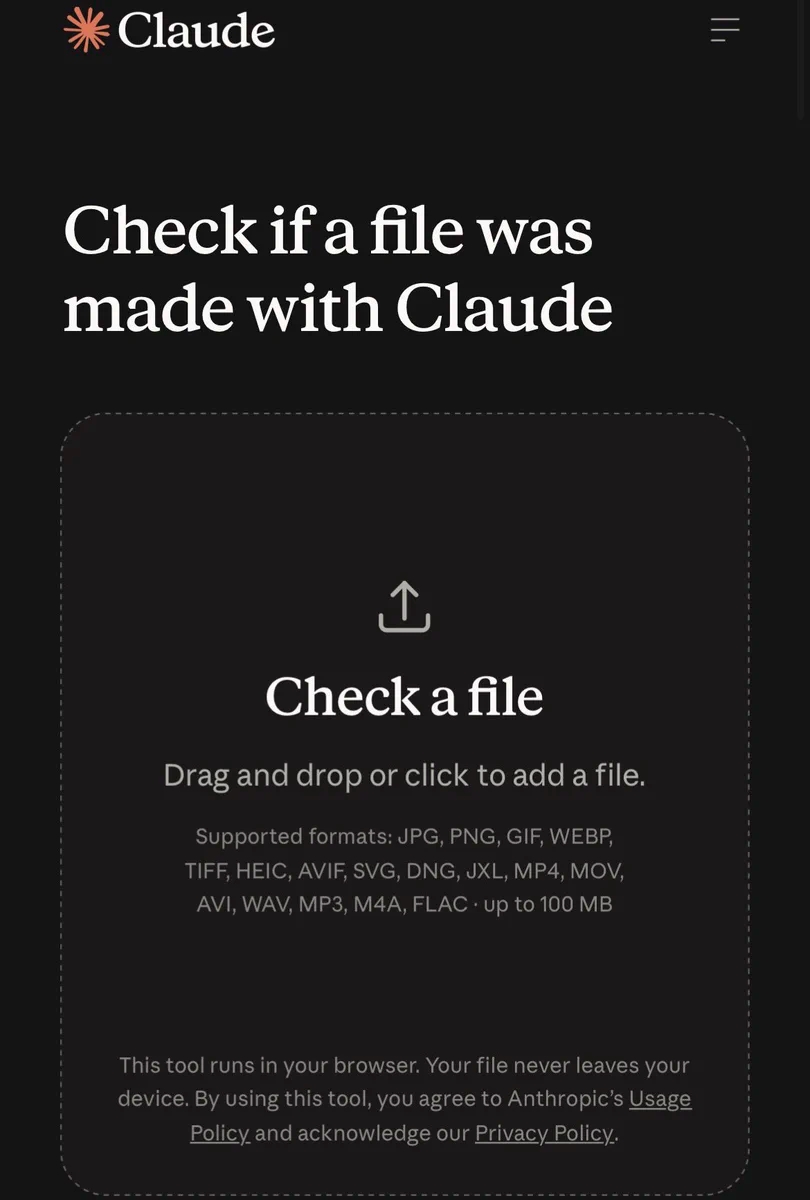
A file checker published on the Claude site reads uploaded images, video and audio for a C2PA content credential naming Claude, accepting 17 formats at up to 100 MB per file. The tool and its description sit on Claude, which frames it as a provenance check rather than a judgement about the content.
At a glance
- The check looks for a C2PA content credential, the record attached when a file is created or edited that names what produced or altered it, and reports any credential pointing to Claude.
- Ten image formats, three video formats and four audio formats are accepted, from JPG and SVG through DNG and JXL to MP4, MOV, WAV and FLAC, each capped at 100 MB.
- Uploaded files stay on the device, with the checker reading only the embedded credential rather than the content, and the page states that files are never stored or used for any other purpose.
The design reads as a deliberately modest claim about provenance: the checker verifies a marker, not authorship, and its answer is only as durable as the metadata a file happens to carry. For developers shipping Claude-generated assets, that likely makes the credential a routine pipeline concern, since ordinary re-encoding and platform processing can quietly discard it, leaving a genuine Claude output indistinguishable from an unmarked one.
The checker takes 17 formats at up to 100 MB per file
The page takes a file by drag and drop or file picker, and accepts ten image formats: JPG, PNG, GIF, WEBP, TIFF, HEIC, AVIF, SVG, DNG and JXL. Video is covered by MP4, MOV and AVI, audio by WAV, MP3, M4A and FLAC, with a 100 MB ceiling on each upload, seventeen formats in total.
The page states its purpose in provenance terms: knowing where content came from, and whether AI was involved, makes it easier to trust what circulates online. The question an upload answers is narrow, covering only whether Claude helped create or edit the specific file that was submitted.
Detection depends entirely on a C2PA content credential
Detection rests on a single mechanism. The tool looks for a C2PA content credential, the record attached when a file is made or edited that shows what created or changed it, and it reports a match on the page when that record points to Claude.
The stated limits follow from that dependence. A credential can be removed from a file, and content produced by a model, platform or feature that does not support marking never carries one, so an empty result does not establish that Claude was uninvolved.
C2PA credentials are an industry provenance standard rather than a Claude-specific marker, which is why the same embedded record can be read by other tools that implement it. The page performs one specific comparison: whether the embedded record names Claude.
The file stays on the device and only the credential is read
The page is explicit about handling. The uploaded file stays on the device, and the checker reads the embedded credential rather than the file itself, with no examination of the content itself. Files are never stored or used for any other purpose, the page says.
A positive result is equally narrow in scope. It indicates that the content was processed by Claude and says nothing about the substance of that content, a distinction the page underlines alongside a pointer to fuller documentation on how the check works and what it cannot catch. The wording covers editing as well as generation.
Which Claude outputs carry credentials
The page does not say which Claude products, models or features attach a C2PA credential, and it lists no document or text formats among the 17 it accepts. It also gives no detail on how the checker behaves with a credential that names a tool other than Claude. Nothing is said about wider format support later on.
Comments
No comments yet. Be the first.
Join the conversation
Sign in with Google to leave a comment. Your name and avatar come from your Google profile, and the comment appears after moderation.
We only use your name and avatar from Google. We never store your email address.