
Curative now signs in a week what took all of 2025

Health insurer Curative now signs 2,000 to 2,400 provider contracts a week with Gwen, an agent on Claude, against 2,100 in all of 2025, the company said in a November 10 case study on Claude’s site. Gwen never prices above Curative’s rate template on its own authority: it works each deal on Opus, a Sonnet reviewer rules on any higher rate and passes what it won’t clear to CEO Fred Turner, and a Haiku judge reads every message before it goes out. The figures are Curative’s own, from Anthropic’s customer series.
Curative counts 23,000 contracts signed with Gwen so far and puts the pace at about 50 times faster than its team managed in 2025. The plan it sells to employers has $0 copays and $0 deductibles for in-network care once a member completes a Baseline Visit. “Last year we signed 2,100 contracts, twice as many as we did the year before, but at 2,000 a year, we realized it would still be a 30-year build,” Fred said.
Inside a Gwen deal
Each Gwen run handles a single provider, mostly on Opus, and keeps no memory from one deal to the next, so nothing from another negotiation influences it. When a practice fills in the form on Curative’s website, Gwen researches it and replies with proposed rates built from a purchased claims data set and the price-transparency files payers are now required to publish, and it shows the provider that market data to support the offer. Outbound is slower work: some providers answer only after the fourteenth email and the ninth fax.
Rates above the template go through the reviewer. Gwen writes out why it wants to exceed the template, and the Sonnet agent decides whether the number makes sense. It clears about two-thirds of those requests; anything non-standard goes to Fred. Early on, Gwen needed human approval for any rate a certain amount above the template, and Curative loosened those limits in steps before adding the reviewer. “Having a second agent review rates worked better than just giving Gwen more authority,” Fred said. What still reaches him, he says, is “a big medical group or someone with a weird request that would come to me even if this wasn’t an agent-led motion.”
The Haiku judge arrived only after Gwen copied providers on internal notes about how high it could go. A blocked message comes back with the reason attached, so Gwen can rewrite it and try again.
Each contract takes about 20 million tokens, roughly a tenth of the original cost. That efficiency underpins one of Curative’s core strategies: signing smaller providers that larger networks have often overlooked. “From that agent’s perspective, this provider is its only focus,” Fred said.
During negotiation Gwen checks a practice’s redlines against Curative’s policy document, then writes Python to merge both sides’ changes into the final contract. From form to signature can take as little as an hour. After signing, a separate credentialing agent checks the provider’s licenses, and other agents load the provider’s data and contract so claims can price against it.
Lessons for agent builders
Curative started with a set of purpose-built tools and found redlining too complex for them. “What we found works best is that the model just has one tool, which is run Python, and it does all the redlining with a docx library,” Fred said.
Brad, an Opus-based agent that sells the plan to employers mainly through brokers, does keep memories, which works but needs care: “You can end up making notes that are wrong and then get into these doom loops, where it has a bad memory that can never be cleared,” Fred said.
Every few days Fred gives Claude Code the same prompt: sample the last 10,000 runs, flag anything weird and open a PR to fix it. For auditing hundreds of thousands of messages, Curative’s advice is to log everything, put a judge agent on every outbound message and have Claude Code sample the runs.
A fax tool more than doubled Gwen’s win rate, and many providers now handwrite on a printed fax and send it back. “Yes, they have email, but really they’re comfortable in fax,” said CTO Isaac Turner.
For a long time Gwen was barred from protected health information (PHI), so early mistakes happened in lower-risk settings. Where agents touch PHI now, back-end controls limit what enters a conversation and agent activity is logged for audit. Isaac credits Anthropic with shipping HIPAA-compliant versions of new services quickly, and Business Associate Agreements, the contracts HIPAA requires before a vendor can handle PHI, have gotten easier to sign.
When providers asked for a flyer to share internally, Gwen made one with its Python tool, with no policy telling it to. When a front desk turned away a member at an in-network practice, Gwen asked the office to train its staff, then checked that the member got in. Curative’s rule is to watch what the agent starts doing on its own and make sure it matches the company’s risk profile.
Where the humans sit
The contracting team grew from 45 to about 55 people after Gwen launched, each about 2.5 times as productive by Curative’s count. They hand Gwen cold outreach and paperwork and take warm leads by phone, and they are paid on Gwen’s deals too, so people and agents share one target.
All of the agents run on claims, prior authorization and finance systems that 13 engineers rebuilt this year with Claude Code; the team had once sized the claims system alone at 100 engineer-years. “The claim system is Python running in AWS, and it has an MCP and it has an API, and Claude wrote it, so it understands it,” Fred said. Claims disputes that used to take about 90 days now get a claim-specific letter in under 30 minutes by email or fax. Next, Curative plans to bring agents to care navigation, extending the reach of the 130 people who guide and coach its members.
Mistakes are planned for. “The bar is, if you had a thousand people signing contracts, how many mistakes would they make that you regret?” Isaac said.
Up next
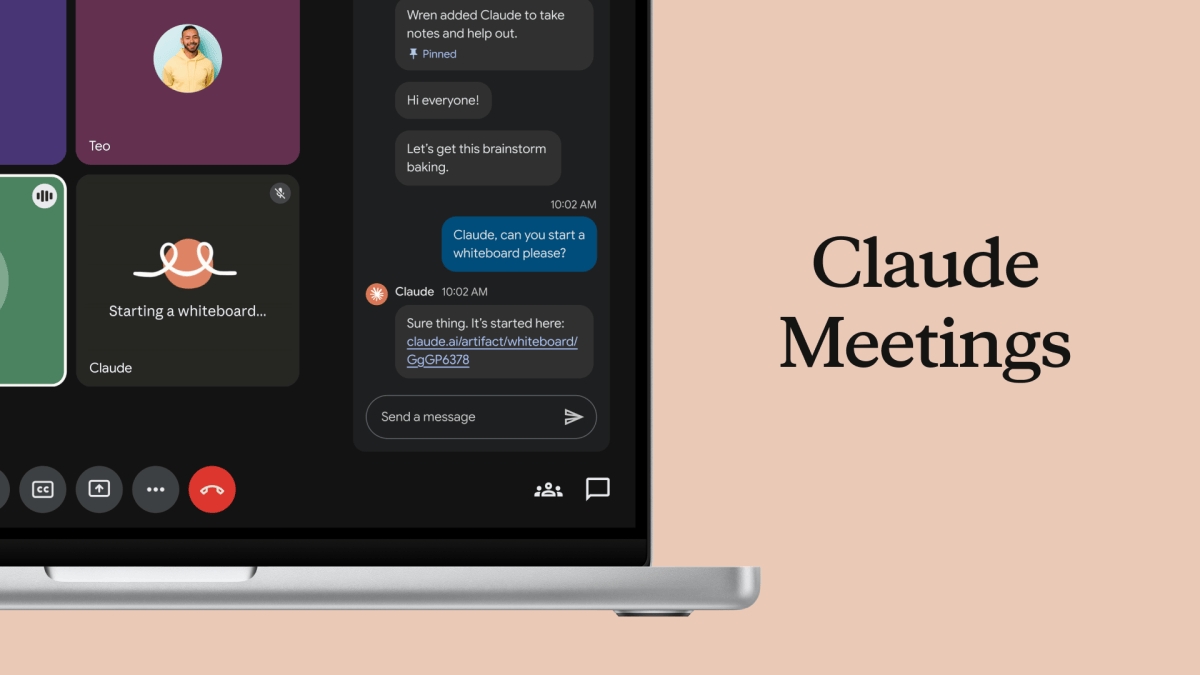
Claude Meetings joins Google Meet calls as a participant
Claude can join a Google Meet call as a visible participant and draft the plan as people talk, but unless an admin authorizes external guests, it leaves when one joins. How many of your weekly calls include someone from outside the company?
Related stories
- ABC Legal runs 50+ Claude agents built by non-developers
- Claude’s commerce blueprint ships two reference agents
- Five agent tools reach Claude deployments hosted on Azure
- Enterprise auth for MCP connectors is GA in Claude
- Claude integration launches within Notion
- Anthropic introduces self-hosted sandboxes and MCP tunnels for agents
Comments
No comments yet. Be the first.
Join the conversation
Sign in to leave a comment. It appears after moderation.