
Only 20% of brand mentions overlap in Claude vs Claude Code
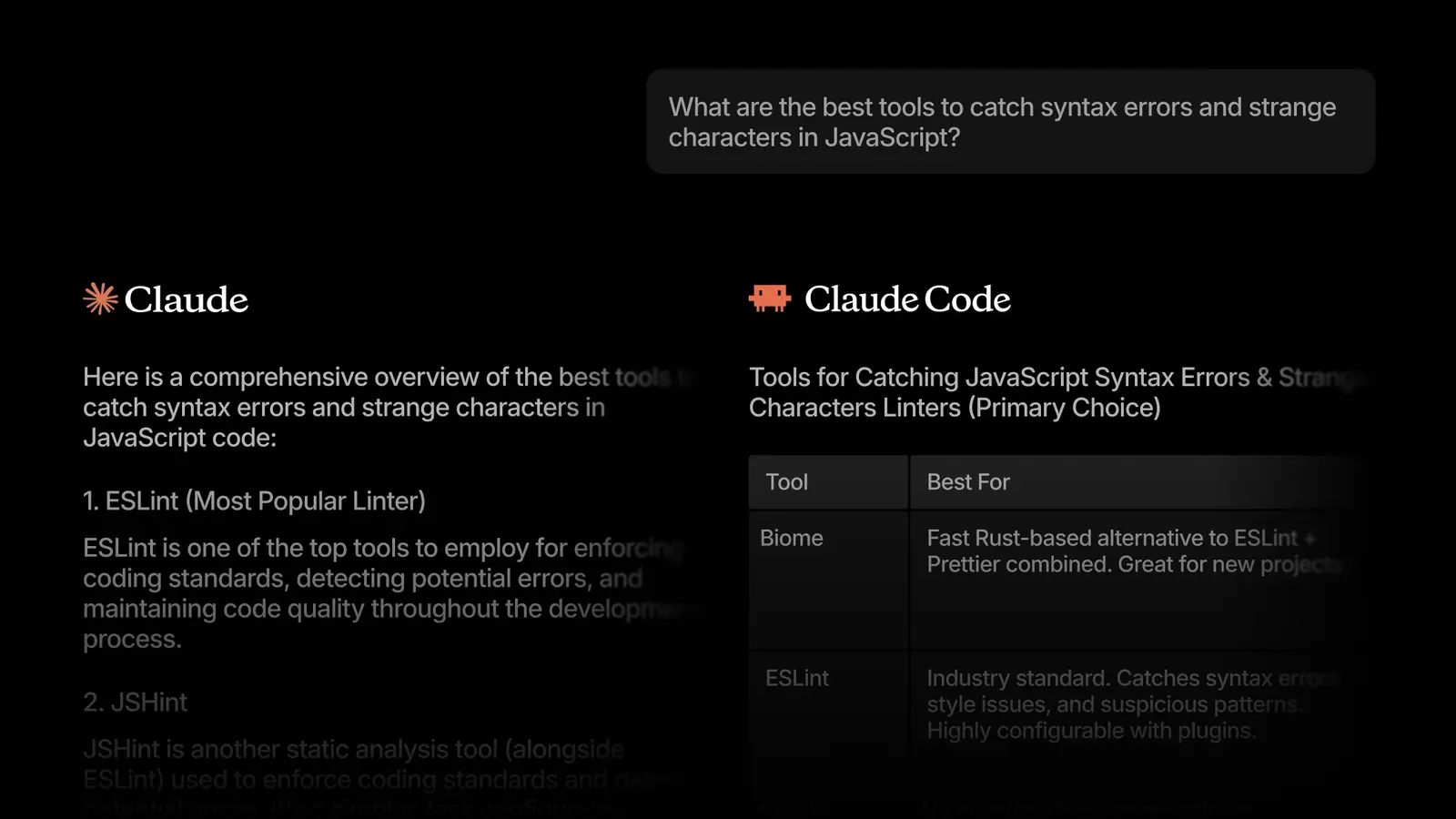
Claude and Claude Code mention only one in five of the same brands when answering the same prompt, according to an analysis of 24,135 responses published by Profound. Both products run on the same underlying models, and web search was enabled across the sample.
At a glance
- The gap starts with retrieval: Claude Code ran a web search in 13% of sampled responses, while Claude searched in more than 93%, yet both surfaced comparable numbers of brands.
- Each product is more consistent with itself than with the other: repeated Claude responses share half their brand mentions, and repeated Claude Code responses share two in five.
- In a 30-day sample of tracked domains, nearly three-quarters of Claude Code agent visits went to documentation, informational and pricing pages, against 5% for Claude's agent.
The finding cuts against the assumption that a shared model implies shared behavior. The harness, with its own system instructions, tool access and interface, appears to act as a separate retrieval layer, which would make foundation-model comparisons a weak proxy for what users actually read on screen. For teams tracking where their product gets named, that likely means measuring each harness on its own terms rather than treating Claude Code as a coding-flavored view of the Claude app.
Claude Code searched the web in 13% of sampled responses, against 93% for Claude
Claude Code, Anthropic's coding harness, has an estimated 2–4 million weekly active users, and shares its underlying models with Claude while running on different instructions, tools and interfaces. In the sample, where web search was enabled for both, Claude Code triggered a search in 13% of responses and Claude in more than 93%.
Despite searching far less often, Claude Code mentioned 6.6 brands per response on average, against 5.2 for Claude. Two separate Claude responses to the same prompt shared roughly half of their brands, and two separate Claude Code responses shared two in five, well above the 20% overlap between the products.
Nearly three-quarters of Claude Code's tracked page visits went to documentation and pricing pages
Although Claude Code rarely searches or cites sources, its agent generated substantial traffic across the tracked domains. Profound compared the 1,000 most-visited pages for each agent over a 30-day window from July 18 to August 18, drawn from a large collection of internally tracked domains. Nearly three-quarters of Claude Code agent visits went to documentation, informational and pricing pages, compared with 5% for Claude's agent.
Claude's agent concentrated elsewhere: 60% of its visits hit robots.txt files, sitemaps and home pages, against 4% for Claude Code's agent. Both agents visited brand-owned content more often than earned media or social pages. The pages were scraped with Firecrawl and classified by type using gpt-4.1-mini.
Claude Code answers averaged 322 words against Claude's 459
Claude Code answers were shorter and more heavily formatted: mean response length was 322 words against 459 for Claude. Lists appeared in 94% of Claude Code responses against 56% of Claude's, and tables in 54% against 11% in the same sample.
The prompt dataset spans 24,135 responses across 1,724 prompts drawn from 11 randomly sampled categories, run from July 13 to July 23 with web search enabled. Repeated responses from the same product were also more semantically similar to one another than Claude and Claude Code responses to the same prompt were.
The coding subset, examined because Claude Code is used primarily in technical workflows, covered 2,800 responses across 200 prompts. Among the top 15 brands mentioned there, Claude leaned toward code editors and IDEs, while Claude Code more often surfaced code-quality and development-workflow tools.
What Profound recommends for documentation
Profound advises treating the two as separate optimization targets and keeping documentation, informational and pricing pages current and machine-readable. Its guidance is to state extractable specifics on uptime, latency and environment support, on the grounds that a claim such as “Supports Python 3.10–3.13, Node.js 20+, and Go 1.22+” is easier to retrieve than “works with your existing stack”, to frame headings as questions, and to lead with the answer.
Related stories
- Claude pushed the zeta-zero lower bound from 41.6% to 67.2%
- Claude does nine loops, one past the N=4 physics record
- Claude went from bug hunt to abuse report on New Year's Eve
- WHO Africa and CEPI turn to Claude in an Ebola outbreak
- Claude found a CRISPR-like puzzle hidden in phage DNA
- Claude hands paid users a spare limit reset until Oct 22
Comments
No comments yet. Be the first.
Join the conversation
Sign in with Google to leave a comment. Your name and avatar come from your Google profile, and the comment appears after moderation.