
Opus 5.5 beats GPT-6 Astra on data-analysis repeatability
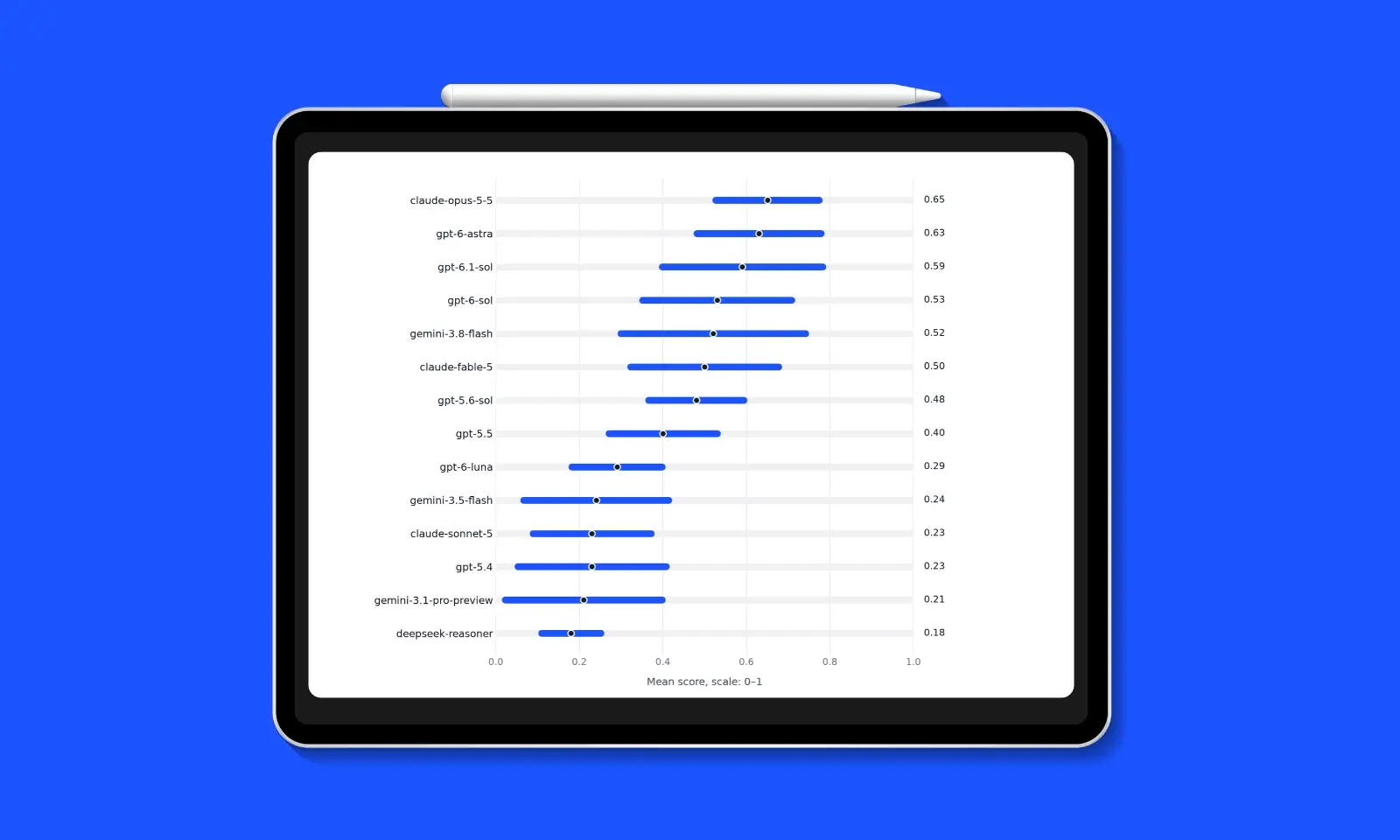
Claude Opus 5.5 leads Deepsense’s latest EDA Benchmark leaderboard with a reliability-adjusted score of 0.62. GPT-6 Astra is next at 0.55, and their mean scores are close at 0.65 and 0.63. The post went up on November 2 under an October 28 title. If your team is choosing a model for data-analysis agents, our recomputation from the published runs supports the top two places. Most of the gap comes from a single task where Astra swung between perfect and near-zero runs, and several places further down depend on how the scoring code treats tasks a model failed completely.
The benchmark gives each model 10 synthetic data-analysis tasks: inspecting files, cleaning inconsistent records, combining sources, detecting anomalies and returning structured results. Each model runs every task five times. The mean score measures average quality. The reliability-adjusted score lowers that mean when a model’s runs on the same task disagree with each other. Models from the July round were not re-tested and stay on the board as a reference. GPT-5.6 Sol keeps its 0.46 and now shares third and fourth place with GPT-6.1 Sol, which has a mean of 0.59. GPT-6 Sol follows at 0.43 with a mean of 0.53. Gemini 3.8 Flash and Claude Fable 5 both sit at 0.42.
Where the Opus lead comes from
Deepsense’s only explanation is that the gap between Opus 5.5 and Astra “widens after adjustment” because Astra is less stable. We traced that to one task, store-audit, where Astra scored 1.00 three times and 0.063 three times. Its adjusted score on that task is 0.06, while Opus 5.5 has 1.00 from five perfect runs. Astra also has a lower mean than Opus on solar-farm-daily-yield, 0.263 against 0.585. The lead does not cover every task. On hospital, Astra scored 1.00 in all five runs and Opus 5.5 scored 0.50 each time. On identify-unusual-values, Opus 5.5 averaged 0.024, while Claude Fable 5 scored 0.958 in all five runs in the July round.
The order still held when we resampled the five runs within each task 10,000 times: Opus 5.5 finished ahead of Astra in 98.5% of the draws, with the gap ranging from +0.04 to +0.145. This resampling covers run-to-run variation only. It does not resample the tasks themselves, and there are only 10. A narrower result appeared in October on Artificial Analysis’ Intelligence Index v5, where Opus 5.5 scored 58 and GPT-6 Astra 57, both at their max settings.
GPT-6 Sol against GPT-5.6 Sol
Deepsense presents this pair as its clearest example. GPT-6 Sol has the higher mean, 0.53 against 0.48, but finishes behind after adjustment, 0.43 against 0.46. The post concludes that GPT-5.6 Sol “is the more dependable choice.” In our resampling, though, GPT-6 Sol came out ahead in 26% of the draws, and the interval for the gap runs from -0.063 to +0.054, so it includes zero.
One scoring rule also affects this pair. When a model scores 0.0 in all five runs of a task, the code drops that task from the adjusted average, but the task still counts as zero in the mean. This happens in nine model-and-task combinations, including GPT-5.6 Sol and Gemini 3.8 Flash on hospital. With those tasks counted as zero, the order changes:
| Model | Published adjusted | All-zero tasks counted as 0 |
|---|---|---|
| GPT-5.6 Sol | 0.456 | 0.410 |
| GPT-6 Sol | 0.434 | 0.434 |
| Gemini 3.8 Flash | 0.423 | 0.381 |
| Claude Fable 5 | 0.423 | 0.423 |
Opus 5.5, Astra, GPT-6.1 Sol and GPT-6 Sol have no task where every run scored zero, so the rule doesn’t change their scores.
Our analysis
What we checked
On November 9 we ran the aggregation script from the benchmark’s GitHub repository on its committed results, recomputed the scores and bootstrapped the runs within each task.
The published scores are calculated differently from the post’s description, and the committed data does not reproduce the published table without changes. Deepsense’s top two places hold. The rankings below them and the formula in the post need the corrections below.
- The post gives the adjusted score as the mean multiplied by exp(-2.25 × CoV^0.88), with CoV measuring how much a model’s runs vary. The code actually applies that penalty to each task separately and then averages the 10 results. Applying the formula to Opus 5.5’s overall figures gives 0.38, while the per-task method gives the published 0.62.
- The repository’s script fails on its own data. Four model-and-task combinations have four or six runs instead of five, and Claude Fable 5 and Claude Sonnet 5 have no results on the-heirs-estate, where all five of their attempts timed out. Astra has six store-audit runs committed. Its published 0.55 and 0.63 match only if one of the 0.063 runs is left out. With all six runs, Astra scores 0.54 and 0.62. Our inference is that the table was built from a five-run selection that differs from the committed data.
- Opus 5.5 was scored at
xhighreasoning effort, although the README’s example configuration showsmax. This comes from the repository files, not from a measurement. - The post calls the previous round “July 26.” The earlier post and the repository date it July 14, and nothing in the repository matches July 26. We read it as a typo.
Up next

Anthropicanalysis
Anthropic’s IPO target slides to $1-1.5 trillion from $2T
“Leaning into that big tech, billionaire kind of caricature,” a behavioral scientist told CNBC of Anthropic going public at $1-1.5 trillion, down from a $2 trillion target. Would a public Anthropic make you trust Claude more or less?
Related stories
- Flagged Opus 5.5 chats stay stuck on Opus 4.8
- Opus 5.5 matches Fable 5.1 on most work for less money
- Intelligence Index v5: Opus 5.5 at 58, GPT-6 Astra at 57
- Andon Labs puts GPT-6 Astra ahead of Claude Fable 5.1
- GPT-6 Astra edges past Claude Fable 5.1 on WebDev Arena
- Claude Fable 5 vs GPT-5.6 Sol: a $100 music video bake-off
Comments
No comments yet. Be the first.
Join the conversation
Sign in to leave a comment. It appears after moderation.