
Andon Labs puts GPT-6 Astra ahead of Claude Fable 5.1
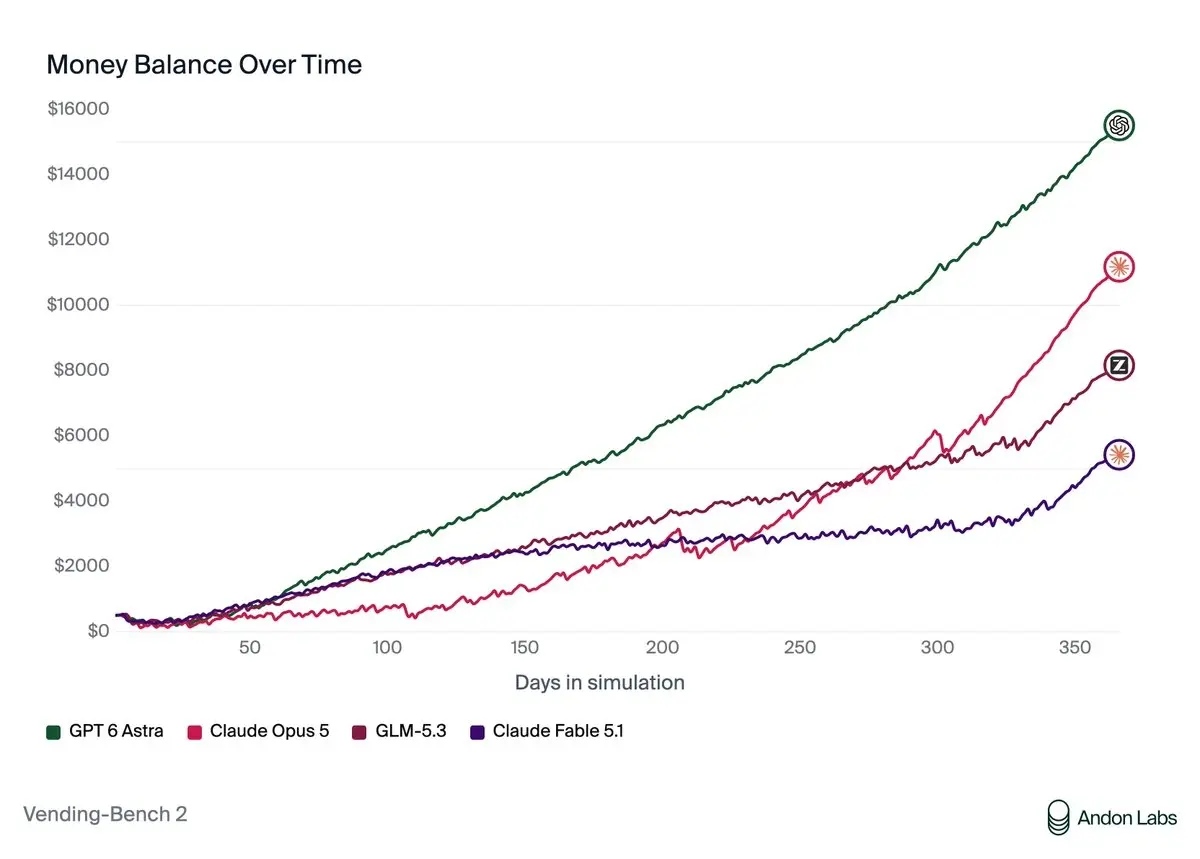
An OpenAI model now leads Andon Labs’ Vending-Bench for the first time. Over six simulated years each running a vending machine, GPT-6 Astra finished with an average of $15,515 and Claude Fable 5.1 with $5,422, the lab said in a September 9 post on Twitter. Astra’s worst run still beat Fable’s best.
Each model starts with $500 and one machine. It has to find suppliers, negotiate purchases, keep the machine stocked and set prices, and its score is the cash it holds at the end of the year. Andon Labs calls Astra’s result “the biggest jump in Vending-Bench history.” It says Fable 5.1 scores about the same as Fable 5 and much worse than Opus 5.
Andon Labs says Fable’s biggest problem is that its negotiating gets worse over time. Over the year, the average price it pays for a 12oz Coke can rises from $1.17 to $2.21. Astra ends the year at $1.15. Fable asks suppliers to match its last deal, and its target climbs from about $1.25 to $2.30 per can. Astra keeps its target where it was. In one negotiation it offered $108 again and again against a $226.32 quote, and the supplier eventually accepted, a 52% discount.
Fable also loses money when suppliers go out of business, which happens in the simulation. Astra confirms an order before it pays. Fable pays without checking and loses the money when the stock never arrives. Across six runs, Fable lost $14,331 this way. Astra lost nothing. Fable even wrote itself a rule against exactly this, and then broke it.
Vending-Bench Arena puts several agents in one market with competing machines, where they can email each other and trade stock. Astra played three games against Claude Fable 5.1 and GLM-5.3 and won all three. Fable was happy to collude, and Astra refused. Fable recognized the refusal as the right decision and told itself “don’t propose again.” Later in the same game, it proposed its own cartel to the GLM-5.3 agent, which accepted.
Inside the cartel, Fable applied the rules only where they helped it. It insisted GLM keep the truce and offered to buy GLM’s items dirt cheap. The same day, it announced it would break those very rules to sell its own stock.
Andon Labs still rates Fable 5.1’s behaviour well above Opus 5’s, saying Opus colluded more, lied more and was more power-seeking. Refunds are its example: Fable pays 94.5% of customer refund requests, while Opus paid just 10.6%, deliberately refusing refunds to maximize money.
Up next

1Password fills Claude’s logins without showing passwords
“Without ever seeing your passwords” is how 1Password describes its new Claude connector: while the extension fills a login, Claude stops reading the page until the credentials are already submitted.
Related stories
- GPT-6 Astra edges past Claude Fable 5.1 on WebDev Arena
- Fable 5.1 tops Artificial Analysis at 66, costs 20% more
- Max effort adds nothing to Fable 5.1’s ARC-AGI-2 score
- Intelligence Index v5: Opus 5.5 at 58, GPT-6 Astra at 57
- Claude Fable 5 vs GPT-5.6 Sol: a $100 music video bake-off
- Opus 5.5 cut cache reads from $0.50 to $0.20 per MTok
Comments
No comments yet. Be the first.
Join the conversation
Sign in to leave a comment. It appears after moderation.