
Claude's API sandbox got a new name and a cost readout
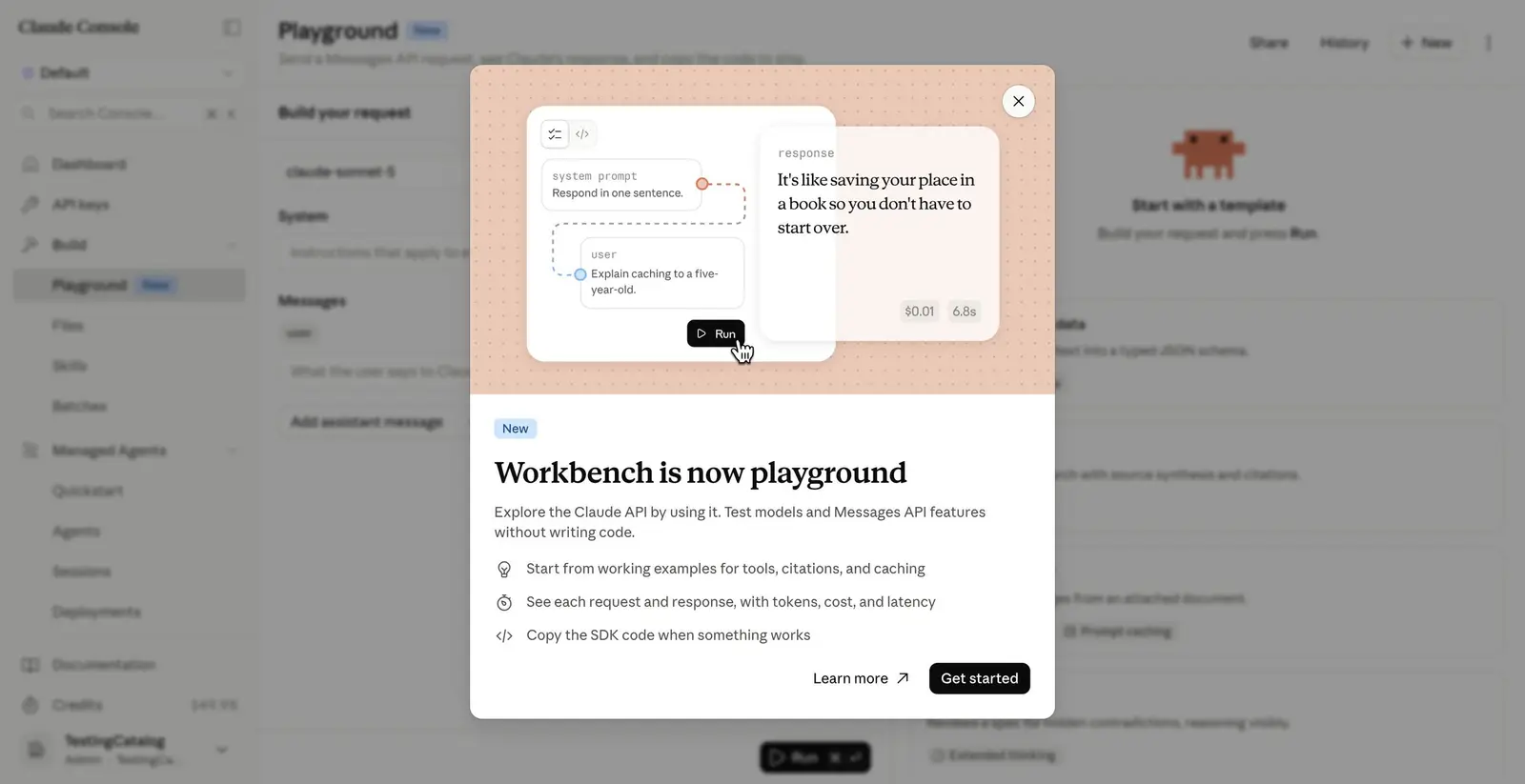
Fire one prompt from a browser tab and Claude's API sandbox answers with three numbers attached to that single call: tokens, cost and latency, sitting next to the request and the response that produced them. Anthropic rebranded Workbench as Playground back in August, and the post on Threads that flagged it says the tool had been in the works a while and now feels more conventional.
At a glance
- The browser page where you poke at the Claude API no longer carries the Workbench name: the same tab opens as Playground, built around the Messages API and usable without writing code.
- It opens from working examples for tools, citations and caching, shows each request and response with tokens, cost and latency, and hands you the SDK code once a call behaves the way you wanted.
- Per Anthropic's documentation on claude.com, Playground keeps no prompt history and does not evaluate prompts. The window to export legacy Workbench data closed on September 1.
If you have not opened it in a while: Workbench was the page where you typed a prompt, picked a model and read the answer back without wiring up a project first. The replacement had been in development for quite a while, per the Threads post, and what came out of it is a more conventional tool.
The rename landed in August, the export window shut on September 1
The framing Anthropic put on the new name is about as plain as product copy gets. The pitch is to explore the API by using it, and the wording of the announcement runs like this:
Workbench is now Playground - Explore the Claude API by using it. Test models and Messages API features without writing code.
Per Anthropic's documentation on claude.com, Playground sits in the Claude Console and is where you try Claude models and API features directly. The same documentation says the page keeps no prompt history and does not evaluate prompts.
The no-code part is the point of the page: the request goes out from the browser, so you are not writing a script just to make one call and read one answer. The rename landed in August, and the window to export legacy Workbench data closed on September 1.
Every call comes back with tokens, cost and latency
Playground shows each request and each response, with tokens, cost and latency attached to it. The figures come per call, sitting with the exchange that produced them, so one prompt's token count and one prompt's price are readable on their own.
Think of a taxi meter you can see from the back seat. The fare moves while you ride, so you learn which routes are expensive before the trip ends instead of at the end of the month. A prompt template that quietly doubled in length shows up as a tokens figure in the same panel where you wrote it.
When a call does what you wanted, you copy the SDK code for it straight out of the page and drop it into your project. That closes the loop: change the wording in the browser, watch the three numbers move, take the version that worked with you.
Why does Playground start from a working example?
Because the examples are the entry point. Anthropic lists tools, citations and caching as the working starting points you open instead of an empty prompt box, and all three are Messages API features rather than settings you flip.
Tool use means handing the model a description of a function it can ask you to run. Citations attach the source spans a response leaned on. Prompt caching keeps part of a prompt on Anthropic's side so repeated context does not have to be processed from scratch on every call.
Each of them needs a correctly shaped request before it does anything at all, and starting from one that already runs turns the work into editing. Because every call carries its own tokens figure, the gap between the first run and the second one is on screen while you edit.
So you get a price for every call and nothing to compare it against tomorrow, because nothing you type is kept. In our view that is an odd pairing: a cost readout invites you to run two versions of a prompt against each other, and the page that shows the cost forgets both of them the moment you leave.
Whether saved prompts return
No date has been announced for prompt history or prompt evaluation arriving in Playground; per Anthropic's documentation on claude.com, both are things the page does not do. So the version of a prompt you want to compare next week is one you retype, and the only record in front of you is the cost and token line on the call you just made. Worth checking on your next session: whether that line matches what you expected to pay before you sent it.
Related stories
- Cowork and chat become one Claude, tasks keep running
- Claude Academy opens with free courses and tutorials
- Claude Desktop boots ~2x faster after a timer fix
- A browser inside Claude Desktop, always on in Cowork
- Anthropic's Workbench moves into a new Build section
- Claude Design now supports one-click publishing to Vercel
Comments
No comments yet. Be the first.
Join the conversation
Sign in with Google to leave a comment. Your name and avatar come from your Google profile, and the comment appears after moderation.